Three exhibitions have compelling and complex work, but stumble on wordy issues
Jan. 20/2026
Three recently opened exhibitions have solid and engaging work, but all had text and context issues. The exhibitions at the Albert E. Finney Cultural Center, the Columbia College Goodall Gallery, and the 701 Center for Contemporary Art are rewarding in multi-layered and complex ways and all need some word, but not the words they have. It’s a minor problem for two, major for the third.
Found dresses turn into art
First up, is an usual exhibition at the Ernest A. Finney Jr. Cultural Arts Center, a place not enough people know about. There you’ll find “The Beautiful Hands of Florestine Kinchen and Helen Hill,” an exhibition of about 80 dresses made by Kinchen. The dresses were found by filmmaker Helen Hill, a native of Columbia, who was working on an animated film about them and their maker at the time of her death.
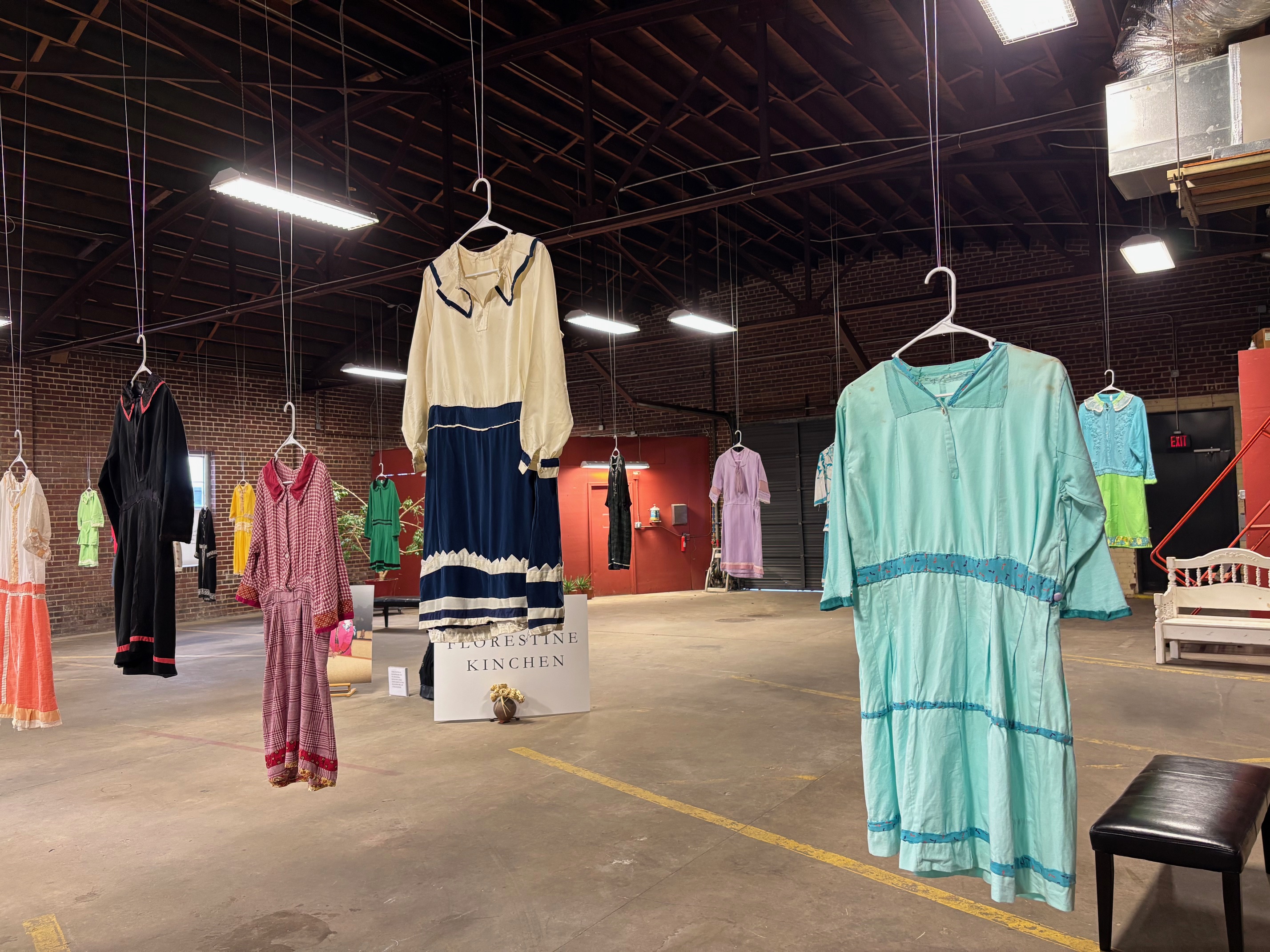
The dresses are displayed simply in the huge brick warehouse space of the center which is in an alley off Harden and Hampton streets. Pieced together from other items of clothing, they aren’t wild, but show invention and craft. They have a simple and beautiful dignity and the way in which they are displayed emphasizes that. Just looking across the sea of floating dresses is a visual treat as is getting close to explore the details. The exhibition was organized and designed by Avis Sumter.
The story behind the dresses is complicated and the exhibition does a poetic, but not through job of explaining it with several large text panels on easels and propped in windows of the room. There is other material in the front of the center where you can read more about both women, so in the end, it works.
In 2001, Hill found the dresses dumped on the street in New Orleans. She set about learning about their maker with plans to make a film. The film was uncompleted when Hill was murdered in 2007. In 2011 Hill’s husband completed the film titled The Florestine Collection, which is about Hill as much as Kinchen. You can watch it here. The dresses were donated to the center by Hill’s mother Becky Lewis.
The center has fairly limited hours. You can see this exhibition on Thursdays and Fridays from 3 to 7 p.m. and Saturdays from noon to 4 p.m. Last day is Jan. 31.
(The center was going to screen 19 of Hill’s short films Jan. 24, but that’s been postponed due to weather.)
Exploring Southern womanhood at Columbia College
“Southern Hospitality” by April Pauza at the Goodall Gallery at Columbia College is a sort of maximalist tragicomedy composed of a large group of installations exploring the world of southern girls and women. There are references to beauty, housework, love and marriage, and religion. Pauza, a native of Tennessee who lives in Maryland, has done a fantastic job of transforming symbols of Southern womanhood into something questioning them all.
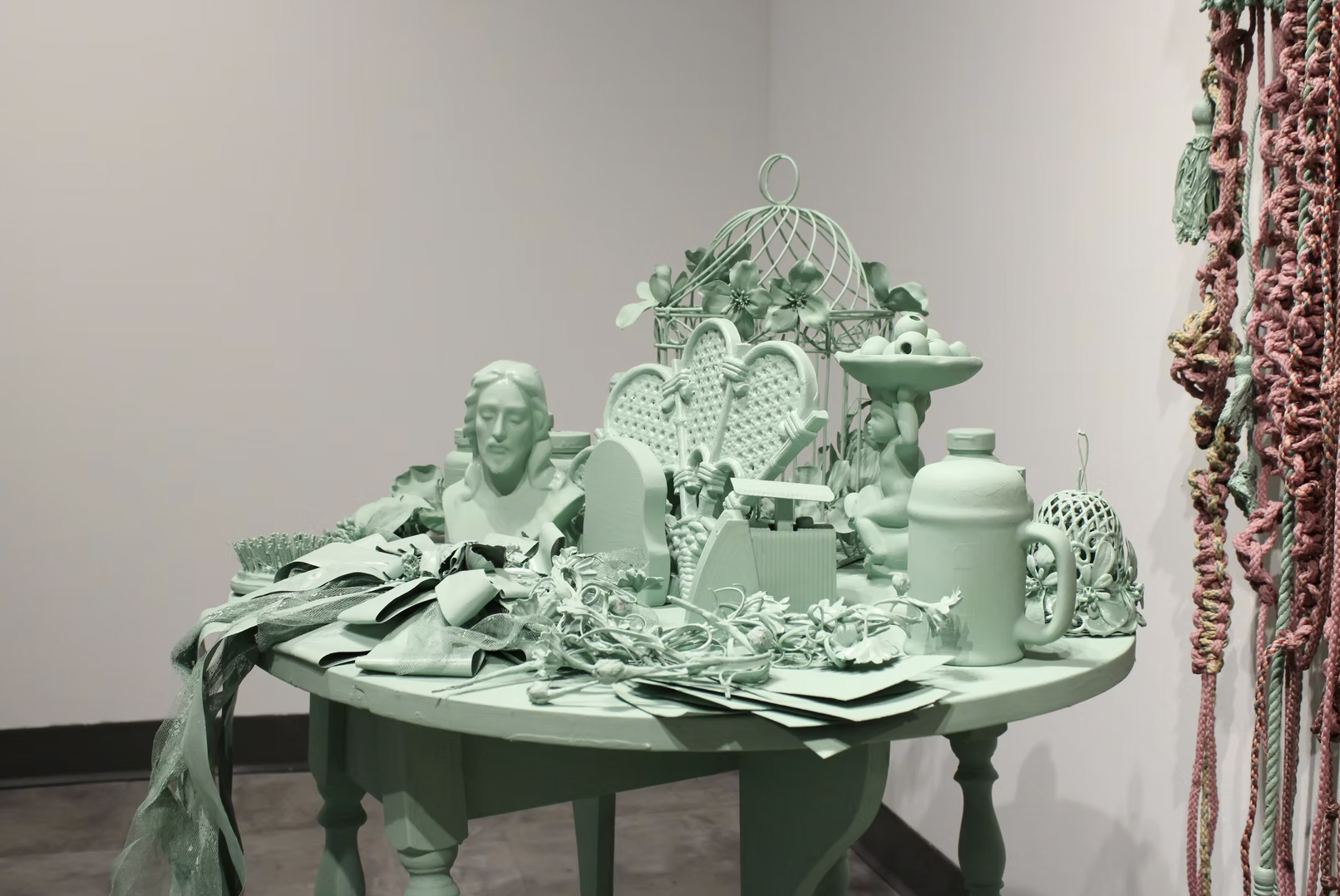
Filling the large gallery are the artist’s takes on a vanity table, a kitchen, a clothes line, and the most disastrous wedding cake ever, with titles You’re Still Pretty on the Inside, Don’t Count Your Chickens Before They Hatch and I Can feel the Holy Spirit Here, the last incorporatinga QVC style video selling a cross made of seashells and other items. Many of the objects in each installation are painted monochromatic or made of a dull brown paper pulp creating an overwhelming, but unvaried and dull-colored world.
Anyone can understand and appreciate the work, but women are really going to get it. Women might also be more critical for the way it sometimes states the obvious and does so in ways that have been done before.
Oh, and the text. Many of the labels are in the artist’s voice speaking about her life and how it relates to the art, but then makes the mistake of saying what the work means. Others skip the story and just say what the art means. This doesn’t leave much room for the viewer and what they might think it means.
The exhibition is up through Feb. 26 and there will be a closing reception with the artist attending that evening.
Digging into the lives of free blacks
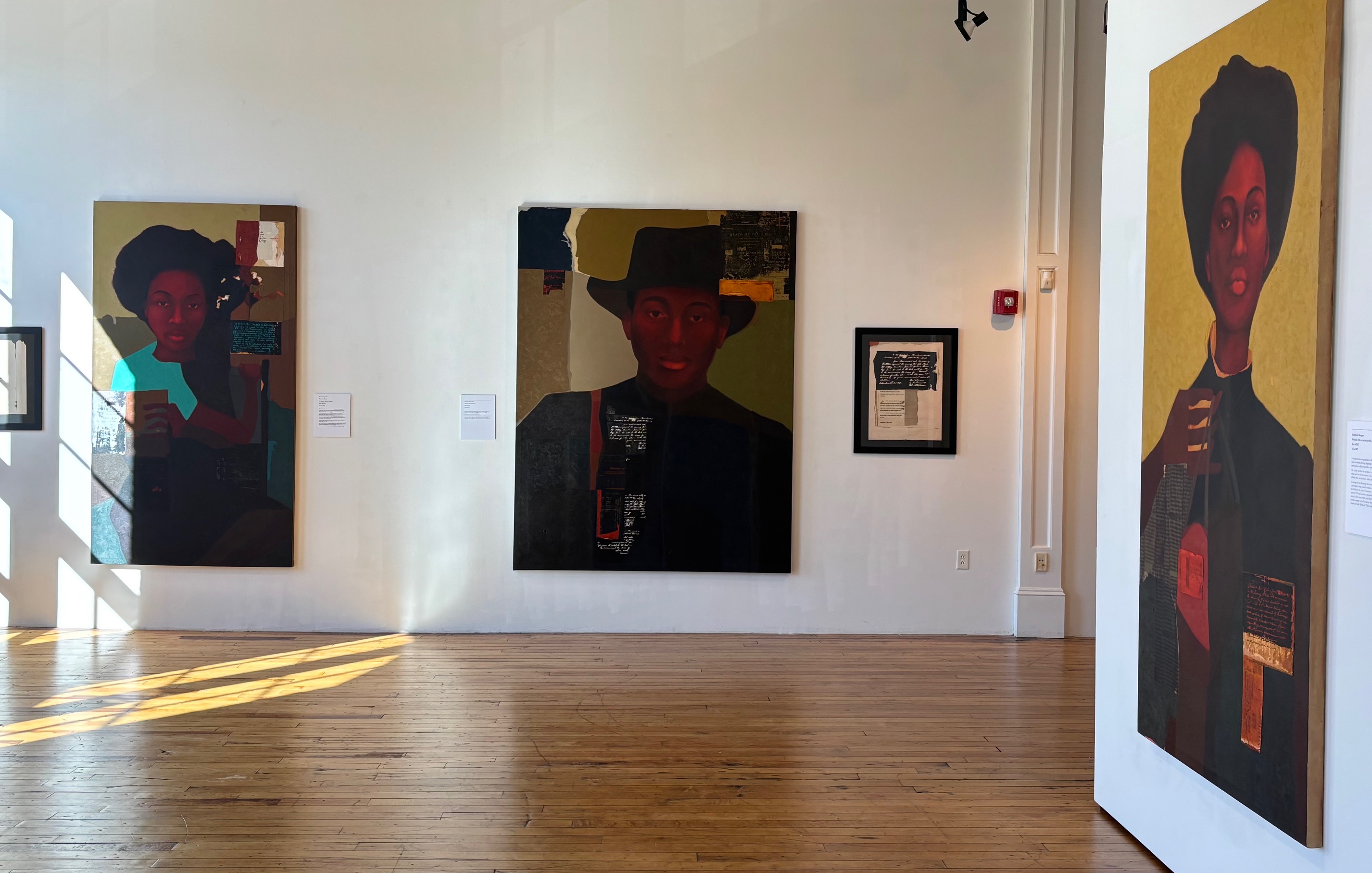
Whatever you do, go see “The Unscene South” at the 701 Center for Contemporary Art. The exhibition by Charles Eady explores the lives of free black people in the South before emancipation. But whatever you do, first go to the center’s website or the artist’s site to read about it. If you depend on what’s at the center, you’ll likely be a little lost even though there’s lots of text on the wall. Unfortunately, the text, based on extensive research by the artist, is presented in a scattershot manner and because the paintings are grounded in this research they also suffer in spite of the fact that they are so good.
The issue would have been largely alleviated if the center had simply posted an overview text in the gallery. Something like this:
“The Unscene South” is an exhibition by Charles Edy, a native of South Carolina who has created a group of paintings to explore the lives of free black people prior to the Civil War and emancipation. The paintings are informed by historical records researched by the artist. Some of that material is included as part of the exhibition and also incorporated into the art.
Or the center could have posted the description of the exhibition that’s on its own website. It also should have taken a hand in organizing, editing and condensing much of the text for clarity and flow.
Eady does an incredible job of providing a broad view of the world of free blacks by telling individual stories in the art. Jumping off his research, often on specific individuals, he has imaginatively and beautifully depicted these people. The figures are generally realistic but set in in a less determinate space and are often quite stylized, sometimes to the point of abstraction. His handling of paint and composition speaks to the often-uncertain status these people held.
The documentation and written narrative can be very informative; much of it is connected to South Carolina, not surprising since Charleston had a substantial free black population. The text and reproductions of original documents speak to various issues: white craftsmen complaining about free blacks taking their jobs; a Richland County grand jury declaring that punishment for teaching black people to read should be harsher; and laws to drive free black people out of the state. But the text and the art are not well integrated.
There are other odd things about this show, from the title itself (why not “Unseen” since that’s what the free black population was and has become?), vague attribution/citation of material and unclear references, and inclusion of a painting addressing an issue from the Jim Crow era, not pre-emancipation.
This exhibition needed significant curatorial intervention on every level.
Both “Southern Hospitality” and “The Unscene South” were mainly organized by the artists. It’s not uncommon for artists to put together shows of their work and offer them to arts organizations. With such shows, there are widely varying levels of collaboration between artist and organization, but these are not the curated creations of the places they are shown.
For “Southern Hospitality” that’s not a significant issue, but for “Unscene South” it is, especially since there is a great difference between a small college art gallery and a place calls itself a contemporary art center. In the case of “The Unscene South” it looks like the only role the center played was hanging the art and text.
Eady will give a talk at the center at 7 on Feb. 11. The exhibition is up through March 8.
Two big shows from a giant of SC art
Leo Twiggs, one of the greatest artist to ever come out of the state (and beyond) has two major exhibitions opening this month. Twiggs is from St. Stephens and has lived in the area nearly all of his 92 years. He is an internationally acclaimed artist who works in the medium of batik, a method using fabric, wax and dyes, to speak eloquently and beautifully on many social issues.
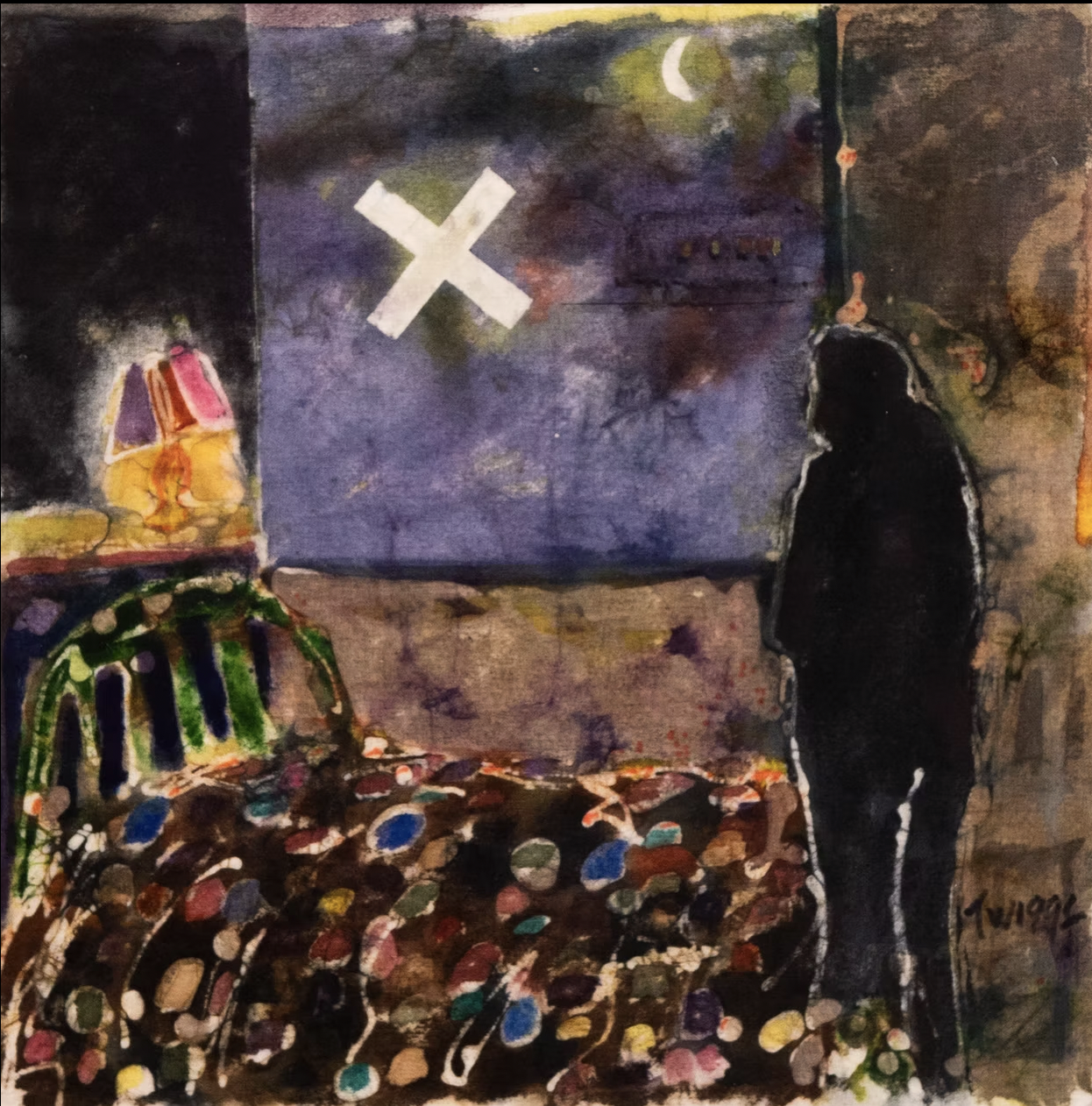
His first ever retrospective in his home state “Revelations: The Art of Leo Twiggs” opens at the Gibbes Museum of Art in Charleston on Jan. 30. It will include 43 works dating from 1961 to 2020. Among these will be all the pieces he created commemorating those murdered by a white supremacist at Charleston’s Emanuel AME Church in 2015.
But before that, the Twiggs exhibition “Running On …” opens Jan. 23 at Hampton III Gallery in Greenville where the artist has shown for many years. This exhibition is made up of about 20 works spanning 50 years and includes major pieces on the confederate flag and the Emanuel Church.
Twiggs attended Clafin College in Orangeburg, studied at the Art Institute of Chicago, received his master’s degree from New York University and a doctorate from the University of Georgia. At S.C. State University in Orangeburg Twiggs founded the art program and the museum. The Georgia Museum of Art at the University of Georgia mounted a retrospective for him in 2004 and he has had exhibitions at the Studio Museum in Harlem, the American Crafts Museum, and in U.S. embassies in Rome, Dakar and Togoland.
Take time to visit his website.
SC Phil launches three concert fest spotlighting its chamber series director
Jan. 8/2026
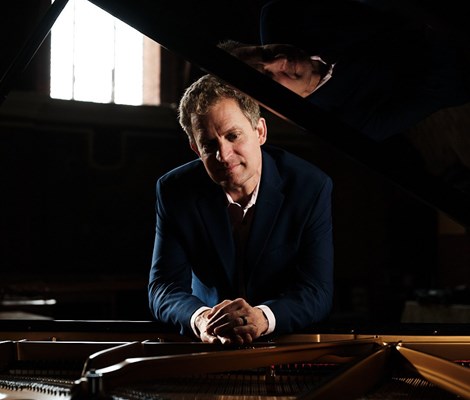
A few years ago, pianist Andy Armstrong was soloist with the S.C. Philharmonic for Ludwig van Beethoven’s “Emperor” concerto.
“I had such a great feeling with the philharmonic and the entire crew,” said Armstrong. “Any opportunity to make music with the Phil — sign me up.”
At the time, Armstrong was also heading a long-running chamber music series at the Columbia Museum of Art. When it came time for the series to find a new host, he and the orchestra partnered to launch the Andy and Friends chamber series in 2024.
The relationship must be solid, since the Phil has created an Andy Armstrong Festival —three concerts in one week all featuring the pianist.
It starts Saturday with a concert titled Northern Lights by the full orchestra performing Edvard Grieg’s Peer Gynt Suite, Grazyna Bacewicz’s Piano Concerto, with Armstrong as the soloist, and Symphony No. 5 in E-flat Major by Jean Sibelius.
Armstrong was a long-time fan of Bacewicz, a Polish composer active in the second half of the 20th century.
“It’s been on my wish list for a long time,” he said. “I think people will love it at first pass.”
On Monday, Armstrong, violinist Stefan Jackiw and cellist Raphaël Bell will perform Dmitri Shostakovich’s Piano Trio No. 2 in E Minor, Op. 67 and Antonín Dvořák’s Piano Trio No. 4 in E minor, Opus 90. The pieces were chosen in part due to the strengths of Jackiw and Bell whom Armstrong called “risk-taking madmen.” Both the works are “music of the people” but of very different character that provide a contrast for the audience and the players.

Jump to next weekend for Beethoven and Blue Jeans (I do wish they’d retire that tired title) with the Triple Concerto for Violin, Cello, and Piano in C major, Op. 56 by (guess who?) Beethoven with the orchestra and Armstrong joined by violinistAmy Schwartz Moretti and cellist Edward Arron who ran the chamber series at the museum for eight years.
Also on the bill are Robert Schumann’s Overture, Scherzo and Finale, followed by Johannes Brahms’s Double Concerto for Violin and Cello, again putting Arron and Moretti in the spotlight.
These works were the picked by Morihiko Nakahara, Phil music director. Both the “Triple” and the “Double” showcase Arron and Moretti.
“Ed and Amy are longtime favorites in Columbia and we three been dear friends for a long time so it should be a great time,” Armstrong said.
Although I learned about the newly refined series upon returning to Columbia in the fall of ’24, I have yet to go (for a bunch of reasons, some good, some not so much.)
Armstrong always speaks about the series in terms of its informality and accessibility, and that approach and attitude comes down through the decades from the founder of the chamber series in Columbia and leader of chamber music internationally (with a South Carolina connection.) The key element: Charles Wadsworth, long-time leader of the Chamber Music Society of Lincoln Center and the chamber series at the Festival of Two World in Spoleto, Italy, and the Spoleto Festival in Charleston. Around 2000, Wadsworth started chamber series around South Carolina including one in the former Olympia Mill Village community center that would later become 701 Whaley (which I remind you, is not the same as the 701 Center for Contemporary Art. Another long-overdue name change there needed too.)
When the building’s roof collapsed, the moved to the art museum. Wadsworth retired from most of his activities in 2010 passing on leadership of various series to several protégés.
Wadsworth died last spring (during the Spoleto Festival) at age 96. But as is obvious, his legacy lives on.
“I saw (Wadsworth) present years ago at the Spoleto Festival and that was a great inspiration for me on a lot of levels,” Armstrong said. “His style was to demystify the experience. He was so far ahead of his time on that.”
If you happened to need more chamber music, and especially if you’re in Charleston check out the Chamber Music Charleston concert Sunday. Pianist Phillip Bush, professor at USC, and Geneva Lewis will perform Béla Bartók Rhapsody No. 2 for Violin and Piano. I hope for most of you, Bush needs no intro; I heard Lewis at the 2025 Spoloto series. She is so good.
A lot of energy
New and expanded places are adding much to the city’s visual arts
Since returning to Columbia about a year ago after a decade away, I’m frequently asked “What do you think of what’s going on with the arts here now?” My answer is that there is some great exciting energy, especially among the newer places and among younger artists. While some of the art being show isn’t always the most accomplished, the energy and effort around what’s going makes up for some of that.
Maybe early next year I’ll have more to say about my first full year back in town.
Where you can find much of the energy is at Gemini Arts, a studio/gallery complex deep in the heart of Rosewood that opened in the summer.
The current exhibition “Nostalgia 2.0” has some of the best works the place has yet shown. The exhibition is from Wonder, a curatorial project of Tabitha Ott, 701 Center for Contemporary Art director. She did a similar project two years ago, asking artists to create works that evoke nostalgia.
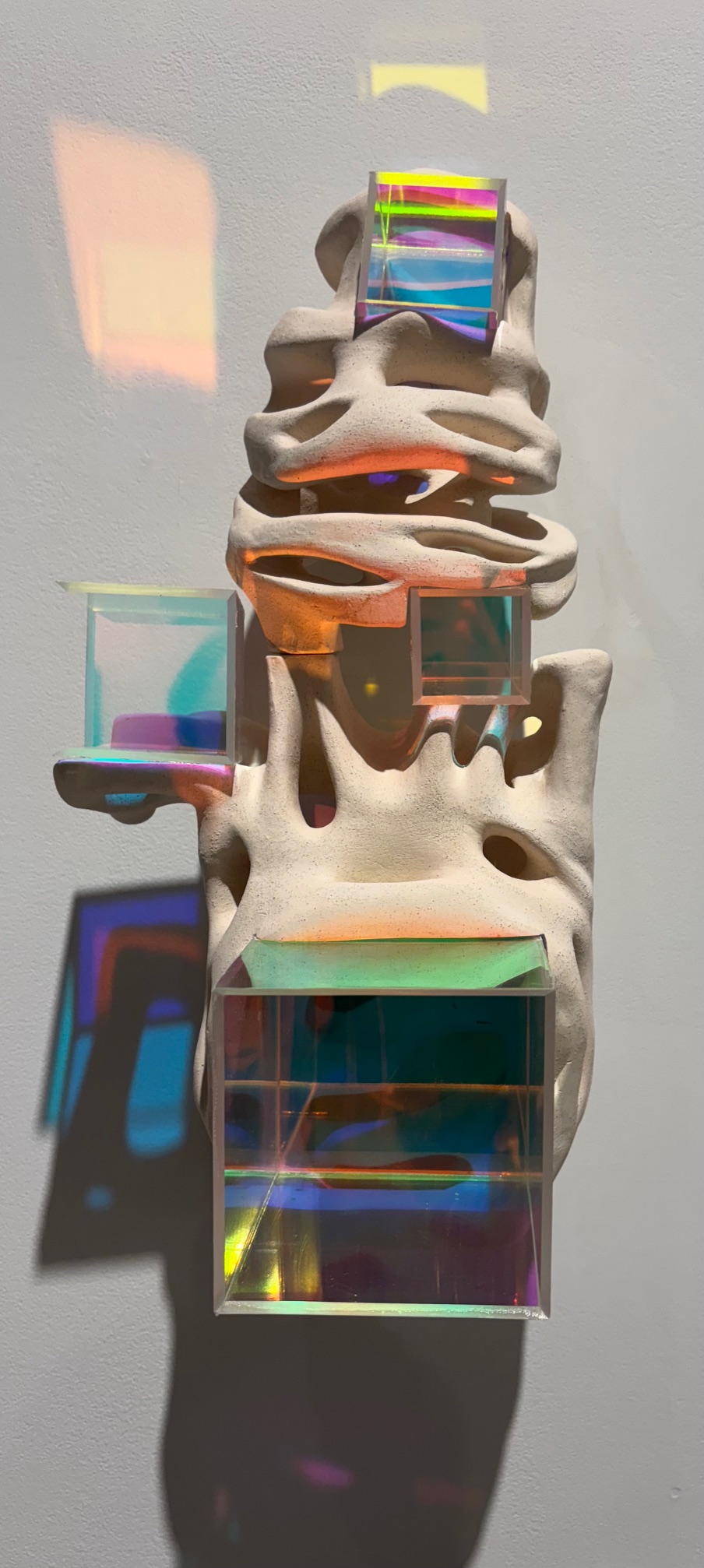
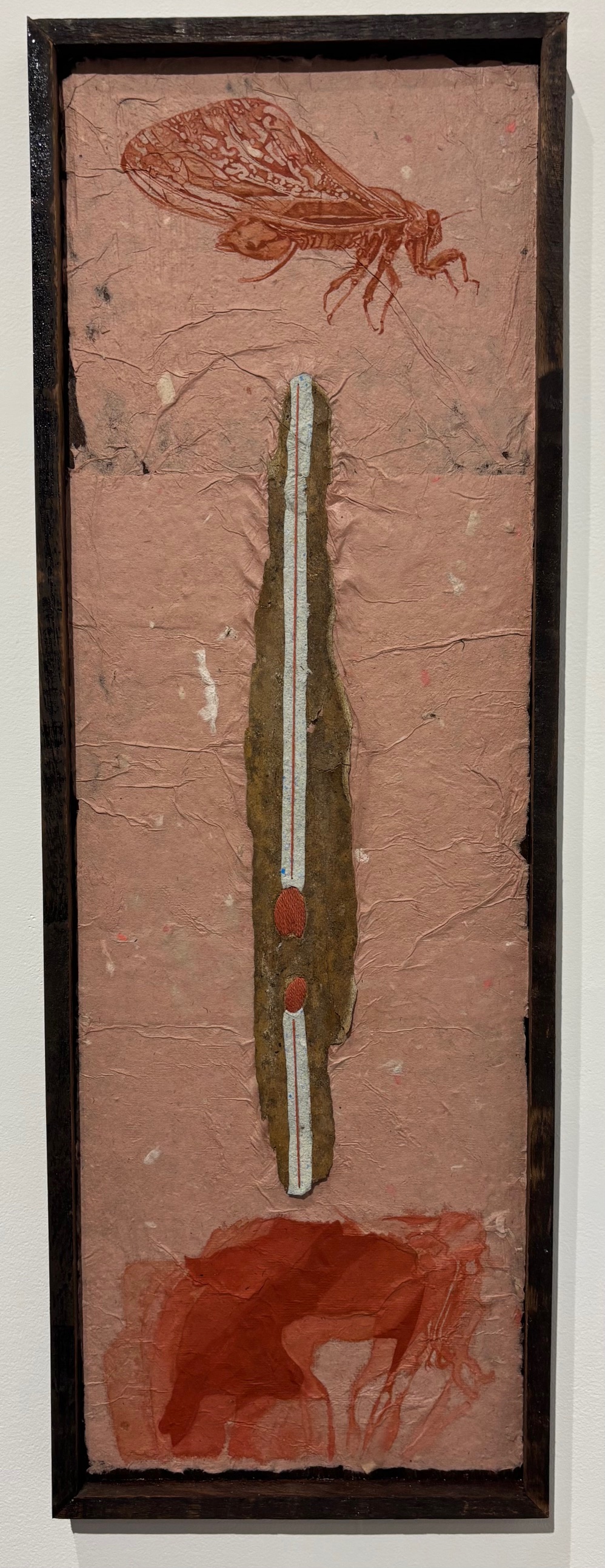

Works by (from left) Mitra Kavandi, Kate Timbes and Devann Donavan.
The 34 artists, each showing one work, have approached the theme in many ways and many mediums. I really wasn’t sure what to expect and I pretty much knew none of the artists, so I learned a lot and liked some and thought quite a few were good.
The show is up through Jan. 9. The space is normally open every Friday night, but with the holidays it will not be open Dec. 26 or Jan. 2, so that gives you this Friday and Jan. 9. But you can also make an appointment to visit others days and times.
There are several places that have added or expanded visual arts offering in the time I was away. And yes, I know, others have been lost and are continuing to be lost.
One that has done the most is the Koger Center for the Arts at USC. Visual arts programming started in 2018 and seems to keep growing.
Having art shows adds much to the center and as Koger director Nate Terracio points out, it’s the Koger Center for the Arts not the Performing Arts. These shows put many artists in front of a new audience, bring in new faces to the center, add to what the center offers to the community, and are surely a great marketing tool.
The Koger Center has one show in its main space, Ija Monet’s “Colorful Memories” through Feb. 22. The center recently partnered with Preach Jacobs, long a presence in the Columbia hip-hop and beyond world, to host his Soulhaus (previously located on Lincoln Street.) Work by Sanford Greene and Anthony Lewis is there through Friday.
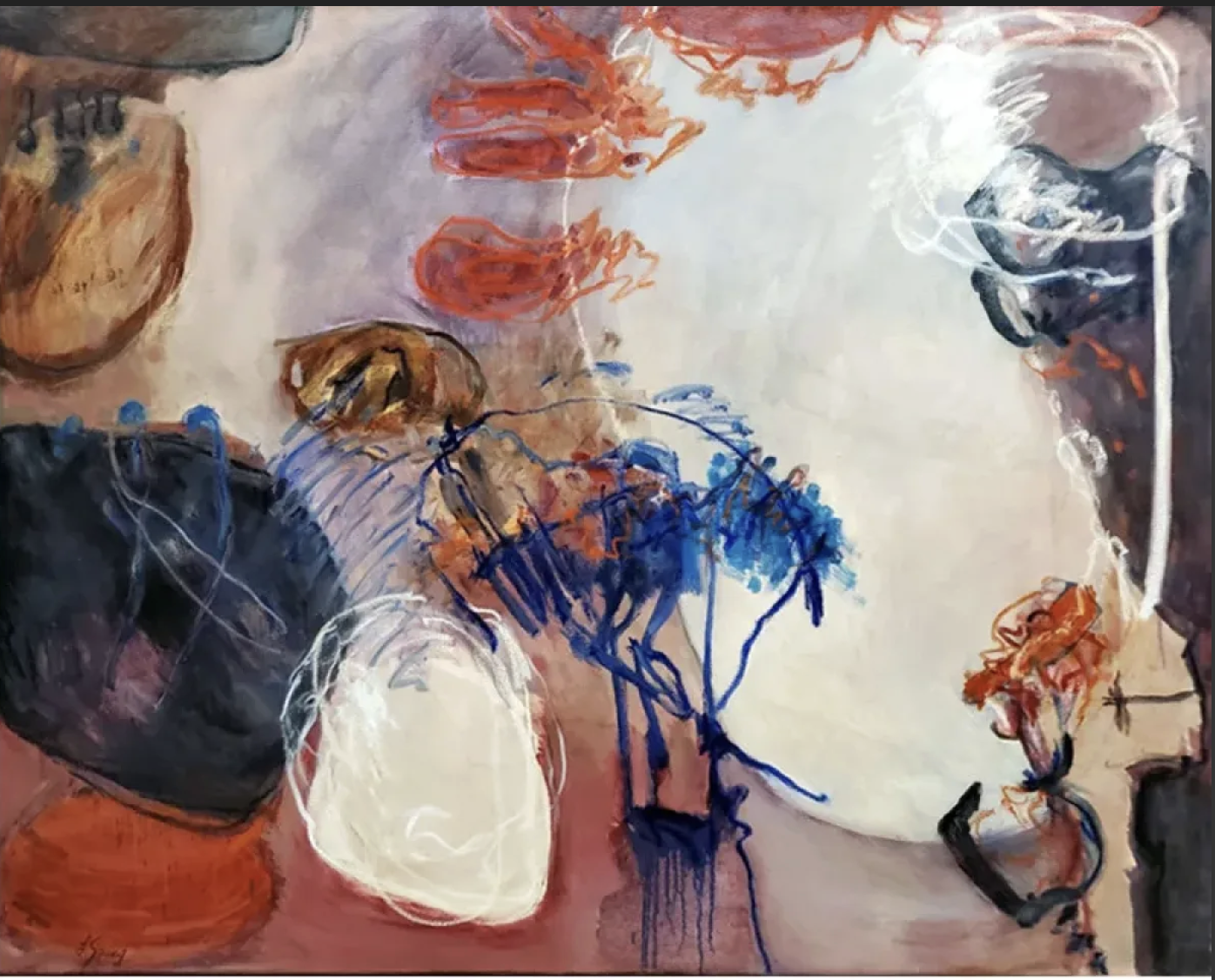
The center also recently put up the show “Laura Spong: Timeless” by the late beloved artist. In the main lobby it will be up through June 14.
And let’s not forget the little gallery aptly named The Nook, a collaboration between the center and the Jasper Project. Up through Jan. 9 are landscapes and other paintings by Sean Madden. Up next: Najee Reese.
The center is open all day most weekdays and you can duck in before or during a performance. Like a lot of the university the center will be closed for a bit during the holidays, but only Dec. 24-Jan. 1.
Learn more about the current and upcoming exhibitions.
(Yes, I do see the irony of writing about visual art at the center when USC shuttered its museum this month. See my post about that Dec. 5.)
It’s not like it is new to showing art, but the Richland Library has ramped up its art program and I’ve seen some very good work there.
“Heroes Art Show: My Healing Journey” by veterans and first responders is up through Jan. 2. “Wish You Were Here: The Art of Sandy Island” is centered on a place off the Australian Coast that was on many maps and even Google Earth, but doesn’t exist. The show opening Jan. 9 brings together 22 artists who were asked “to imagine a place that could have been anything, precisely because it never was…”
Along with all the above, here are reminders of shows to see, including some closing soon and a bit more of what’s coming up.
The S.C. Biennial part 2 wraps up Sunday at the 701 Center for Contemporary Art.
Coming up at the center is what sounds like an amazing exhibition. “The Unseen South,” opening Jan. 15, is an exhibition of paintings by Charles Eady exploring the lives of free African Americans in the South prior to the Civil War. Much of his research for the project was centered in his native South Carolina. Eady, also a writer, graduated from Claflin University in Orangeburg and won the grand prize at the 2021 ArtFields.
This exhibition was organized by the Appleton Museum in Ocala, Florida, where he lives. His novel Hidden Freedom, based on historical research, tells the story of a free black family seeking equality in South Carolina before the Civil War.

At Columbia College’s Goodall Gallery, “Southern Hospitality” by April Pauza is made up of “maximalist sculptures, constructed from familiar household objects, challenge long-held ideas about domesticity and womanhood drawn from her Southern upbringing.” It runs Jan. 12 – Feb. 26.
Also coming up at the Benedict College Ponder Gallery is a show drawn from Anthony J. & Davida Artis Collection of African American Art. It opens Jan. 20 and runs through Feb. 27. Not sure what will be in this exhibition, but here’s info about the collection that has work by Sam Gilliam, Romare Bearden, Kerry James Marshall, Sanford Biggers, Henry Ossawa Tanner and others. Opening and artists talk takes place Feb. 12 at 6.
I probably don’t need to remind you that “Keith Haring: Radiant Vision” is still at the Columbia Museum of Art. But the most exciting news from the museum is the reopening of the second floor and the reinstallation of the permanent collection Jan. 17. The museum also has a great deal of programming in conjunction with the re-opening. Learn more about the reopening.
Have you not yet gotten to “From the Vault: South Carolina Art from the Museum’s Collection.”? I’ve long felt having to pay general museum admission (a reasonable $13) keeps people who just want to see the art shows away. (Serious question: What do you think? Add a comment or email me.) If you feel that way, the first Sunday of the month admission is $1. Hoping to hear about programming in conjunction with the show soon.
A bit of bad news too. Sound Bites, a sandwich shop on Sumter Street, has partnered with Jasper to mount shows monthly and the place is always open for First Thursday on Main. The place is shutting down early next month so make sure you get by and see the show. Looks like it will still be up for February First Thursday.
Within a few days of moving back to Columbia last fall, I went to a First Thursday and left Main Street to go to Sound Bites where i not only saw a little art show, but a whole bunch of people including some I’ve known for a long time, but hadn’t seen in a decade. And I always go by not just to see the people I know but to meet new ones and to see the art. Everyone is usually super engaged, interested in art and support it. And I also go because other than what’s at the museum and the poor artists who set up on the sidewalk, there’s not much art at First Thursday, but at this point that’s not why people go to it. The art at Sound Bits was rarely great, but going back to the original topic of this post, the energy was. It’s a real loss.
Went for one show and got three great ones
Don’t miss these gems in Greenville
Dec. 15/2025
I finished a hike to Raven Cliff Falls earlier than expected Saturday and decided to run by the Greenville County Museum of Art to see an exhibition of 11 paintings (mostly big) by Brian Rutenberg and two professors he studied with at the College of Charleston, William Halsey and Michael Tyzack. I ended up getting a lot more than that.
In the late 1980s, Rutenberg was among Halsey’s last students at the college before he retired. Tyzack was a great influence on Rutenberg and they remained close friends until Tyzack’s death at 74 in 2007. Halsey was working steadily until his death in 1999 at 84.
The two teachers were from very different backgrounds.


‘Summer Solstice,” 1958, by William Halsey (left) and ‘Amadeus.’ 1968 by Michael Tyzack
Halsey grew up in Charleston, briefly attended the University of South Carolina, then on to the School of the Fine Arts Museum, Boston. He was among a handful of artists in South Carolina, and especially Charleston, making, for lack of a better term, modern art. His art was greatly influenced by the textures and temperature of a Charleston before it was all prettied up, as well as extensive periods abroad, especially in Mexico, and African art (more on that later.)
Tyzack was British and after studying in his homeland and time teaching there he landed at an Iowa art school in 1971 before accepting a job at the College of Charleston in 1976. His earlier bold color geometric works, what’s in this show, are a mix of hard edges and expressive paint application. The Halsey paintings span 1956 – 1978 and all feel related with their composition of patchy colors, some sunny, some dark. The Tyzack paintings are all from the early 1960s, all but one quite colorful. The three Rutenberg paintings, two from the early 1990s and one newer, were part of a recent exhibition (see my review July 20/25) at the museum. All were donated to the museum recently. One of the three, September (Four Last Songs), I’d consider one of the best pieces he’s ever done.
Rutenberg grew up in Myrtle Beach and has long lived in New York. He has a don’t missed exhibition of paintings on paper at the Jerald Melberg Gallery in Charlotte through Jan. 3. (See my short review posted Oct. 27/25.)
This show opened a couple of months ago and has no end date listed, so I’d suggest you go see it ASAP. Last time I recommended someone see a “no end date listed” show at the museum, it was closed.
Now the art I wasn’t expecting.
I’d more or less finished looking at the show and was getting ready to head to Hampton III Gallery, but needed a bathroom break. I found myself walking through a couple of galleries that I didn’t even recall existing at the museum (keep in mind I’ve not visited the museum at all between 2014 and 2024.)

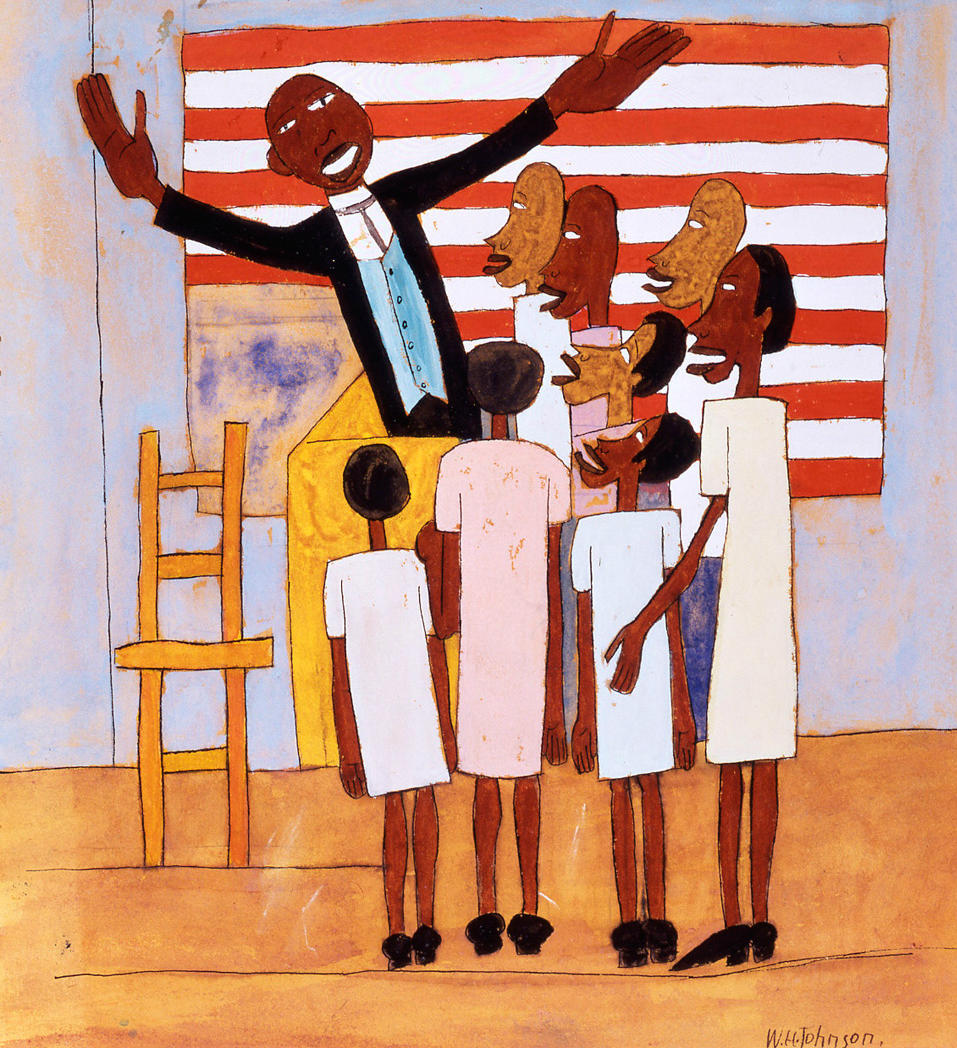
‘Flowering Trees, Norway,’ 1937 and ‘Lift They Voice and Sing,’ 1942, William Johnson
First, I found myself in what felt like a forest of art by William H. Johnson, a Florence, South Carolina native whose art was nearly lost to history, and one of my favorite artists. Over the past couple of decades, the museum has acquired many works by the painter who lived and worked in New York and Europe and explored many art influences before developing what was a truly original style. Most of the 42 pieces in this show were created during the 1930s in his wife’s native Denmark. The art in this exhibition is remarkable, but little is in his signature style celebrating African American life that that he created after his return to the U.S. in 1939.
If you don’t know about Johnson, you must look into his art and life. There is plenty online and several great books on him. Most of Johnson’s art is in the collection of the Smithsonian Museum of American Art. The Florence County Museum also has a number of his artworks.
Adjacent to the Johnson is a show by another important South Carolina artist (who also happened to be African American): Merton Simpson. This show, titled “Confrontation” is made up of about six large paintings from 1962 to 1972 that explore and express the racial and social upheavals of the times conveying both positive and negative energy, hope and despair, violence and sadness.
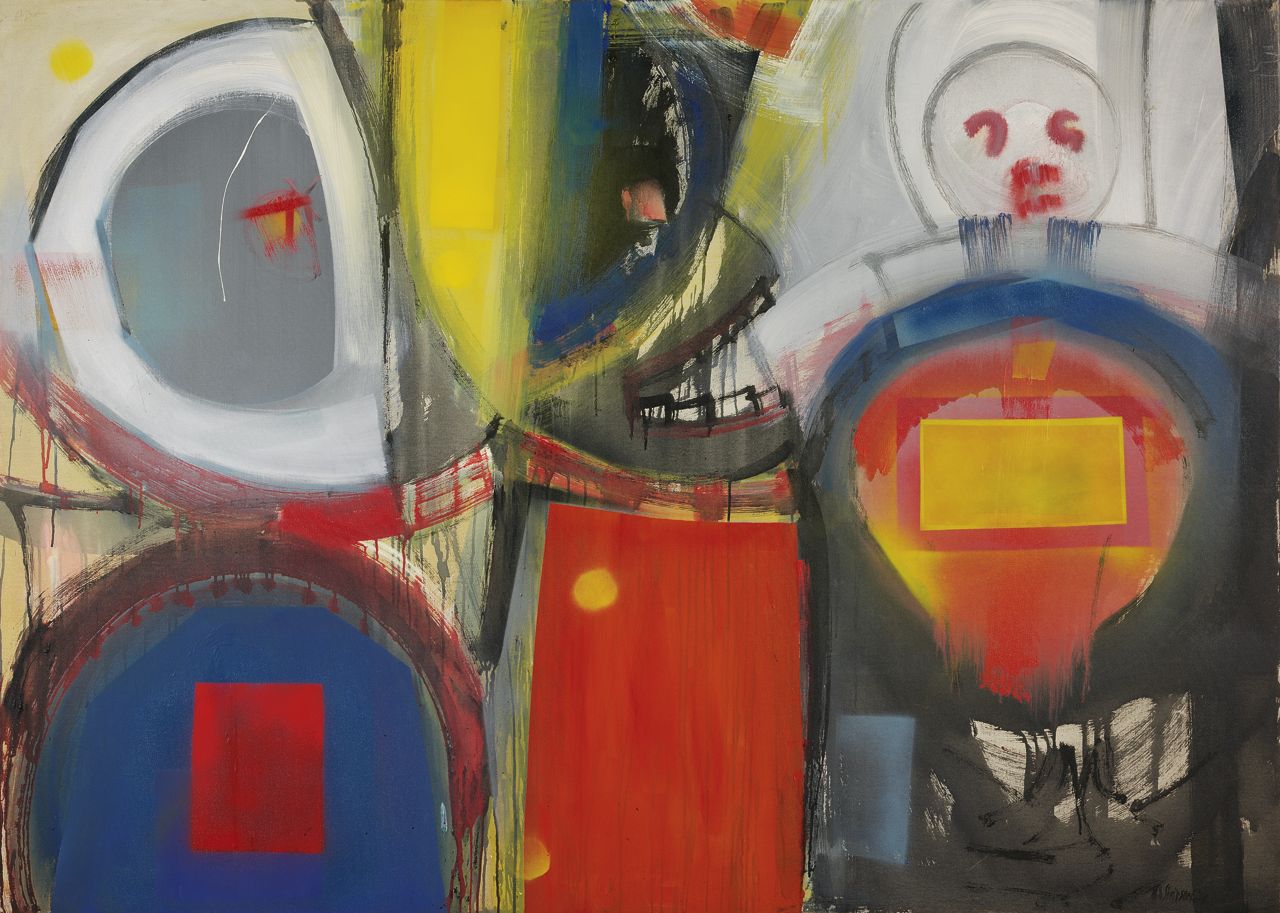
Like Rutenberg, Simpson was also a student of Halsey, but not in the same way. As an African American boy living in Charleston in the 1930s, art classes weren’t available to him; but William Halsey was. When Simpson was only 13, Halsey saw his work and began giving him lessons. Halsey and his wife Corrie McCallum were big supporters of the young Simpson and along with a couple of other Charleston artists organized his first exhibition.
Simpson continued his studies in New York and went on to meet and become friends with some of the leading artists of the period. Along with having a prolific career as an artist, he owned New York galleries specializing in African traditional arts as well as modern art. Many of the African sculptures the gallery carried came wrapped in textiles, some of which he gave to Halsey who used them in his own art. Simpson died at 84 in 2013.
The paintings in the museum exhibition were part of a 50-year Simpson retrospective at the Hampton III Gallery in Greenville in 2011. Watch a video tour of that show with gallery owner Sandra Rupp.
As with the Rutenberg, Halsey, Tyzack show, the Simpson and Johnson shows, which opened Dec. 3, have no announced closing dates. All I can say, is you really shouldn’t miss these.
And one final thing. Also at the museum is the photo exhibition “At This Moment: Portraits of South Carolina Artists by Jerry Siegel,” connected to a recently published book of the same name. You can read my review of the book posted Nov. 11/2025. My main criticism was that the photos don’t really show any work by the 78 artists included and has only a “rudimentary restatement of their resume”. The exhibition doesn’t even include a rudimentary restatement. It’s just one photo after another after another after another lined up. Pretty pictures that that don’t tell us a damn thing.
The long death of a once great museum
USC’s McKissick Museum won’t be what we think of as a museum
Dec. 5/2025
With all the back and forth and vague information and me jumping the gun a let’s take a closer look at what’s going on with the University of South Carolina McKissick Museum.
In the wee hours Thursday, I was checking the museum website to confirm an event and saw on the homepage a short statement that the museum would be closed for “renovation and relocation” starting Dec. 6. (That post is now gone, replaced with a longer piece about the renovations that says the museum closes Dec. 8.)
So, I posted on FB that the museum was closing. Then there was much back and forth. (see it here, the post is from Thursday update at 7:48 a.m.) At some point Lana Burgesss, museum director, weighed in the say the museum is not closing, and around the same time I received the rather vague statement that’s now on the museum site.


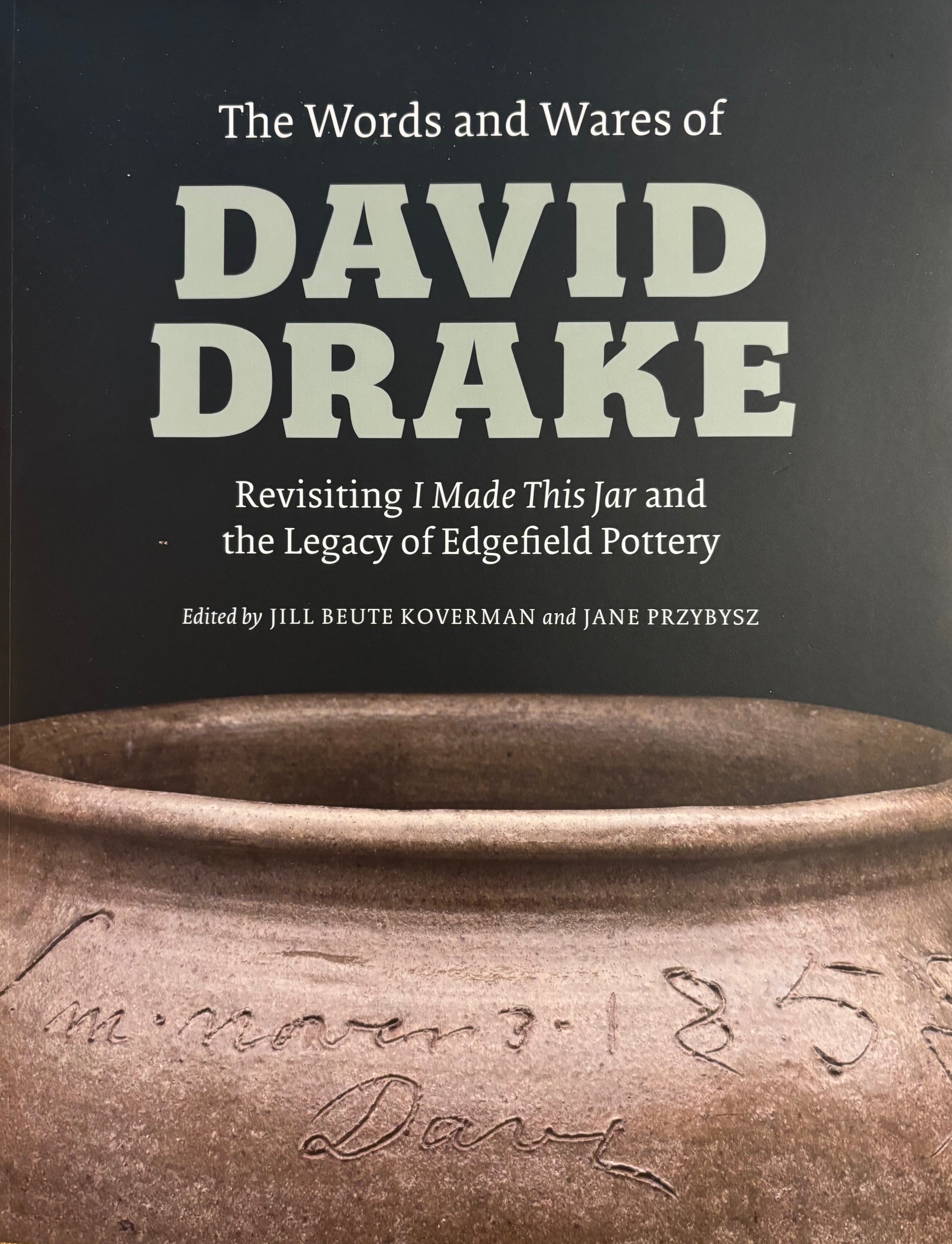
A 1901 quilt by Dessie Corrie Lee Morrison in the museum collection, books connected to exhibitions on sweetgrass basketry and Dave the potter by museum affiliated scholars
In light of that, I modified my post saying the museum was not closing. This morning, thanks in part to a story in the Post and Courier (I tipped them off) to say the museum is NOT closing, is not quite true.
From the Post and Courier: “While the university says it will work pieces from the collection into the renovations — including a dedicated classroom space for researchers and students to work with the historical and cultural artifacts — there are no set plans on whether the university will retain a broader, dedicated gallery space in the building.”
Doesn’t sound like a museum as most of us understand it.
Here’s a lot of background that I’ll try to keep short. It may will give you some idea of how complicated and messy this is.
The museum, which opened in 1976 in what was the McKissick Library, made its major mark through research on folk arts and folk traditions in the South. It did groundbreaking exhibitions and publications on sweetgrass basketry, ceramics, the enslaved potter Dave, quilters, and many other topics. The museum also mounted fine art exhibitions, including shows by graduate art students, art faculty members and others. (Sadly, there’s almost no information about any of the exhibitions or books on the museum website.)
In 2004, the museum lost its first floor when it was turned into a welcome center with exhibitions on the history of USC. Not long after several positions were eliminated. Cuts to space and staff were aimed at aligning the museum mission with academic programs rather than serving as a museum for the general public, according to then director Lynn Robertson. (I’ve been away for a decade but on my visits since last fall, the museum seems to have lost more space and has only two employees.) Cutbacks of space and staff at the museum were widely acknowledged as a real blow by people other than me, including the curators of the Greenville County Museum of Art and the Gibbes Museum of Art in Charleston.
I hated to see the cuts, but the “realignment” seemed a legitimate reason for the university making changes. I wrote a column in 2004 (see the full column at the end of this post) saying that the museum had sown the seeds of its own demise and was aided and abetted by a university administration (how that happened is another story entirely) The problem is that the museum was focused on folk and traditional arts and the university had no folklife program; the museum never affiliated itself with other academic programs that that might have provided protection.
What’s a university to do? Apparently not much and not in a timely manner. It just kept cutting and kicking the can down the road. Now the can is being recycled into something else. But it’s not a museum as we know it in spite of ow the university is trying to frame it. (Renovations won’t start until late 2026 so who knows when we’ll see the result of all this.)
I ended that column about the museum downsizing writing “What the university should be doing is expanding the museum. Most flagship universities have at least one, and often several, significant museums. Instead of whittling and watering down McKissick, the university should be working on a plan for a new, bigger and better museum. That’s the vision we should expect from South Carolina’s largest university.”
Now older, maybe wiser, but mostly more realistic about how universities and the world works, that sentiment is almost laughable.
But I still feel that way.


An artful week in Lagos, Nigeria
It’s messy, but there’s a lot of good art
Dec. 3/2025
Just returned from a spur-of-the-moment trip to Lagos, Nigeria (Columbia to D.C. to Lagos – easy) where an old friend lives. She knows just about everyone in the arts in Lagos so we saw a lot of art in all kinds of places. There’s no way I can give a particularly detailed looks at everything but I’ll hit a few high lights. Also, I’m not expert on Nigeria art and history.
The art world and venues in Lagos seem to reflect the massive disparities that exist throughout the country; some are nice and well to do and even super rich, others run down as hell and barely getting by.

The most obvious examples are the Nigeria National Museum and its across the street neighbor John Randle Centre for Yoruba Culture and History. The museum isa lovely building with an open courtyard and walkways; inside it is the dangerous combination of falling apart plywood and scary electrical wiring. Not a fitting home for the many fine traditional objects that are used to tell the story of life in a wonderful way.
The Randle Centre is a nice newer building ( not as interesting as first look promise) with beautiful displays of magnificent works. Some that I found most compelling were twins sculptures. The rate of twin births in Nigeria is four times the world average and even so, they are considered special and even if one or both die these sculptures serve as stand ins.
The only museum in the country dedicated to modern and contemporary is the Yemisi Shyllon Museum of Art at Pan Atlantic University (about 40 miles and a 2 1/2 hour drive outside Lagos.) The museum has a few of famous Benin Bronzes (subject of much controversy both inside and outside the country) but it is mostly about newer work from the 20th century before independence in 1960 up to today. It’s also had several recent exhibitions drawn from private Nigerian collections.

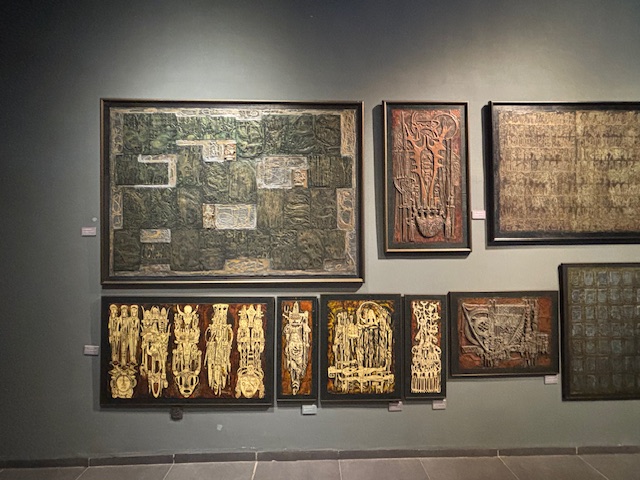
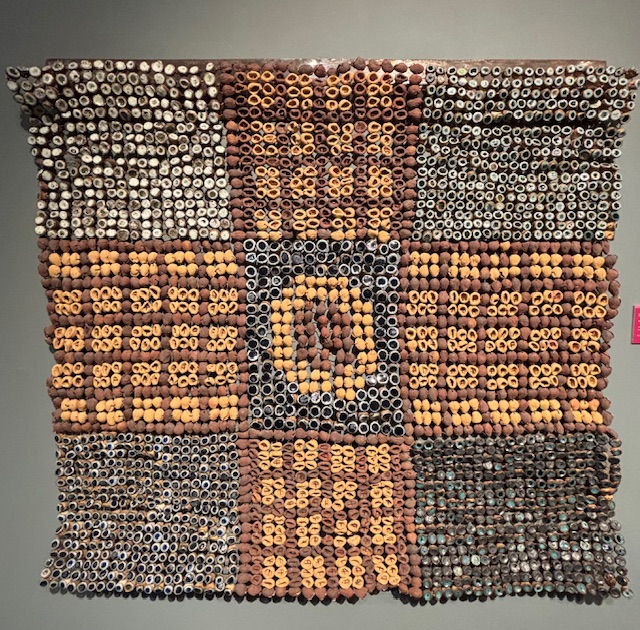
Works in the Yemisi Shyllon Museum of Art

One day we headed out to the Nike (not pronounced like the shoe) Gallery where owner and artist Nike Davies-Okundaye presides and welcome all. We planned to stay for a couple of hours in the four-story space packed floor to ceiling with art (for those who know the Natsoulas Gallery in Davis, California, think of that on super steroids.) We ended up spending most of the day since she gave us coffee and lunch and introduced us to a bunch of artists and then to everyone who entered the gallery. It was quite the time. The quality of the work is all over the map as with any place this big, but there’s some great work. Among the best is her own which includes textile work, paintings, bead work 2D art and a lot more. The 74-year old has just returned from an art event in Adu Dhabi where she been commissioned to do an installation and was heading to Art Basel Miami.
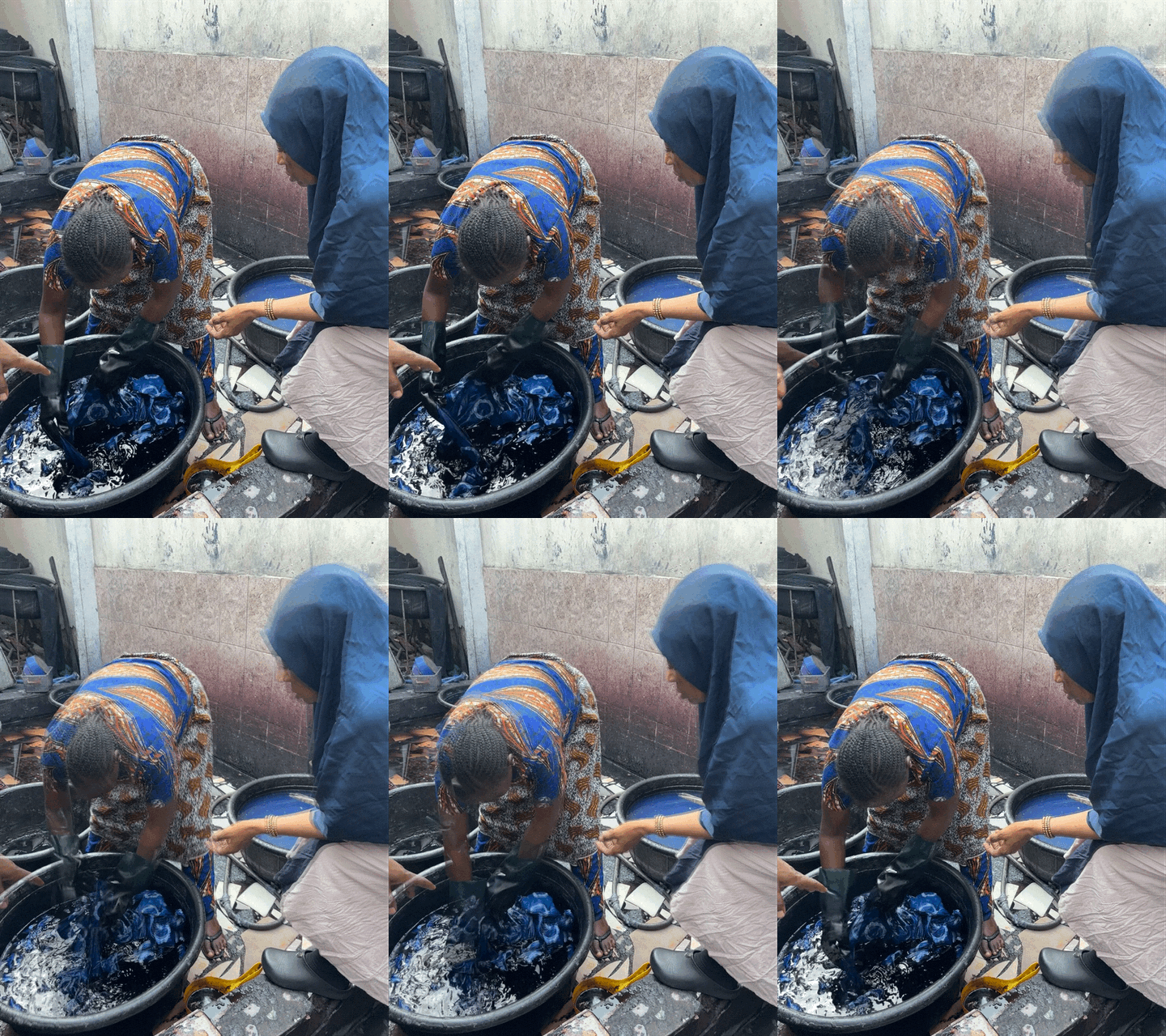
One of my favorite things was visiting the Adara Foundation adire-batik making center to train and empower low-income women in Lagos. It’s not like I’ve not seen the wax an dye process of batik before but not at this level. It’s not a huge place, with about 10 women working and a few kids around as well. Beautiful work that’s used by designers all over. I also show them some of SC’s great artist Leo Twiggs’ batik paintings.


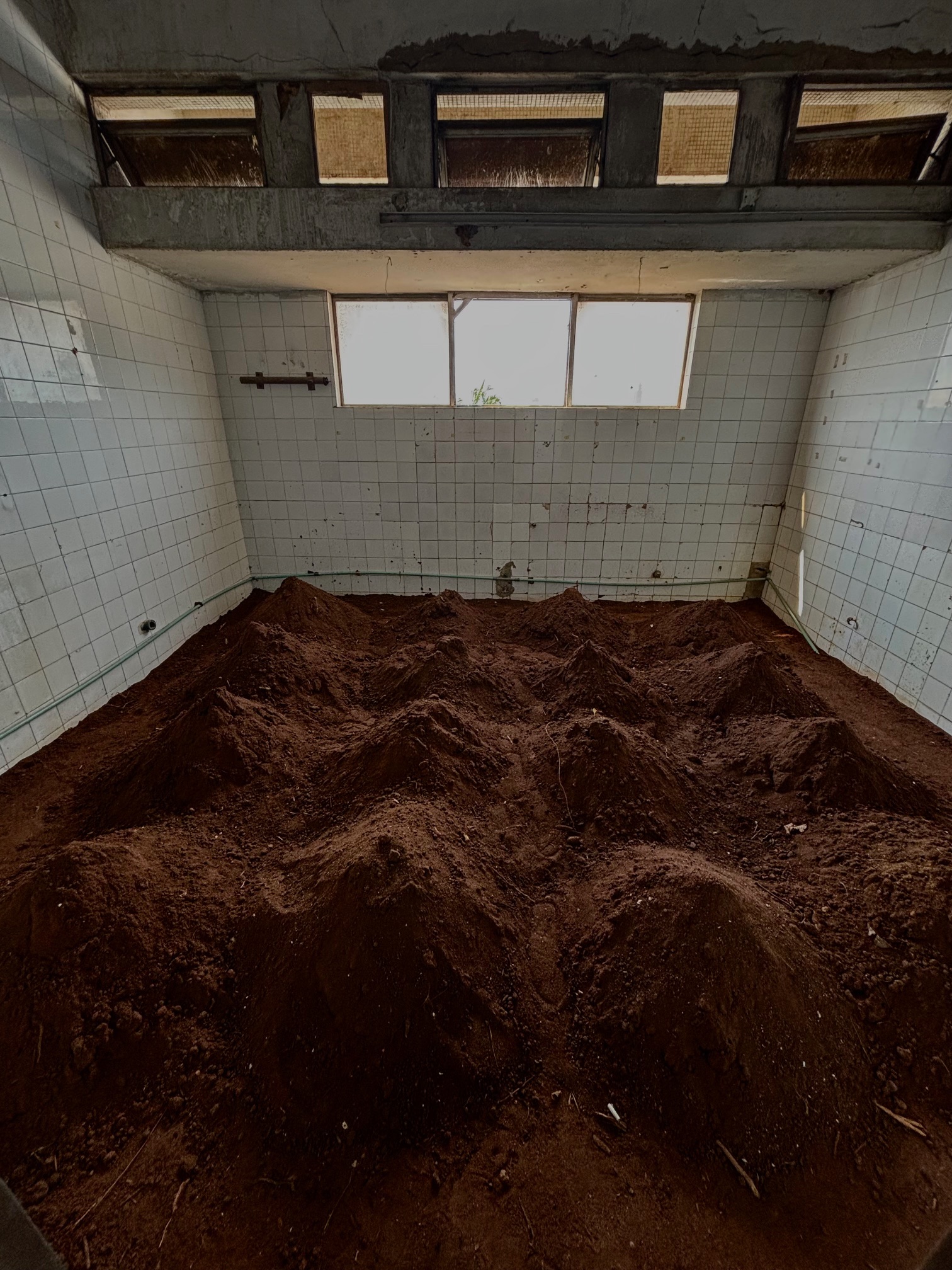
The last stop of the trip was at a decrepit, long abandoned high rise waterfront hotel which was most likely remarkable in its heyday of the late ’70s oil boom. The hotel is now home of NaHous for art installations and some shops. One of the main exhibitions there address the kind of poor quality processed food created by giant conglomerates many Nigerians consume. Another, nearly hidden away consisted of mounts of direct below a window where you can view the band and wind blown palms trees.
And it was just my kind of falling apart places coupled with tacky and terrible but also wonderful ’70s tropical Brutalist architecture and design. (If you want to see more of this or anything else from the trip please visit my FB page)


And it was just my kind of falling apart places coupled with tacky and terrible but also wonderful ’70s tropical Brutalist architecture and design. (If you want to see more of this or anything else from the trip please visit my FB page)
Maybe there is more to say, but I’m still kinda jet lagged. And sick.
Part 2 of the SC Biennial : don’t miss this second look at S.C. art and artists
Nov.18/2025
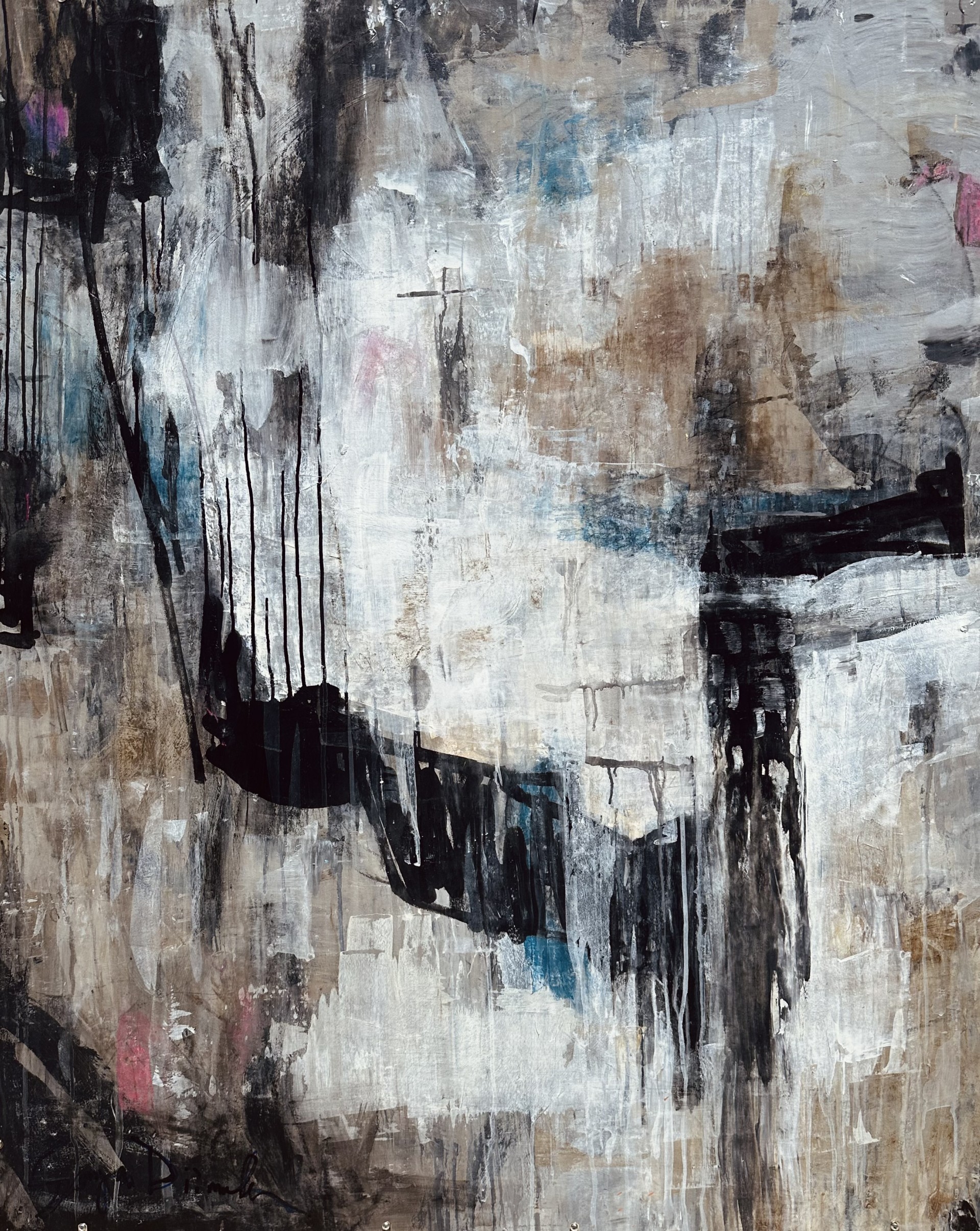
Part two of the S.C. Biennial shows artists across the state making varied and accomplished work in both in execution and content. The 12 artists in the exhibition at the 701 Center for Contemporary Art though Dec. 21 offer a wide range of works: monochromatic drawings and paintings, various approaches to abstraction, abstraction posing as realism, crazy colorful ceramics, some refreshing figuration, and an installation of found objects and sound. The second feels stronger than part one. (See review posted Sept. 2.)
A large painting by Sonya Diimmler of Prosperity provides a bold hello to the show. It’s a bright orange-red explosion surrounded by slashes and swirls of blue, with open areas of white, and lots of drawing over the shiny surface. Nearby is Diimmler’s very dark and mysterious painting completely opposite of the welcoming painting in every way but even better.
Works by Donald Medley of Rock Hill speak softly and powerfully. He uses a variety of methods, including printmaking, which give the surface a unique look, as doe his muted palette. There are many layers in his work, with geometric shapes shifting in an out of the space, sketchy small figures hanging out in the middle distance, and detailed faces up close.

On the other side of the gallery is a life-sized black and white figure painting, stretched horizontally, her body twisting through water by Morgan East of North Charleston. It is gorgeous and full of gesture, but look again and that body is visually, not literally, cut into many pieces.
Charleston artist Ada Goldfeld’s still life paintings (broken egg shells, a measuring cup of reddish liquid in a microwave) look quite realistic, but like East’s there’s much more going on with subtle colors and many intricate marks and layers.
Jeff Sumeral and Goda Rupeikaite of Greenville have created a towering sculpture made of aluminum walkers with a soundtrack of two very positive voices speaking about confidence, dealing with changes and being on your own, all over some lovely cello music.
A group of five 6-by-6-inch drawings, all titled “Tower” by Patrick Mahoney of Columbia are seemingly simple images of imagined structures. The towers look like they would be gigantic in real life, but rendered this small and isolated without any context, gives them a mysterious and somewhat ominous feel.
The three clay pieces by Jay Owens of Travelers Rest are hand built multi-color works both fun and threatening; buildings fight with one another and an undulating earth, a skeleton rides in the bed of an open pink hearse, and a clunky tornado whirls through the gallery.
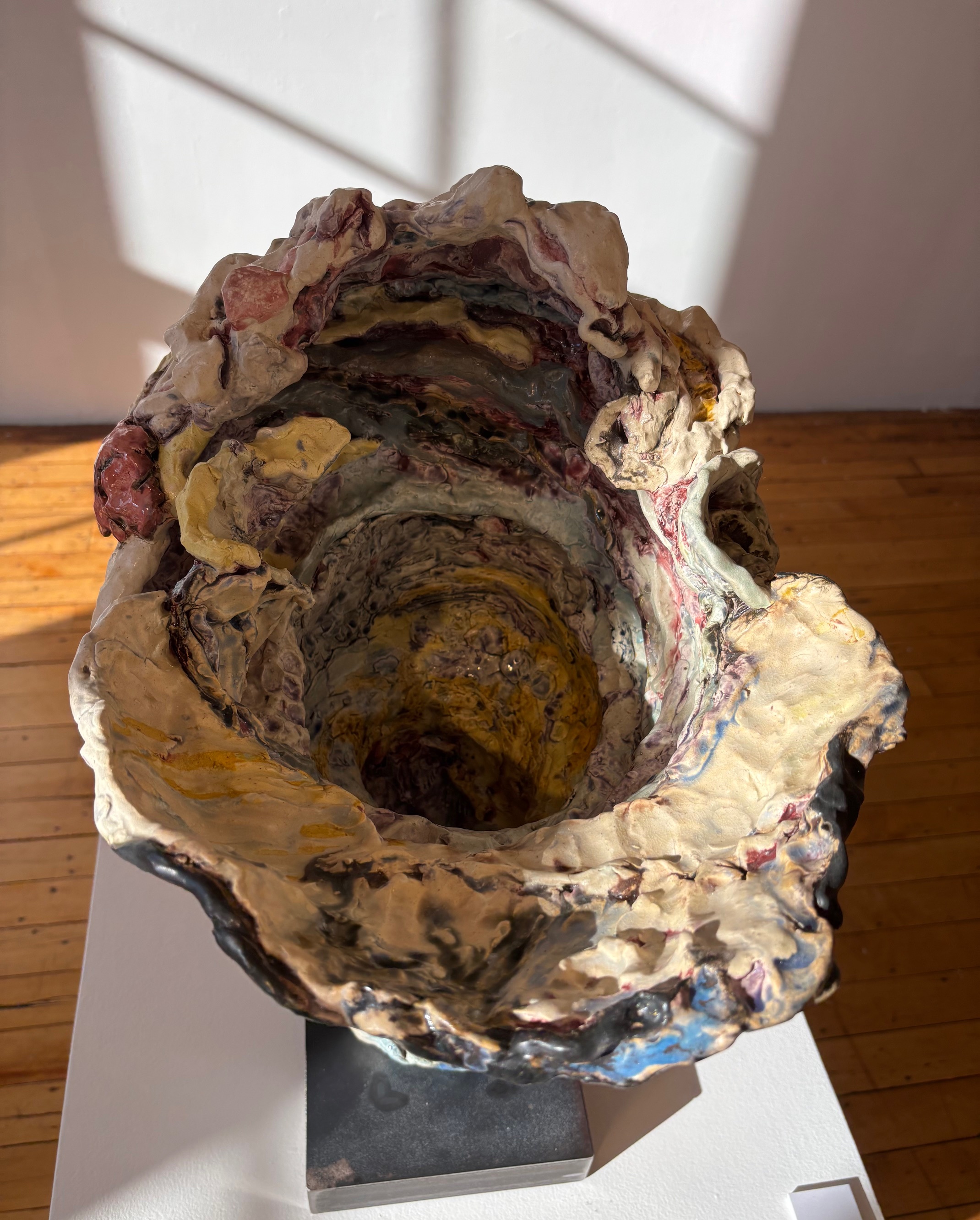
Most of the artists have three works in the show, which seems fair enough, but there’s only that one large figure for East and two by Nina Rastgart of Columbia, who is showing one small metal sculpture and one large wooden one. There’s room for more Rastgart work and anyone who has seen her recent solo shows knows she deserves more pieces here. Her pieces are also poorly displayed, separated by a door and light controls.
The other artists in the show are Emma Barnes McClure, Beaufort, and Lori Isom, George Wenzel and Nolan Wright all of Columbia.
Overall, the installation eels unimaginative, but that could have a lot to do with the works included and the gallery space. There’s really room for more work, even if it makes the place a bit crowded. (Yes, if it was crowded, I might have a problem with that too. This isn’t math and neither is installing a show. And again, the center gives us very little information. No text panel explaining the Biennial, and the center website provides artists statement, buy no bios or links to their websites.
A few shortcomings, but anyone interested in the state of the state’s art shouldn’t miss it.
The exhibition is only up until Dec. 21. Hours are Thursday – Sunday 1-5 p.m. You might want to check on Thanksgiving weekend hours to be on the safe side. A panel discussion with several of the artists takes place Dec. 11.
(The Sept. 2 review addressed some of the larger issues with the Biennial such as the low number of artists who entered.)
S.C. contemporary artists book just published
Long-awaited follow-up to 1970 book tells us little about the artists
Nov. 11/2025
The book South Carolina Contemporary Artists, published in 1970, long served as a guide to the who and what and ups and downs of contemporary art and many artists in the state. Even decades after its publication, the book was and is still useful.
Finally, there’s a follow up, but its unlikely to have the staying power of the previous book.


John Acorn, Tarleton Blackwell, Hirona Matsuda (photo cropped). Most don’t show this much art. All by ©Jerry Siegel
At This Moment: Portraits of South Carolina consists of single portraits of 78 artists taken by Jerry Siegel. In some photos you get a glimpse of their art, but often it is in the background, out of focus or absent. There’s a short write up about each artist; it’s only a rudimentary restatement of their resume with one line about their art. The portraits are nice, but they all look much the same and tell us little about the subjects. Siegel has done some stellar work, but this isn’t it. An exhibition of the photos opens Nov. 12 at the Greenville County Museum of Art. The museum commissioned the photos from Siegel and published the book.
By contrast, the 1970 book had real stories on 39 artists speaking about their art and lives, where they studied, significant shows, and what collections held their works. Along with a portrait, there were another 10 or so dynamic photos of each artist working or talking, along with color images of their art. I will give the new book this; the portraits are much better than the mostly tightly cropped headshots in the old one.)
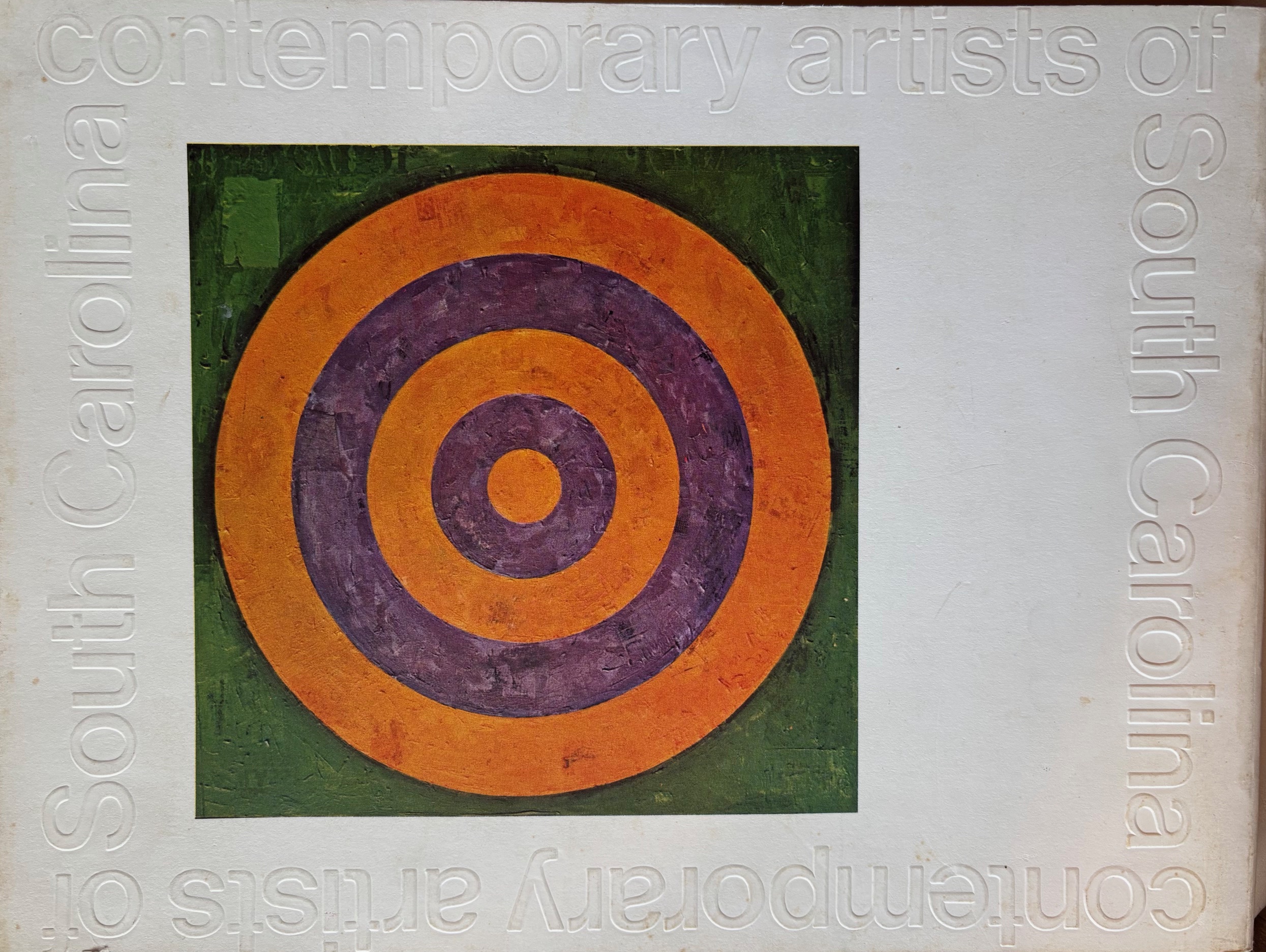
The 1970 book was also a project of the Greenville County Museum of Art with text by then museum director Jack Morris and black and white photos by Robert Smeltzer. (Those photos now belong to the S.C. State Museum and some are part of the current exhibition “From the Vault: South Carolina Art from the Museum’s Collection” there. See my Oct. 7 review.)
A handful of those who were in the first book are in this one as well: John Acorn, Boyd Saunders, Jeanet Dreskin, Sigmund Abeles, Jasper Johns and others. Most included are in mid-to-late careers; the very nature of this kind of book is going to skew toward older artists. It looks like few under 50 are in the book. (Among the many facts missing from this book are years of birth.)
The original book focused on artists making what at the time could be considered fairly mainstream contemporary art with most of the artists having academic training. Those were times before traditional folk artists or outsider/self taught/visionary artists were part of the contemporary art conversation. The new book somewhat corrects that gap by including a few of the latter.
Overall, this book provides a good sampling of artists. One could argue about who is missing, but putting something like this together has to be a complicated, imperfect picking process.
The selection was made by the book’s editor Mark Sloan, an independent curator and writer who was director of the Halsey Institute at the College of Charleston from 1994 to 2020, and long-time Greenville Museum director Tom Styron. There are brief essays by both and a longer essay about the photos of the artists, but not the artists, by arts writer Eleanor Heartney.
We waited 55 years for this? What a disappointment.
(Full disclosure: Around 2007, I pitched a book like the 1970 one to the Greenville Museum, the S.C. Arts Commission and USC Press. The first two said they didn’t have the money or interest. USC Press was interested and I wrote a proposal and introductory chapter. I met with the USC Press a few times; they had questions, but never replied to my questions about those questions so it went nowhere.)
What’s coming up
The second half of the S.C. Biennial opened last week at 701 Center for Contemporary Art. There’s an opening event Thursday eve where we should be able to meet some of the artists. I’m looking forward to that since I don’t know many of them. Like part one, there are 12 artists here from around the state working in a variety of mediums. I did a quick run through last week and came away with a positive impression. (To learn more about Part One and the Biennial as a whole, look at my review posted Sept. 2.) Through Dec. 21.
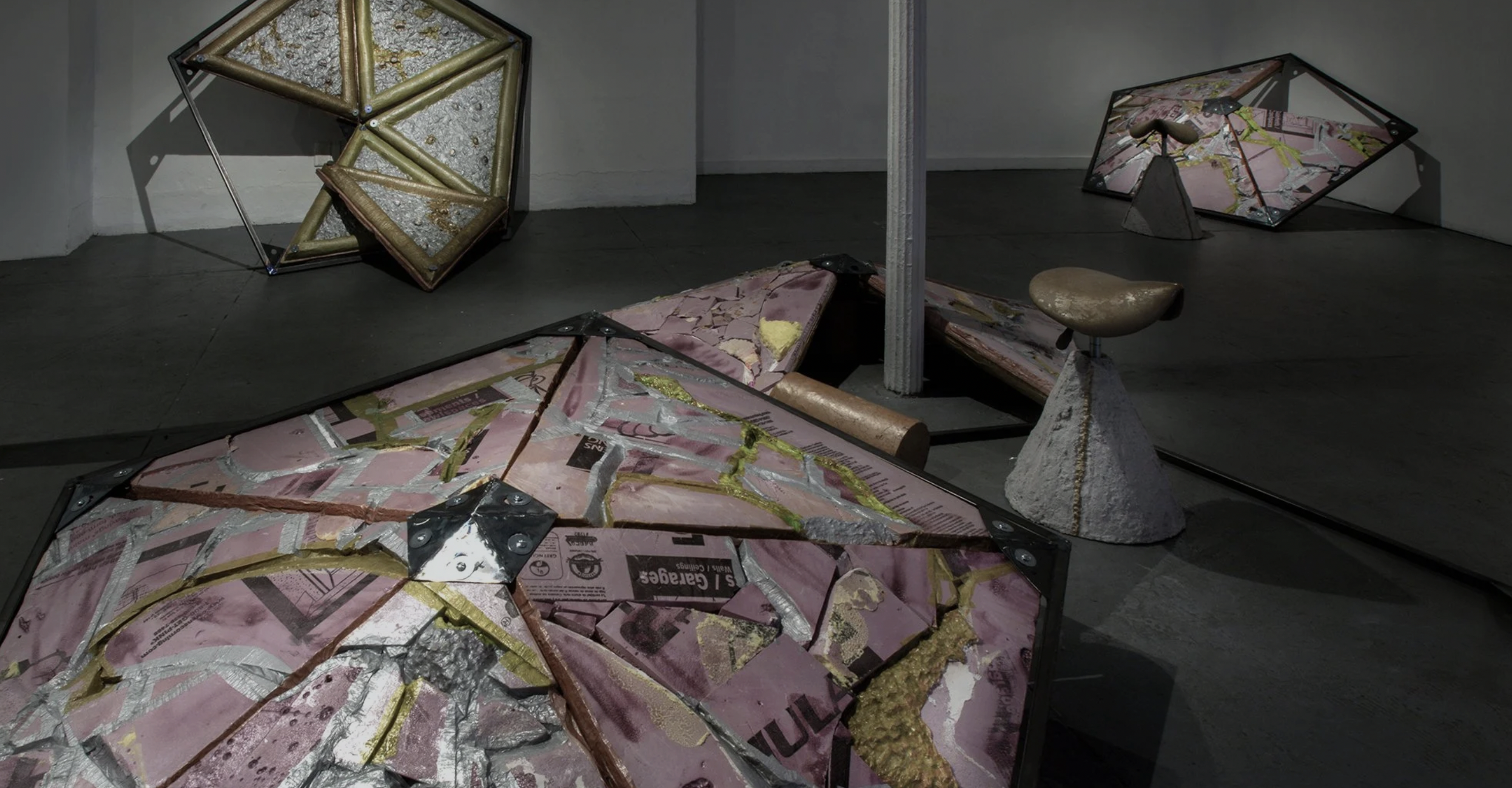
Opening that same night (talk to one another people!) at the Goodall Gallery at Columbia College is “Double Dopple” by Carrie Fonder, an installation made of steel, wood, digital prints and video exploring themes of identity, transformation and repetition. Based on the images, very much looking forward to seeing this show. Fonder is an associate professor at the University of West Florida. It’s only up through Dec. 12.
And the same night at the same time, in conjunction with Keith Haring: Radiant Vision, Columbia Museum of Art trustee Joseph Bruce will give a talk about living in New York during Haring’s time, with insights into the artist’s work through the lens of Bruce’s experience as part of the city’s community of gay men in the 1980s.
Southern Exposure music series brings to stage scenes from composer Robert Ashley’s 1983 “television opera” Perfect Lives. The opera is kind of about a bank robbery, cocktail lounges, geriatric love and adolescent elopement in the American Midwest and is consider one of the definitive text-sound compositions of the late 20th century. See and hear it Friday at 7:30 in the School of Music Recital Hall.
Next door the same night at the Koger Center will be an exhibition and performances about hip hop and comics featuring artists Dan Lish, Sanford Greene, Dre Lopez, Shepard Fairey, Danny Hastings and others that’s part of Soul Haus at the center.
On Sunday the USC School of Music wind ensemble performs The Automatic Earth, a musical depiction of the climate crisis and how technology has transformed what it is to be human. The work by Steven Bryant will be conducted by Verena Mösenbichler-Bryant, chair of the Duke University music department. The ensemble will perform several other pieces as well.
And some things that already happened
I had the best intentions last week to go to several events Thursday and Friday nights, but that didn’t happen.
But I was fine with that on Friday since I spent three hours in Five Points for the Philosophy of Five Points. What, you may ask, the hell is that? I had the same question. Now in its third year, the event pairs artists with philosophers (mostly USC grad students), but also Matt Kisner, chair of the USC philosophy department and the first philosopher I ran into that night. He was partnered with Shabnam Miri, a master of fine arts student in the USC School of Visual Art and Design, whose work I was already familiar with. Like all the projects, located in businesses in Five Points, the site posed a question. In this case, it was Are All Perceptions of Art Valid (or something like that.)
I had some other great encounters during the evening and was especially taken with Starlitt Miller’s participatory movement-based project that posed the disturbing question “Is Our Body Just A Bag of Flesh?” I found it unsettling and enlightening. There was a great turnout and people seemed very engaged.
The project was concocted by a group called Cola Love (look them up), the philosophy department and the Five Points Association. Congratulations to all of them, but mostly thanks to all of them.
On Saturday I did manage to get to everything. Spent the day kayaking on the Edisto River, back home at 4, unpacked everything, quick nap and food, on to Gemini Arts for the Jasper magazine release event that included readings, and look at art for sale to support Gemini.
Then on to the USC School of Music for The Consul, a 1950 opera by Gian Carlo Menotti, founder of the Spoleto Festival USA in Charleston. It was his first opera and won the Pulitzer Prize. The opera, sung in English, is set in an unnamed but repressive country where most of the characters are displaced, in limbo and caught up in a maze-like bureaucracy.
Amazing singing, even by those with smaller roles, solid acting, a stunning set (the consul’s office was a giant wall of filing cabinets) by Nate Terracio (whose full time job is director of the Koger Center) and lighting, and a good sounding small orchestra conducted by Clinton Smith, the new music director/conductor of opera. At the helm was Ellen Douglas Schlaefer, director of Opera at USC; she really knows how to put an opera together.
Schlaefer retained the original setting in an unnamed possibly European country in 1950. When it premiered this setting would have been familiar as tens of thousands had been displaced by World War II and shifting national boundaries. There must have been a temptation to reset the opera in a more contemporary time, and for example, to transform the secret police in trench coats and fedoras into ICE agents in flak jackets, helmets and face coverings. I’m glad that didn’t happen; I think it would have stripped the opera of its timelessness. Most people don’t need to be beat over the head with the relevance and those who don’t see connections to today never will.
The production was held in Drayton Hall Theatre, not the greatest venue, but you work with what you got. My only quibble is that although the opera is in English, it still needed supertitles.

Sunday afternoon I took a quick run up to the Lancaster Cultural Arts Center to check out Chamber Music for All series directed by Calin Lupanu, Charlotte Symphony Orchestra concertmaster. I learned about the series through Phillip Bush, a pianist and professor at USC. Along with Lupanu and Bush, the other players were CSO members. I was also interested in this concert because it was all 20th century music with works by Darius Milhaud, Igor Stravinski and Dmitri Shostakovich. Stellar playing all around. The concerts take place in a beautifully restored 1862 church that was a roofless ruin a few years ago.
Since this series is called Chamber Music FOR ALL, Lapanu and the others discussed and demonstrated parts of the works prior to playing. Very informative, but it went on a bit long for me. Also, at $20 this is quite the deal for high level chamber music.
For more about the concert series and other events, the church and other revitalization efforts in Lancaster go to https://lcshp.org/.)
Reconnecting with Asheville after long time and and a run down of lots of great things in Columbia
Nov. 6/2025
Something different for this site. A visit to Asheville and a long rundown of a lot of great stuff happening in Columbia. I’ve tried to stay away from creating curated calendars because it’s so much busy work and isn’t really my job, but I’d hate to see some of this overlooked. If you don’t care about Asheville scroll down.
Bouncing back and beautiful
I needed a couple of days away from dealing with health insurance companies (I’m fine, just trying to find a company with in-network dentists) and thought I might be able to take in some fall color and also see how Asheville is faring a year after the storm. Turned out to be a good plan. Since this is an arts blog rather than an outdoor blog, I’ll talk about art rather than the fantastic hikes I took and the color I saw.
I rolled into Asheville around 10:30 on Saturday and the place was already hopping and just got busier as the day went on. I roamed the streets since I’d not been in the city since probably 2013. Still charming and filled with shops and restaurants (more than ever, like almost everywhere.) I stopped back in the city Sunday eve and could hardly find parking. A good sign.
I wasn’t in the area most affected by flooding that destroyed much of the River Arts District. Some displaced artists are showing at the RAD Outpost, 24 North Lexington Ave. My understanding is that studios on the upper level of the River Arts District are back in business, but I didn’t have a chance to stop by.
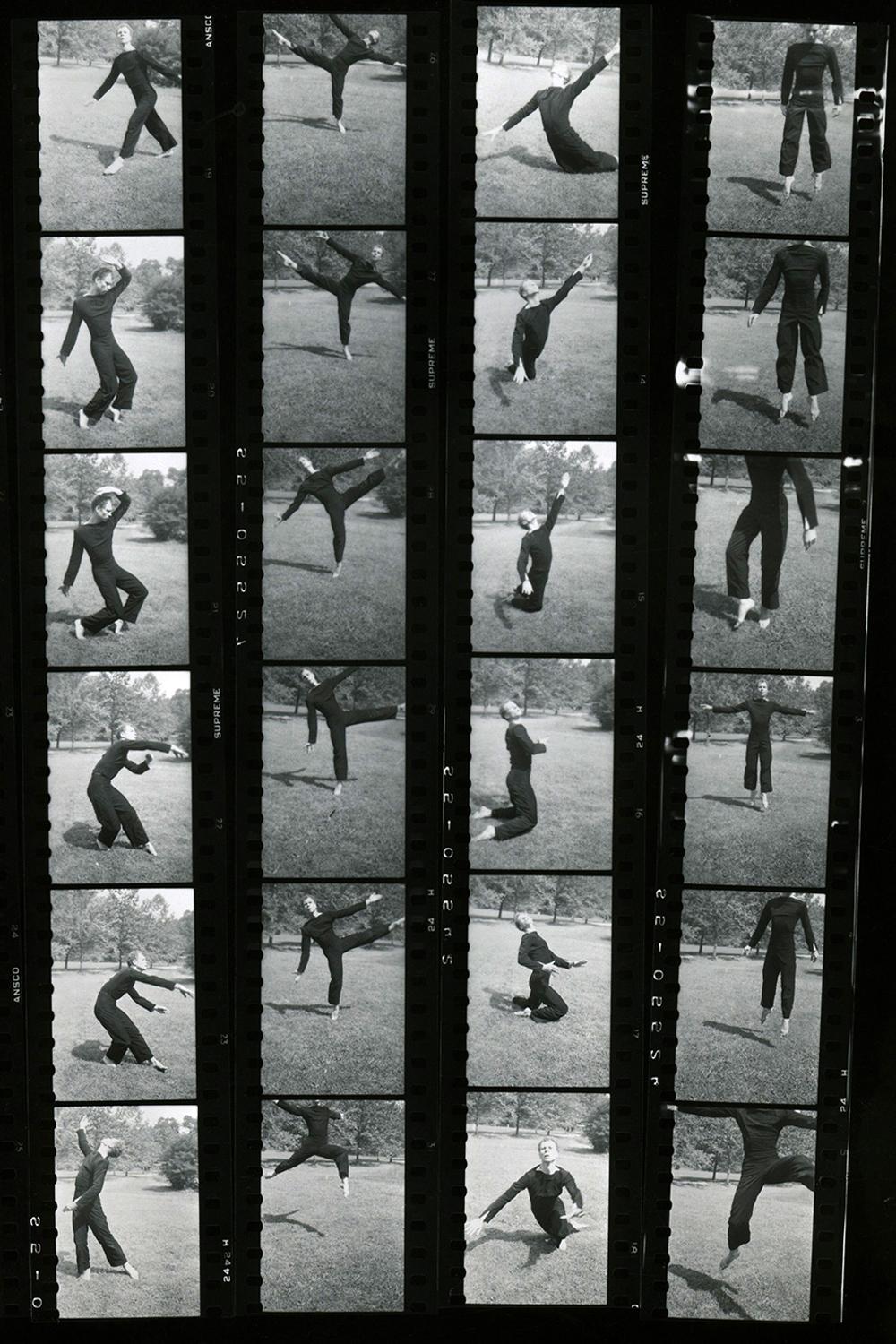
Along with the fall colors, I was also motivated to visit Asheville by Columbia artist Michael Dwyer and Ann-Marie Dwyer who had posted on Facebook about going to the Black Mountain College Museum and Arts Center. (Also, a thanks to Michael for giving me a tour of his studio recently.)
Black Mountain College was founded in 1933 as an interdisciplinary experimental college that was a career defining place for some of the greatest artists and thinkers in the second half of the 20th century. Among the faculty and students were Josef and Anni Albers, Ruth Asawa, John Cage, Robert Creeley, Merce Cunningham, Robert Rauschenberg, Elaine de Kooning, Willem de Kooning, Buckminster Fuller, Walter Gropius, Ray Johnson and many others.
The current show is “Points in Space: Performance at Black Mountain College” focused on music, dance, theatre and a mix of all with works by Cage and Cunningham, composers Lou Harrison, David Tudor and others. The exhibition has historical and contemporary works, interactive installations and a lot more. I was really taken with all the Cage materials. There’s even a prepared piano you can play.
I can’t recommend this exhibition, up through Jan. 10, and the museum highly enough. Also there have been a number of events connected to the show with more to come including a performance by Sandbox Percussion on Nov. 19, a lecture on David Tudor in December, and a Cunningham Dances / Rauschenberg Celebration with music by John Cage on Jan. 7 and 8. Check the website for details.
The always excellent, dependable and huge Blue Spiral Gallery seems to be going strong. I met the very nice and helpful new director Nicole McConville and spent way more time in the gallery than I planned because as noted earlier, it’s very big and very good.

The gallery staff was in the middle of installing four new shows that open tomorrow.
“Spectrum” is made up of works that explore the energy of color; Heidi Tarver’s patterned ceramic vessels are technically accomplished, beautiful and fun (I loved them); another pairs Chris Liberti’s paintings and Will Dickert’s sculptural ceramic forms (I know Liberti’s paintings from the John Natsoulas Gallery in Davis, Calif., and was so happy to see them again); “Field of Vision” is a landscape-inspired show including Luke Allsbrook whose works many know from Hampton III Gallery in Greenville. In the gallery also saw a few other familiars/SC artists there including basket maker Clay Burnette and painter Katie Walker.
A very busy time at home
I will not be in Asheville for the opening of those shows, because I’ll be very busy in Columbia, trying to figure out how in the next two nights and beyond to get to everything that sounds interesting to me. Some of it may interest you as well.

At the top of my list is the opera The Consul, by composer and Spoleto Festival founder Gian Carlo Menotti at the USC School of Music, Friday – Sunday. It was Menotti’s first full length opera and won the Pulitzer Prize. It premiered in 1950, not in an opera house, but in a Broadway theatre as part of Menotti’s philosophy of reaching out to non-traditional audiences. The dark, slightly surrealistic work follows displaced persons dealing with a nightmarish bureaucracy. USC opera director Ellen Schlafer worked with Menotti often early in her career. I believe this is the first outing for Clinton Smith, an assistant professor, and the school’s new music director and conductor of opera.
Also please look at the music school calendar of performances because they have so much going on, much of it free.
The Philosophy of Five Points on Friday promises artists’ installations and interventions, along with some philosophical grounding. It sounds super cool with a bunch of good artists involved.
A fund-raising auction at and for Gemini Arts is going on today through Saturday with the big event Friday night. Also, on Saturday eve at Gemini, Jasper Magazine is releasing its new print issue.
Part two of the SC Biennial opens Friday at 701 Center for Contemporary Art (opening event next week)
The Betsy Blackman Dance Company, part of the USC Theatre and Dance Department, performs tonight and tomorrow. Oscar Wilde’s “The Importance of Being Earnest” opens Friday at USC Theatre and Dance.
Tonight the rare books department at USC libraries and USC Theatre and dance present “Case of the Collection Caper: An Academic Affair,” a murder mystery comedy in conjunction with the exhibition “100 years of Elmore Leonard.” Might be too late for that, but the exhibition about the great crime writer is up for a while.
“The Minutes” by Tracy Letts is running at Workshop Theatre through Nov. 9.
The S.C. Underground film festival runs this weekend at the Nickelodeon.
And just up the road at the Lancaster Cultural Arts Center on Sunday is a chamber concert featuring Darius Milhaud’s Suite 157b for Clarinet, Violin and Piano; Igor Stravinsky’s L’Histoire du Soldat; and Dmitri Shostakovich’s Piano Trio no 2 in E Minor. Performers will be Charlotte Symphony Orchestra’s clarinetist Taylor Marino, violinist Calin Lupanu, and cellist Monica Bobo, and pianist and USC professor Phillip Bush.
One more great Halsey Institute exhibition, meet the new director there, and the third fantastic Brian Rutenberg show this year
Oct. 27/2025
Not long ago, I stopped by the Halsey Institute of Contemporary Art at the College of Charleston, something everyone should do any time they are in Charleston. The gallery has created museum quality exhibitions for decades and shows no sign of slowing down.

Section of ‘The Divine Eye’ at Halsey Institute at the College of Charleston
The major show there now is “The Divine Eye” by Kenny Nguyen, a native of Vietnam who has been in the U.S. since 2010. It is a magnificent installation of painted and woven silk sculptures many made specifically for the space, including a huge work consisting of a giant undulating wall and tubular hanging elements that you can walk through and be immersed by. There are also many smaller, but not much smaller, individual pieces each of layered fabric and colors.
I cannot recommend this exhibition highly enough. Both it and the exhibition “Raheleh Filsoofi: At the Edge of Arrival,” in the second gallery space of the institute, are up through Dec. 6.
Meet the new Halsey director; you may already know him

While visiting the gallery, I ran into the new director, who I already knew — Michael Dickins, who has a history with South Carolina. He and his wife Dawn Martin moved to Columbia in 1997 when she entered the master of fine arts program at USC. During their three years in Columbia, he was an active artist and may have framed your art while working at City Art where he also helped organize and install exhibitions.
“We’ve always had a sweet spot for Columbia – it was a very transformative point in our lives,” said Dickins, who arrived at the Halsey in July.
Dickins has directed several galleries since then, most recently for 11 years at Austin Peay State University in Tennessee. He has also curated for other venues and co-curated “Raheleh Filsoofi: At the Edge of Arrival.” Dickins’ interdisciplinary artwork includes sound, works on paper, video, text and many other components, often addressing political issues has been exhibited widely.Learn more about him here.
New works on paper by Brian Rutenberg are a revelation

I am seeing a lot of Brian Rutenberg and his art this year. The Myrtle Beach native and College of Charleston graduate whose landscape inspired paintings are always exciting has a new show “The Wild South,” at the Jerald Melberg Gallery. in Charlotte.
What makes this show unique and eye-opening is that other than one work, it is comprised entirely of oil paint on paper pieces. This is the first time he’s ever had an almost all on paper show. The 19 paintings were all done this year: ten 30-by-22-inch paintings, all titled The Wild South; eight 15- by-11-inch works, called Sunseeker; and the 5-by-6-foot oil on linen Myrtle.
I didn’t know before I went that this was going to be a painting on paper show; not sure what I would have been expecting if I did, but this exceeds any expectations I would have had of any Rutenberg show. These are magnificent. Although so much smaller than most of his work I’ve seen, they have the same power, maybe even more concentrated. Usually his works on paper take a secondary role; it’s great to see them on center stage.

Since returning to South Carolina last fall, I’ve seen Rutenberg several times, along with a lot of his art. The first was a great show of mostly large paintings at the Sumter Gallery of Art, then a painting he donated to USC that’s on display in the Koger Center for the Performing Arts, and an exhibition of 15 early works at the Greenville Museum where he had his first museum show in 1993 which is where and when I met him. (See reviews of the Sumter and Greenville shows below, May 1 and July 20 postings respectively.)
I’ve seen a great deal of his work over the last few decades, but never so much in such a short period of time. When I think it can’t get better or maybe I’ve seen enough, he’s done it again as with this exhibition. I’ve written so much about his work this year, that I won’t go on much more than that. I’d rank this as some of the best work he’s ever done.
The exhibition is up through Jan. 3.
Boyd Saunders at Hampton III Gallery
Career of long-time USC professor gets a deep look
Oct. 20/2025
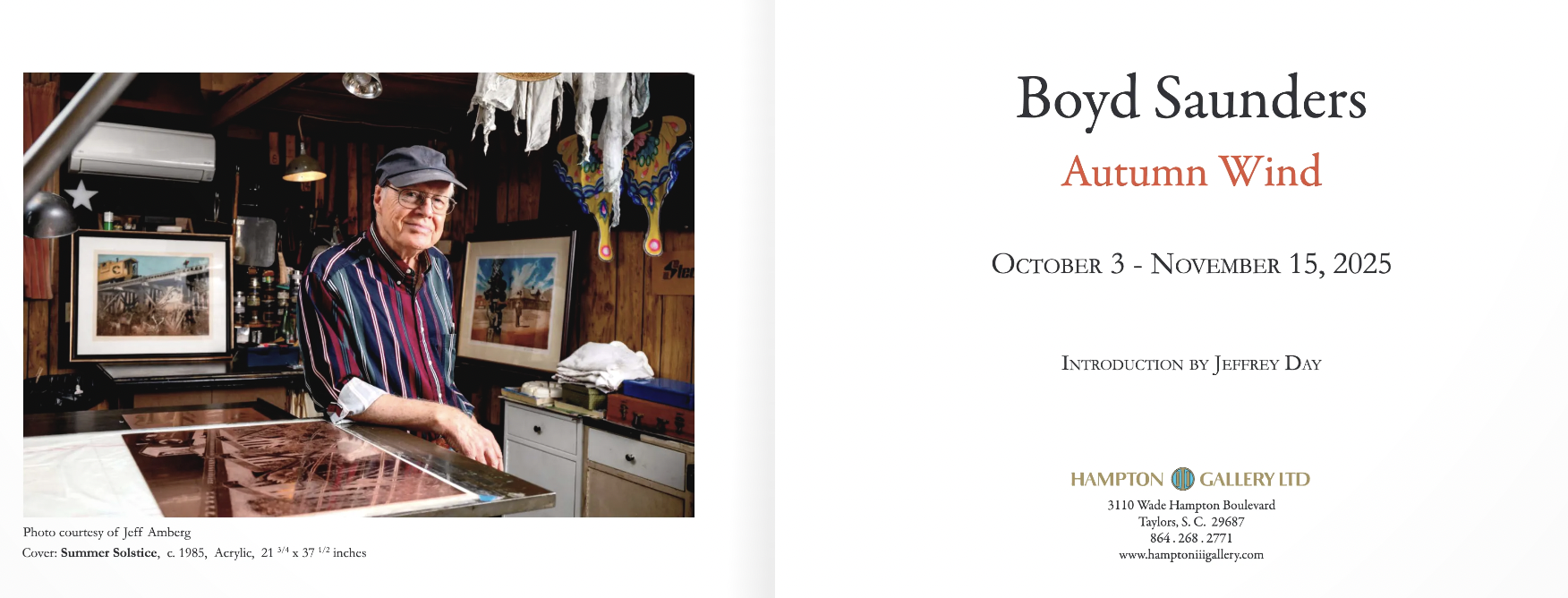
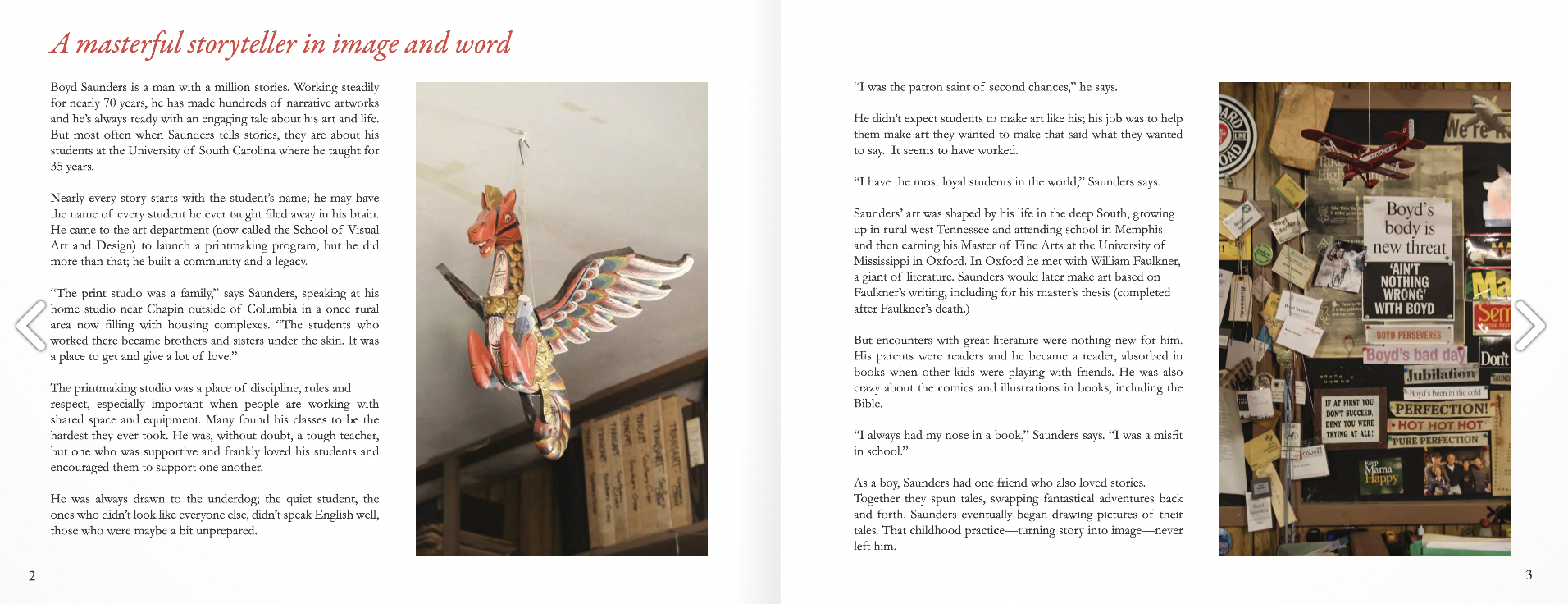
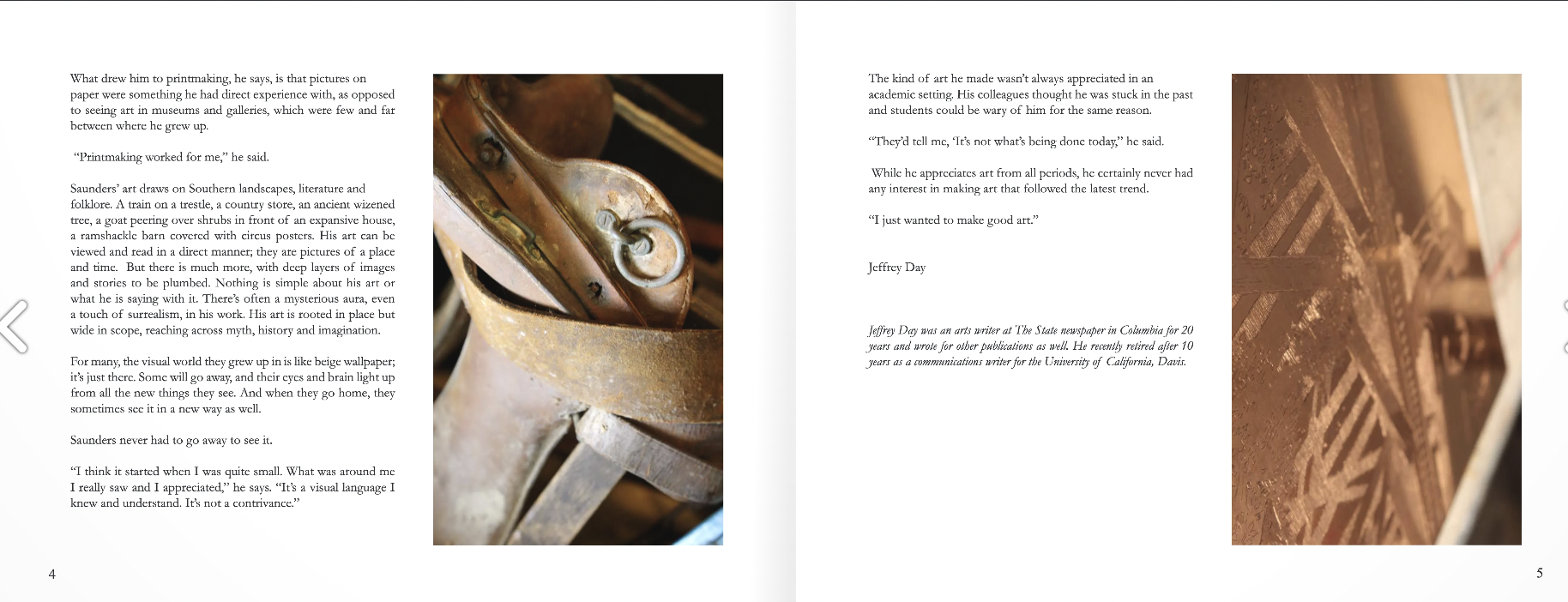
Here’s a essay I recently wrote about Saunders, long-time professor at USC, for the catalog for his exhibition at the Greenville gallery. (click on images to enlarge)
100 years of USC art
Two exhibitions take the long view with dozens of alumni and former faculty, but badly shortchange the women
Oct. 15/2025
Organizers of “Generations: 100 Years of Arts at the University of South Carolina” have done an impressive job of packing 100 years of art history into the remaining art gallery at the university’s McKissick Museum. The exhibition of 70 works by 23 former faculty members and 26 alumni is a joint project by the museum and the School of Visual Art and Design (known as the department of art for most of its existence.)
You can find a companion exhibition at the SVAD art gallery; “Intersections II: Teachers and Students in Art and Design” with about 35 pieces by 10 former faculty and 18 alumni. (There’s an opening reception Oct. 16 at 5:30.)
While there is a lot of good art to see in these shows, they have an ugly side: there are only 10 women in the museum exhibition of 50 artists and only 12 in the gallery show of 28.
The museum exhibition spans the full 100 years, while the gallery focuses primarily on the 1970s to the present, with particular attention to recent decades. Several concise panels outline the department’s history, complemented by informative labels on each artwork. Together, the shows offer a solid overview of the department and the artists who shaped it — though some notable gaps remain.

The museum show starts with founding faculty Katherine Heyward, who was also the first female faculty member at USC. She was joined a few years later by Catharine Rembert, the first graduate of the art program. Rembert was a mentor for many students, including Jasper Johns, over her four decades teaching and for many years beyond.
Two of the earliest works are by Elizabeth White, an instructor, and her student James Fowler Cooper. These two printmakers were part of the Charleston Renaissance and are much more associated with that than USC, so it’s good to be reminded. Their etchings from around 1930 are very much about the South Carolina Lowcountry: spreading live oaks for White and a swimming hole for Cooper.

Other students in the fledging department were Corrie McCallum and William Halsey, who met there and later married. Based in Charleston, they were important contemporary art figures in the region and influenced many others. Each is represented by similar 1960s works; for Halsey, a painting of a city skyline, for McCallum, a panoramic view of Charleston.
In 1945, Edmund Yaghjian—already an established name in New York—arrived at USC and made a lasting impact not only on the school but on the arts community in Columbia and beyond. (His children and grandchildren would continue that influence.) His early paintings were stylized scenes of the city, often depicting its more run-down areas. In this exhibition, he’s represented by 1970s works showing the city skyline and a bird captured in flight.
Jasper Johns, one of the world’s most acclaimed artists, spent just the 1947–48 academic year at USC. On view here are a minimalist screen print and a playful piece that might be titled Make Your Own Jasper Johns “Target” Painting complete with three tiny containers of paint. Johns maintained a long friendship with the art department, especially with Catharine Rembert. A touching reminder of that connection is a letter he wrote to her in 1988, which is included in the exhibition.
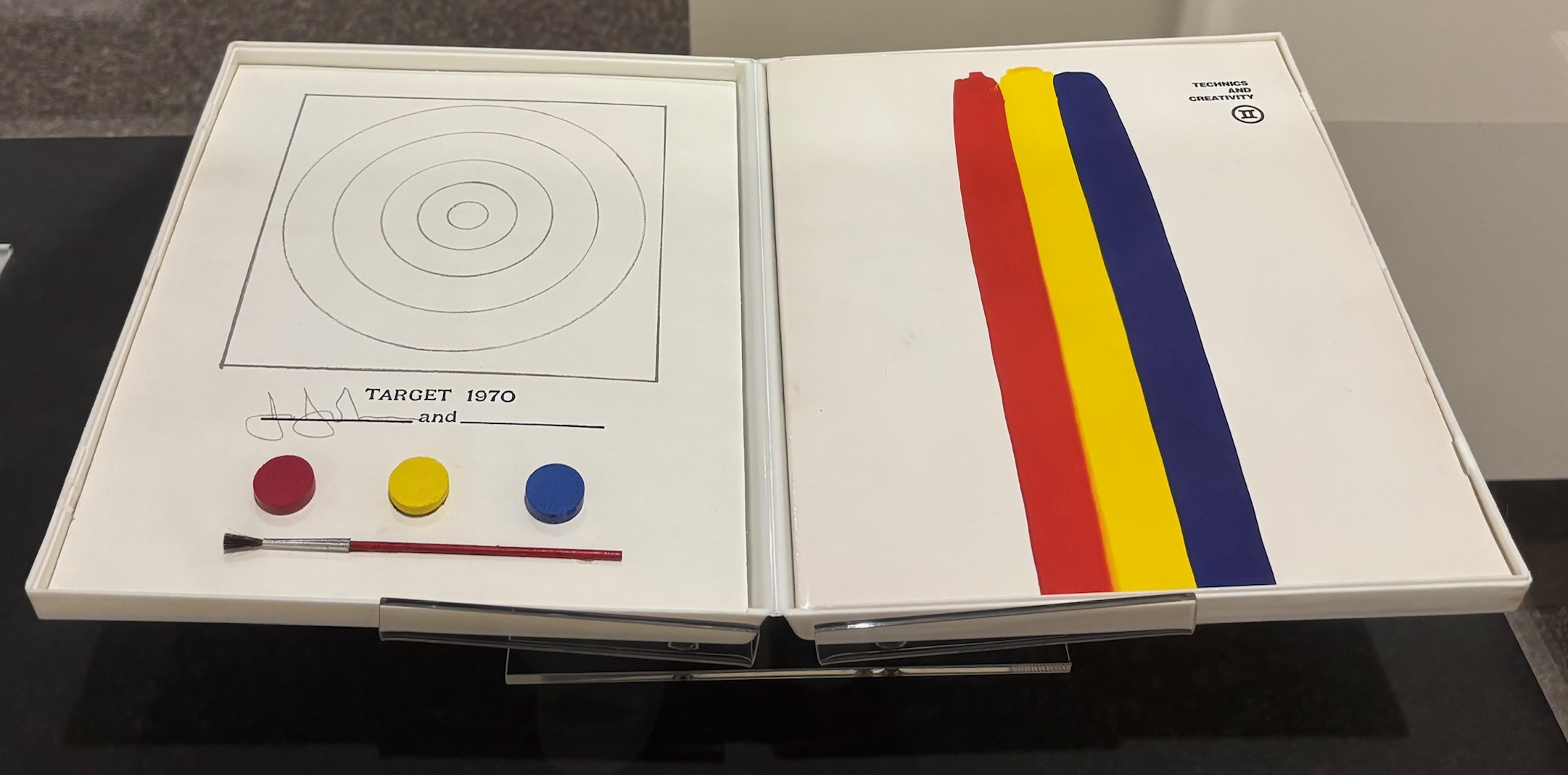
The letter is from the USC Libraries collection as are some other items in the show. Much of the art is come from the museum collection, a few from other museums and many loaned by the artists, their families, and individuals, including other artists also in the exhibition. The exhibition organizers, museum director Lana Burgess and Susan Felleman, an art history professor, with assistance from students in a museum studies class, have done a remarkable job in bringing together work from many sources.
There show includes several students from the 1950s like J. Bardin, who was an important artist, educator and arts leader in the area, and others like Sigmund Abeles, who left South Carolina, but maintained connections.
The second half of the exhibition grows busier as the art department—and art programs nationwide—expanded rapidly. The arrival of faculty from across the country brought new ideas and exposure to the latest artistic movements. Many of these artists served the department for decades, leaving an influence that still resonates today.

Among them were Philip Mullen, James Edwards, Roy Drasites, Jim Steven, Boyd Saunders, and others—all represented here by strong and varied works. Notable students from this period include Clark Ellefson, a respected furniture designer, builder, and key figure in Columbia’s arts and downtown revitalization; and Tarleton Blackwell, whose powerful paintings use animal imagery to explore social and political themes. Also featured is Ronald Jones, a less familiar name locally but an internationally recognized artist, writer, curator, and educator.
From this time period though, Nell Lafaye is the only long-serving female faculty member in the exhibition. And nothing by Virginia Scotchie, one of the most important and influential artists and teachers the department ever had. Also missing is Deanna Leamon who was a faculty member for decades and an artist with a career outside the university. Maybe they declined taking part.
And as mentioned at the start, women overall are woefully underrepresented in both exhibitions.
Another odd thing is the show includes several artists who taught for only a year or two .
Like any big exhibition spanning many decades (for example: “From the Vault: South Carolina Art from the Museum’s Collection” at the S.C. State Museum), there is too much of some and not enough of others. That’s understandable, but leaving out someone like Scotchie and having so few women is inexcusable and actually insulting.
The companion “Intersections” is also a significant show.
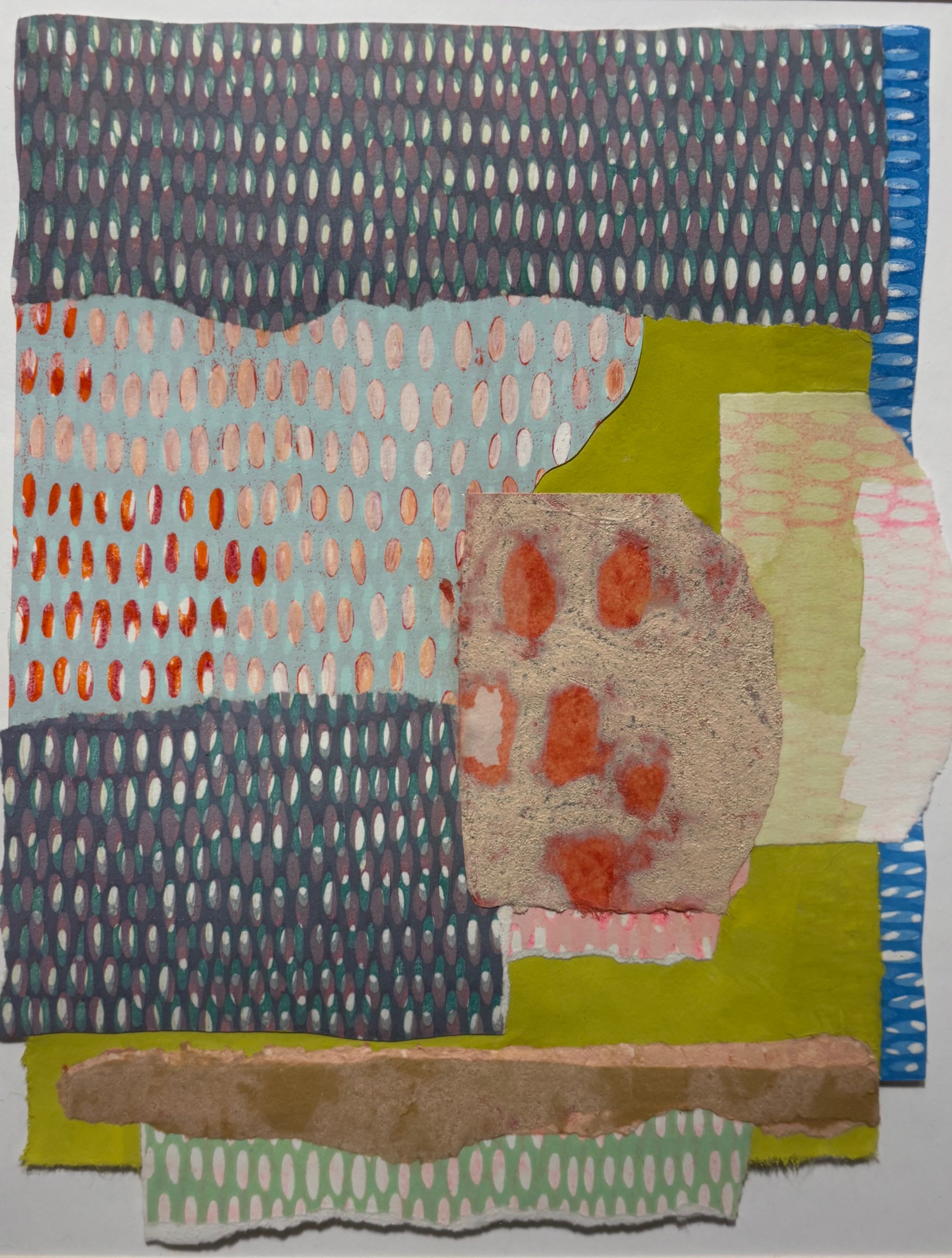
It’s especially good to see work by Chris Robinson and Mary Robinson (not related) here. But the standouts are the alumni; many have had and still have a huge impact on the state and beyond as artists, educators, gallery directors and more (some of them now retired): Tom Stanley, Jim Arendt, Michael Cassidy, Heidi Darr-Hope, Stephen Nevitt and Jane Nodine. (Along with his figurative fabric piece in the gallery, don’t miss Arendt’s giant portable display in the front yard of the art building.)
Again, choices have to be made, but there are a few pieces in here that are far below the quality of the majority. Still, it provides a good glance through a certain time with some outstanding work. Women don’t have much better representation in this show; 12 of the 38.
The exhibition is only up through Nov. 14, so don’t delay.
(I’m going to end this with what might sound like snark, but it is totally serious. If you are looking for a link to “Generations: 100 Years of Arts at the University of South Carolina” on the McKissick Museum website, do not waste your time. The museum is not updating its website. Nor will you find anything about it on the SVAD website, because the person who updates it has left and apparently there’s not another person in the school, College of Arts and Sciences, nor the vast communications office at the university capable of assisting the school or the museum. And also, neither the museum nor the gallery are open beyond 9 to 5 on weekdays. So why do I bother writing so much about exhibitions that the university doesn’t promote and makes so difficult to see? Because I think art programs at the university are important, I respect so many of these artists, and would like to share that with others. You’ll have to ask the university why it doesn’t care.)
State Museum gallery reopens with a finely-tuned sampling of South Carolina art
Oct. 7/2025
Recently, I attended the celebration of the S.C. State Museum Lipscomb Art Gallery reopening, but rather than studying the art and exhibition I was mostly catching up with people. (Although as I noted last week, not everyone I was hoping to see or many people in general).

I went back a few days ago to take a closer look at “From the Vault: South Carolina Art from the Museum’s Collection” that reopens the gallery after an 18-month closure for lighting, roof and HVAC work. The wide-ranging exhibition is made up of 145 works by 85 artists, most from the 20th century. All the artists have strong and long connections to the state even if they are originally from or live elsewhere.
Overall, this exhibition does the job. The show has only a few text panels covering broad topics (Contemporary Art, Pottery and so on) and some areas could use more of a con(text). The info panels on each artist are quite good and thorough without going on too long. Considering how many works are in the show, it’s quite manageable to take in and appreciate.
Mid-20th century groundbreaking artists are well represented with a strong showing by those who arrived in South Carolina to teach in the emerging art departments like Edmund Yaghjian at the University of South Carolina and Carl Blair at Bob Jones University. There’s also an excellent sampling of the homegrown, like Elizabeth Verner, and migrating artists, Alfred Hutty, key figures in launching the Charleston Renaissance in the 1920s.
Then there are those who were a bridge between the two, such as Charleston couple William Halsey and Corrie McCallum. From there, we jump to another wall for a painting by Brian Rutenberg, one of Halsey’s last students at the College of Charleston.

Another nice touch is connecting device is showing Ed Yaghjiahn’s painting with one by his son David, and a large, multicolored textile piece by Louise Halsey adjacent to art by her parents Corrie McCallum and William Halsey.
Throughout this section of the gallery, the exhibition design creates an interchange among the artworks; this is true even if you don’t know the literal connections among the artists.
Maia Payne, associate curator of art, and Paul Matheny, chief curator and director of curatorial affairs, have done an extraordinary job of creating a conversation among the art. They make it happen throughout the gallery, such as juxtaposing works by the state’s best known artist exports — Jasper Johns and Shepard Fairey.
The museum has long collected traditional folk art and art by outsider or visionary artists and the exhibition contains a good number of them.

The most striking, and a highlight of the exhibition, is “City Within a City” by L.C. Carson. In a swampy area his Orangeburg property, Carson fashioned miniatures of Greek and Roman buildings, along with famous churches and his own creations. The museum has recreated the original feel of the city with an installation of about a dozen pieces set against a large photo backdrop of their original Orangeburg setting. This may be the first time so many of his works have been shown at the museum, especially like this. Here’s more information about the little city and how it came to the museum.
Ceramics range from functional jugs and jars, to large installations. Among them are a pot by David Drake, an enslaved potter who wrote poetry on some of his wares, and the contemporary interpretation of the face jug by Peter Lenzo, including some of the final pieces he made before his recent death. One large case is dedicated to sweetgrass baskets from the Lowcountry, with a mix of contemporary masterworks by Mary Jackson, Janie Mazick and Mary Jane Bennet, along with older pieces by unknown artisans.
Only a small sampling of pre-20th century works, some furniture and portraits, are part of the exhibition. The furniture and the large number of functional ceramics in the exhibition surrender too much space to historical works that can be found in parts of the museum that haven’t been closed for almost two years.
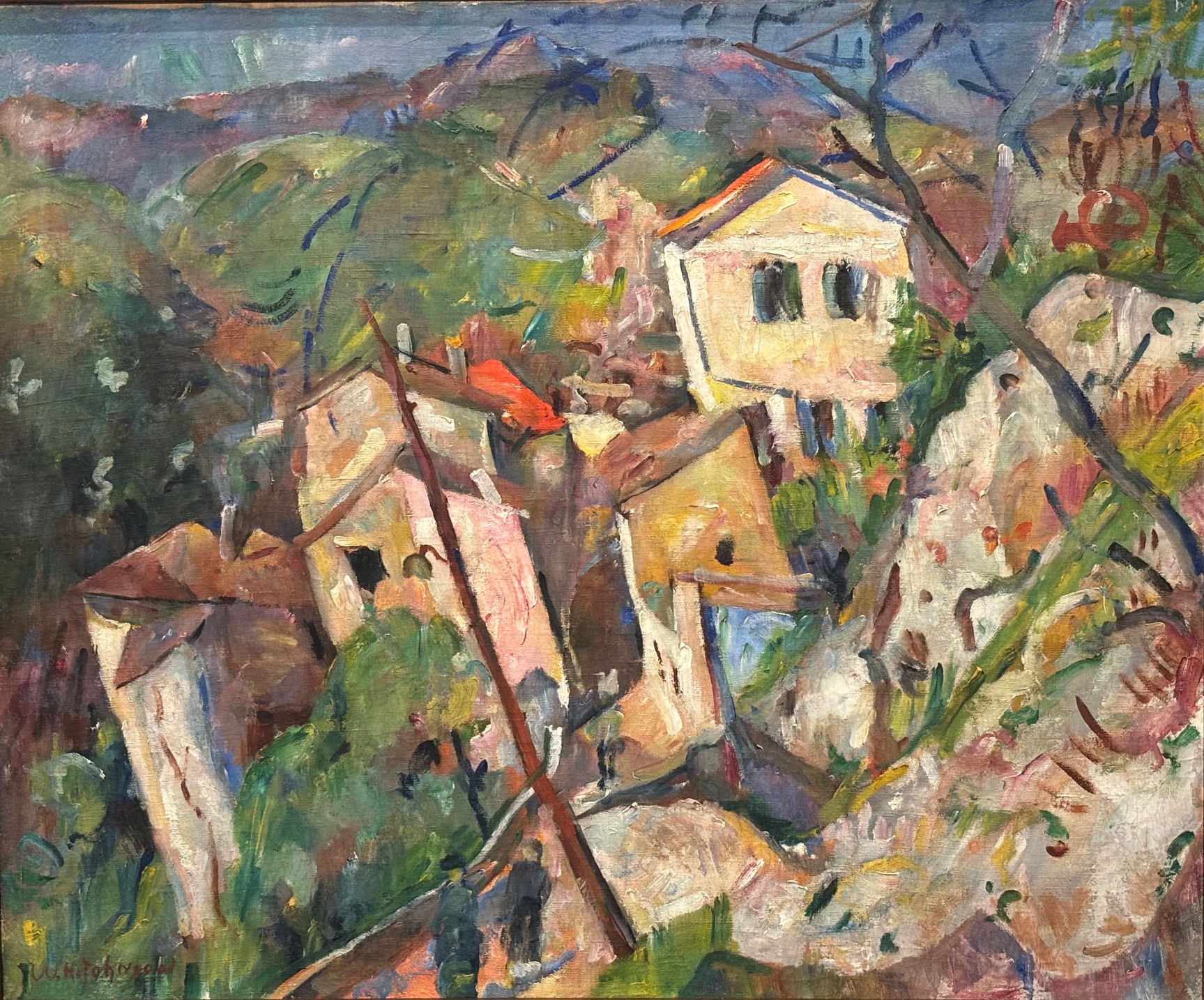
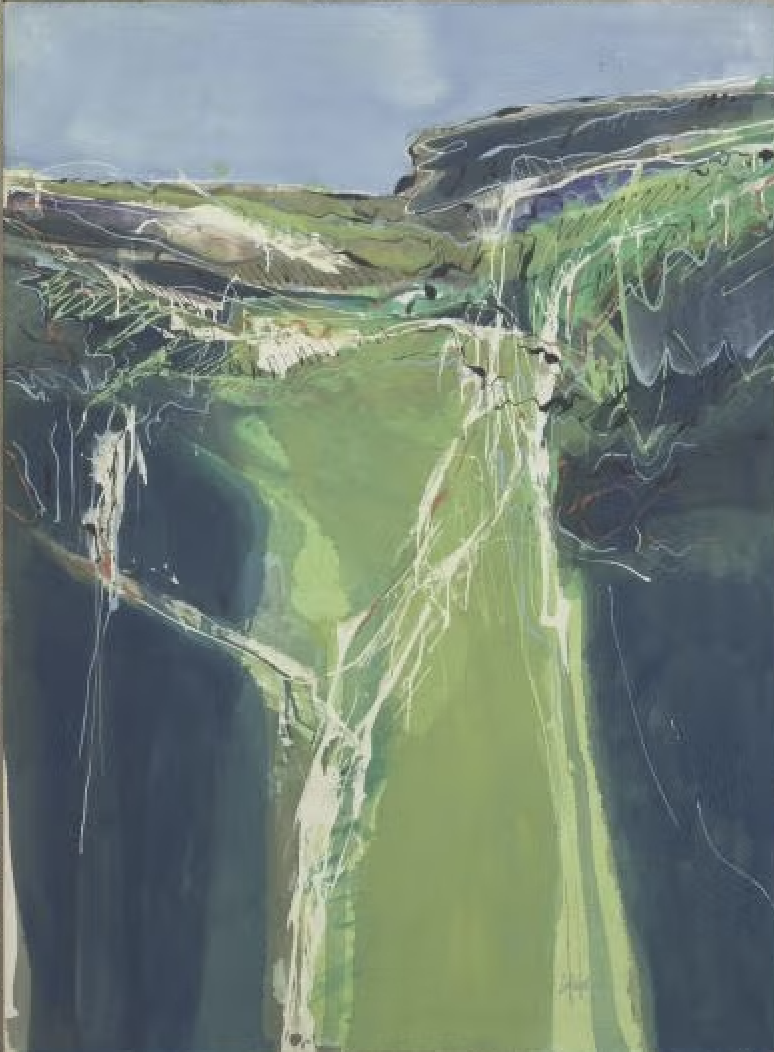
Scattered throughout the exhibition are quite a few gems that don’t fit neatly anywhere (or that grabbed me anyway): a 1930 Paul Cezanne-inspired painting of a French town by William H. Johnson; Tisra-Til, a 1974 hard edge geometric work by Tom Diamond; and Anderean, a abstract landscape by Nell Lafaye done in 1974 (left to right in image)

An added bonus is a slide show in the hallway leading to the gallery of many of the older or deceased artists These black and white photos (projected very large) were taken by Robert Smeltzer for the 1970s book Contemporary Artists of South Carolina. (A long overdue followup book titled At This Moment: Portraits of South Carolina Artists will hit the shelves soon. I’ll write more about that soon.)
Being familiar with the museum’s art collection and many of the artists in it, there are works and artists I wish were included. I’m sure others feel the same, including the curators, but they can’t show everything.
On a more personal note, I’m been fortunate to be familiar with much of this art and to know or have known many of the artists. Seeing this art, much for the first time in well over a decade, is a very personal and often emotional experience for me. But even if you’ve not been as lucky as I, this art and the way it is shown offers a fantastic experience for anyone.
Where is everyone? Turnout at these statewide celebrations is so disappointing
Sept. 30/2025
The other morning I was talking to someone about the S.C. State Museum art gallery reopening that had happened the night before. Both of us were taken aback by how few people turned out for that event and shared similar observations about the opening of the S.C. Biennial at the 701 Center for Contemporary Art in August. I felt a bit relieved that I wasn’t alone in my thoughts and that the person I shared views with is probably 40 years my junior.

I’m not sure what’s going on– do people just not care, are the organizations failing to get the word out, is it that the media ignored them (maybe because the organizations didn’t do a good job publicizing), overlapping events, or what? In the days leading up to the museum gallery reopening, I talked to a number of people at art and most didn’t even know about it.
Overall interest in the Center for Contemporary Art and the Biennial specifically, by artists and art viewers, seems to have fallen off (see my Sept. 2 review below where I address that). And it’s no secret that the State Museum’s role in a statewide art conversation began diminishing many years ago as other projects took more museum resources and the museum decided to not do as much art programming.
Still, I was let down by the sparse crowd at the reopening of the State Museum art gallery with the exhibition “From the Vault: South Carolina Art From the Museum’s Collection.” The gallery has been closed for over two years and the new exhibition is made up of about 100 works of all sorts covering several hundred years, many that have never been show before or have been under wraps for many years. I can’t wait to go back a few times to really explore it.
Turnout at an opening isn’t a measure of a show’s success or how many people will see it during its run. But both the state museum show and the Biennial are not just any old exhibition; they are celebrations of art and artists around the state and a place and time for artists and art lovers from all over to come together.
One reason for poor turnout is obvious. Why have a statewide celebration on a Thursday night in Columbia when this event is for and about entire state. (Same for the Biennial at the CCA.) The state museum also had a couple of panels connected to the show and art collection on Friday morning. Same problem. (There were people at that from around the state, but nearly all of them were people who work in the arts.) The Center for Contemporary Art is finally having a panel discussion with artists in the Biennial this Wednesday night. How many people will be able to come to that from outside of Columbia?
If these organizations want decent attendance, if they want to be truly accessible, and if they’re interested in making a contribution to the state’s art conversation, they need to locate Saturday on their calendars. (We already have a huge issue with college and university galleries, and even one university museum, not being open on weekends.)
While I’m disappointed in the organizations, I also wonder what’s up with the supposedly art interested public (that includes artists.) At many Columbia-centric art events I see the same people often, which is great; they’re supporting the locals. But when it’s something that doesn’t directly involve them or those they know, where are they?
I don’t know what kind of a job the museum did on getting the word out. (Waiting for responses from them.) I don’t recall seeing anything substantial in local or statewide media about the exhibition. Same for the Biennial, although Free Times did a review. I should probably credit myself in that I wrote about the exhibitions in advance, did social media posting about them, and reviewed the Biennial. (I didn’t have great success in getting complete info on either of these shows.)
The arts community in the state has changed and grown so much. It was once closely knit and an exhibition bringing together artists from around the state was exciting and really brought the art community together. Now the three South Carolina cities have large and diverse art communities, many of which rarely interact with one another, let alone with those in other cities. The lack of interest in two wide ranging, statewide exhibitions reveals how the state’s art environment has simultaneously expanded and contracted.
In conclusion ….
Go see “From the Vault: South Carolina Art From the Museum’s Collection.” It’s pretty amazing and this coming Sunday, Oct. 5, admission is only $1. Join me for an unauthorized tour? The show is up through the middle of next summer. The first half of the Biennial wraps up Oct. 5; there’s a panel discussion with several of the artists Oct. 1.
One Columbia doesn’t put on the best face for local art
On the other disappointing front was local arts organization One Columbia celebrating its move to the Ensor Keenan House. Fantastic building, grounds and turnout. But what was served up at the grand opening was less than celebratory. Yes there was a very good turnout. In one room was a lovely ceramics show “The Forgotten Garden: Imagined Blossoms for a Memory Fading” by Caroline Clark in one room. But other than that, this wasn’t exactly a showcase for Columbia arts. A pop band was playing generic playing pop songs and making conversations tough. Don’t we have some great musicians of all sorts in town? In another room with drawings and paintings propped up or laid flat on tables and drawing benches, with titles and prices on post it notes. That was about it.
I know it’s difficult to make a big move and organize a housewarming party (after a year here, I’ve still not done that). But this event didn’t do much to celebrate and promote the excellence of the arts in Columbia.
I hate to be such a downer about all this, but I’m just disappointed. Still I am excited about taking an in-depth look at the State Museum show, seeing the second half of the Biennial starting Nov. 13, and am looking forward to the great things One Columbia will eventually do with its fantastic new home.
A very full September for the arts
Sept. 15/2025
Fall is officially here, which means a lot is happening (although summer seemed quite busy to me.) This is more of a what’s coming up write up than I usually do, but feels like it is needed.
Plenty of music
First up, the Southern Exposure new music series kicks off Friday with Splinter Reeds, a reed quintet. I’m thrilled they’ll be here as I saw them several times when I lived in California (2014 – 2024). I also heard bass clarinetist Jeff Aderlie and oboist Kyle Bruckman, based in the SF Bay Area perform with others there. Bruckman also taught at my place of employment, the University of California, Davis, so I saw him often. Great player and nice guy.

Founded in 2013, Splinter Reeds has collaborated with many important composers who have written about 100 pieces written for the ensemble.
“I’ve been wanting to get Splinter here for a number of years, and it’s finally worked out,” said Mike Harley, Southern Exposure director and professor.
The group will play create. process by Mario Godoy; Exercices by Cara Haxo; Firing Squad by Niloufar Nourbakhsh; appendages by Aaron Mencher; LEAD/LEAD by Stefan Freund; and Antenna Studies by Paula Matthusen. Splinter Reeds’ most recent recording, including Antenna Studies, was released last August.
Harley has direct connections with members of the group and one of the composers. He and Splinter Reeds clarinetist Bill Kalinkos attended the Eastman School of Music together and are both in the group Alarm Will Sound. The group’s bassoonist Dana Jessen and Harley, also a bassoonist, have performed together many times. LEAD/LEAD composer Stefan Freund will be at the concert; a cellist, he is also a member of Alarm Will Sound.
The rest of the series:
- Nov. 14 – USC music faculty Greg Stuart and David Kirkland Garner lead a cadre of students in scenes from Robert Ashley’s 1980s opera Perfect Lives.
- Jan. 30, 2026 – Violist Nadia Sirota and cellist Gabriel Cabezas play Donnacha Dennehy’s epic Tessellatum that has pre-recorded viola and 11 microtonally-tuned viols and a projected animation.
- March 20, 2026 – An all-female vocal new music group, including USC faculty member Rachel Calloway will give a concert centered around John Zorn’s The Holy Visions.
This is looking like a USC School of Music sponsored story, but the school offers so much that is so good. So, no apologies for that.
The USC Wind Ensemble’s Sept. 21 concert titled “Rites and Renewal” will be conducted by Morihiko Nakahara, long-time music director of the S.C. Philharmonic. The adventuresome sounding program: Cool Cat by Arnold Schoenberg; Secret Rites by Akira Miyoshi; Re(new)al by Viet Cuong; Mysterium by Jennifer Higdon; and Music for Prague 1968 by Karel Husa. The last is about the Soviet military crushing the “Prague Spring” uprising, which seems particularly appropriate with military on U.S. city streets these days.
The USC Symphony Orchestra kicks off its season Sept. 25 with Florence Price’s Violin Concerto No. 1 featuring soloist Melissa White and Antonín Dvořák’s Symphony No. 8.
The S.C. Philharmonic’s Chamber Crawl lands at the War Mouth restaurant this Sunday, Sept. 21. These informal concerts at local bars and restaurants continue all the way through next August (then, I suppose, they start again.)
The more underground new music scene here has an active September.
Guitarist Tashi Dorji and drummer Chris Corsano on Sept. 22; cellist Daniel Levin and percussionist Mike Pride on Sept. 28; and Kevin Murray, saxophone and percussion, and Will Greene, sax and guitar, Sept. 30. The concerts are at the Cola Jazz venue in Five Points. More (not really) info.
Recently opened or soon to start art exhibitions
“Generations: 100 Years of Arts at the University of South Carolina” is made up of work by 50 or so former faculty and alumni of the School of Visual Art and Design (formerly the Department of Art). The exhibition at the McKissick Museum includes historical items and photos.
Among the artists is the first person to receive an art degree from USC: Catharine Rembert. Rembert graduated in 1927, then taught there from 1930 to 1967. Among her students were Jasper Johns, Blue Sky, J. Bardin, Aldwyth, and Sigmund Abeles, all of whom are in the exhibition. Other faculty represented are Edmund Yaghjian, John Benz and John O’Neil, longtime department chairs, and alums Clark Ellefson, Tarleton Blackwell, Wade Sellers and many, many others.
It is up through Dec. 5.
“…and this stays between us, right?” by Taylor Colimore and Noren Gelberg-Hagmaier (cyber//chiffon Artist Collective) is at the School of Visual Art and Design gallery until Sept. 19.
I’d provide links to these exhibitions, but SVAD and McKissick say they don’t have the resources to update websites, so nothing there. The gallery site has only the exhibition title and I challenge you to find even that. It’s a sad state of affairs.
“Art of Being: Visible” with a wide range of work by 16 artists opens at the Richland Library main branch Friday. This exhibition marks the third edition of the “Art of Being Series’ celebrating the work of artists who explore identity, resilience, and the fundamental human need for recognition and belonging. If you don’t know it already, the library has been doing excellent exhibitions.
Benedict College’s Ponder Art Gallery “Rooted in Community” has work by internationally celebrated artists Samella Lewis, Benny Andrews, Sam Middleton and others with works by more local artists. Through Oct. 3. There’s a talk with some of the artists Sept. 25 at 6.
“Queens and Monsters,” a solo exhibition by Melissa Wilkinson opens Sept. 19 at the Columbia College Goodall Gallery. Her art explores themes of identity, gender and mythology through layered ink wash portraits.
And on the theatre stages
“The Seeing Place” is a new play by USC Theatre and Dance department faculty member Lauren Wilson, a ghost story set in and performed in USC’s Longstreet Theatre. The modern, in-the-round theatre, is in an 1855 structure once used as a Civil War hospital and morgue and rumored to be haunted. In the play the theatre is long abandoned and in a “state of disrepair” due to budget cuts. Students sneak in to stage “Hamlet.”
When I was there last the theatre was in an advanced state of disrepair. Since then, the tattered seats have been replaced. Not sure about the filthy carpets.
It runs Sept. 26 – Oct. 5.
William Shakespeare’s bloody Titus Andronicus by the S.C. Shakespeare Company will be performed for free at Earlewood Park Sept. 25, 26 and 28, and Oct. 1 – 4.
A celebration of all the arts in a historic house
And finally, the umbrella arts organization One Columbia will have a celebration of its move to the Ensor Keenen House. The event is Sept. 24 from 5:30 – 8 p.m. You’ll get to see a show by area artists, take a tour of the circa 1868 house, hear some music and meet people involved in the organization and others interested in the arts. The house, part of the City of Columbia Parks and Recreation department, is at 801 Wildwood Ave. (My neighborhood!)
Michala Brown’s new large installation and a batch of older works create a whole
Sept. 9/2025
Michaela Pilar Brown, artist of many forms, director of Mike Brown Contemporary, Joan Mitchell Fellow and all around arts leader, has a large and stunning show titled “To Hell You Preach” at the Redux Contemporary Art Center in Charleston.
The exhibition, running through Oct. 11, has a dozen 2D works — photos, collage, drawings and a mash up of all those — that surround a large installation that takes over much of the main gallery. Titled Death Letter, the installation shares its name with a song by blues legend Son House.

Several upturned church pews thrown around as by a storm with text chalked on their blue upholstery serve as a central element of the work. A wide ribbon of dark gray fabric sails upward from the piles of pews, evoking both the destructive force that upended the pews and the rise of a soul, dark or otherwise.
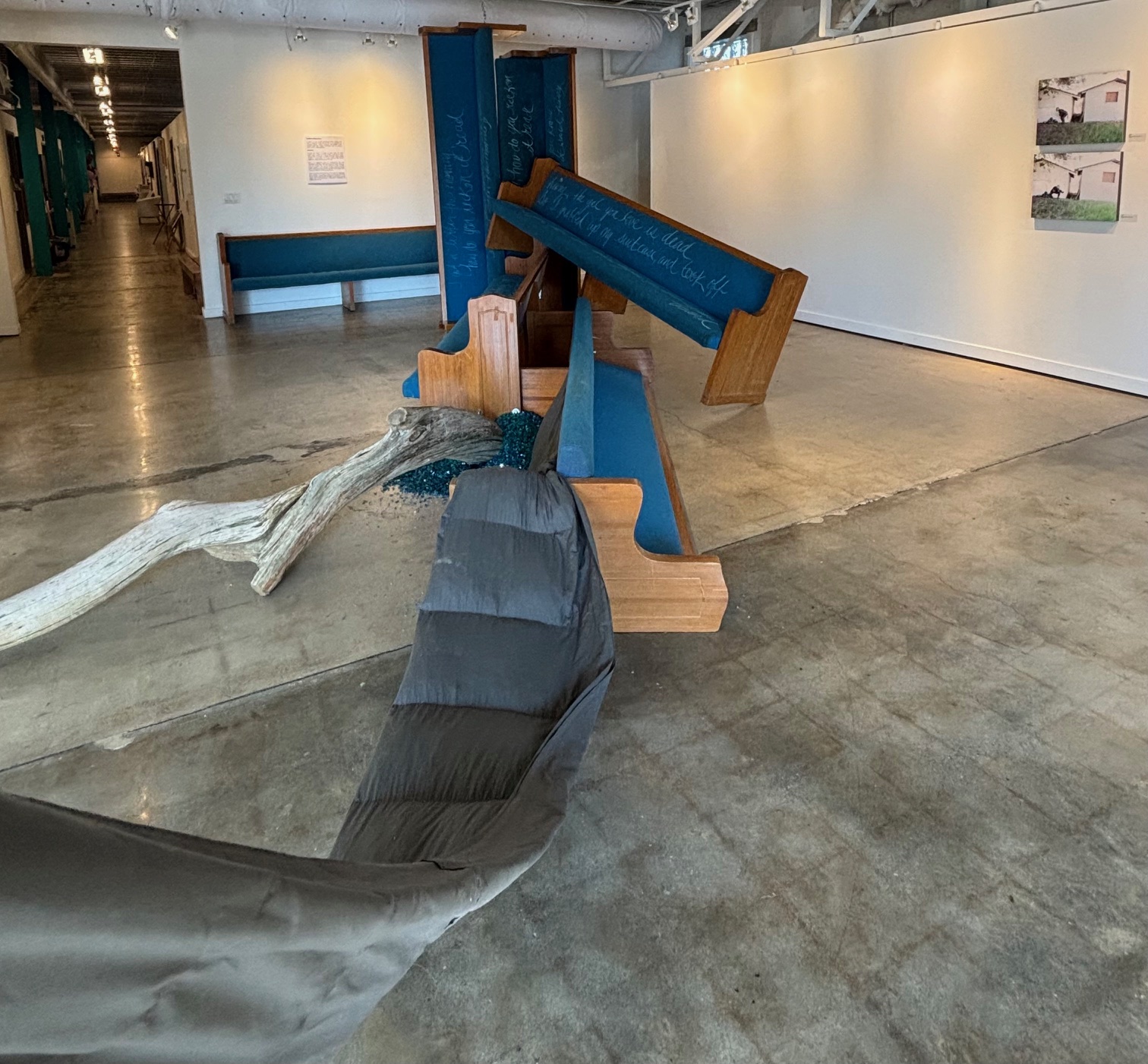
Reaching out from the pews is a large limb, sun bleached gray like the fabric. It connects to several cut granite stones, a pile of what looks like broken blue glass and another limb, this one honey-colored with dark striations that bends skyward. Set somewhat separated by a wall is another element of suspended limbs, with gray balls and a bundle of deer antlers suspended by chains. On the floor here is a mound of shiny black glass pieces.
Overall, Death Letter shows us both sides of death, the route there and after. The storm and destruction, the dark and light escape, the heaviness and age of the objects, contradicted in that they are also floating above the earth. It is a site of precariously balanced disarray, that threatens to fly apart, fly away or come crashing down. Is it about spiritual uplift or the end of any notion of the spirit?
Other elements of the exhibition are displayed on the gallery walls, but feel very much a part of Death Letter. A photo of the artist looking up peers over the pews as we peer of them. It gives a whole other, disorienting dimension to Death Letter.

While Death Letter is new, the 2D pieces in the show are all from a few years back. These include a number of images related to Brown’s performances in which she covered herself in white ashes/makeup and engages in ritualistic movements. Other are elaborate but poetically spare collages with images that overlap, at times one element can be seen through another.
Along with creating a brand-new powerful installation, “To Hell You Preach” provides a good look at Brown’s work over the years especially for those who aren’t familiar with her art and all the parts work together.
SC Biennial: survey of state’s art needs a refresh
Sept. 2/2025
I haven’t written much in the past few weeks, being mostly caught up with what’s been going on and haven’t had the energy to take on some larger issues (aside from annoying people on social media and elsewhere.)
But August wrapped up with a bang.
In the past few days, I’ve seen the S.C. Biennial at the 701 Center for Contemporary Art, great exhibitions at the Halsey Institute of Contemporary Art at the College of Charleston, and Michaela Pilar Brown’s “To Hell You Preach” at the Redux Center for Contemporary Art in Charleston.
As I have a bit to say about all of them, I’ll just review the Biennial for now. But before that, a reminder to see the excellent “Together, Here: Work by South Carolina Educators” at the Goodall Gallery at Columbia College. There’s a closing event Thursday, Sept. 4 at 6 and the exhibition runs through Sept. 10. (More info and comments about on it my previous post of Aug. 14 below.)
The S.C. Biennial was launched by the Center for Contemporary Art in 2011 to fill the gap left when the S.C. State Museum and the S.C. Arts Commission killed off the S.C. Triennial which had been held from 1992 to 2004. The show is in two parts, each with a dozen artists. Part One runs through Oct. 5; Part Two Nov. 6– Dec 21.
Part One has a decent sampling of artists from around the state, few of whom I’m familiar with. (I was living elsewhere from 2014 – 2024, so I’ve missed most Biennials and the arrival of many artists onto the state’s scene.)
There’s also a good variety of mediums, some paintings, some paintings that have been messed with, sculptures, some of which are more like installations, a few photos, and a couple of pieces that include a video component. It’s a mix of more adventuresome with more traditional, some excellent in content and execution, some not so much.
Brooks Harris Stevens’ works are standouts.
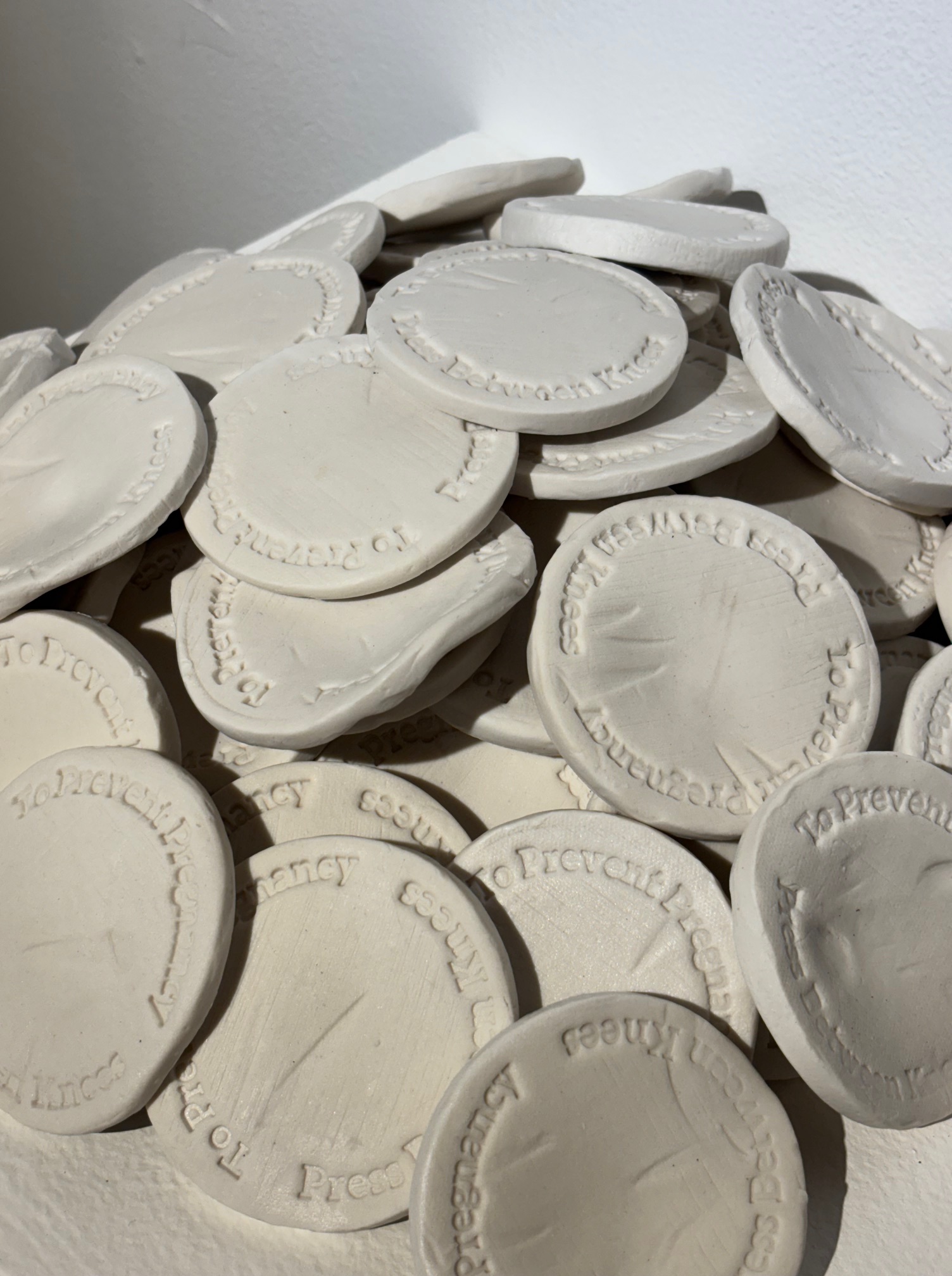
In Porch Talk a video shows the artist repeatedly place a small ceramic disc between her knees and hold it. On an adjacent pedestal is a pile of these discs, each embossed with the words “To Prevent Pregnancy Press Between Knees.” This sounds like advice ill-informed parents, teachers and Sunday school lessons gave young women in the distant past. Not long ago this work’s commentary would have felt outdated, but as women’s rights are rolled back in this country it’s relevant again.
Her sculpture/installation in the center of the gallery, The Set Up (Run, Hide & Fight), is a quilt-like pup tent with dun colored plastic toy soldiers attached to the outside, sheltering a mound of green soldiers who spill out across the gallery floor. It appears to make a broad anti-war statement, but does so in an effective and interesting way.
Several artists explore place and space.
Morgan Kinne’s boxes, stacked about 12-feet high, are painted with images of small traditional rural dwellings and Lowcountry landscapes. Her other work is a grouping of cardboard structures, exaggerated in shape and painted white.

Kate Horray Osmund’s paintings have ghostly buildings coming together and floating apart, with figure silhouettes moving through open areas. What look like solid lines of subtle colors dissolve and resolve, interrupted by sections of washy paint, splatters and drips.
Jenny Bonner’s paintings are of places taken apart and put back together, using not just paint, but collage elements, such as colored mylar, sometimes sewed to the canvas.
Michael Cassidy’s paintings of animals capture them out of context and in unexpected pinks and light blue. They emerge from a fog, but are also sheltered in its softness. They look vulnerable and in the case of a fawn, bring to mind the saying “like a deer caught in the headlights” which emphasizes their fragility. Surfaces have a soft consistent tone, but a close look reveals much texture that creates a glow and shimmering movement.

Having seen many of Keith Tolen’s paintings during the past year, his three works in this show are among his best. In most of his paintings drawn faces and figures emerge from a sea of small multicolored dots. That’s the case with two of these (one created and displayed diagonally), but one instead has a large blob of color floating atop the field of dots.
Kevin Kao offers up fun and funky sculptures. One looks like an upside-down tornado or the undulating tail of a creature. Upon closer inspection there’s a human face at floor level. The other is composed of several bright yellow phallic forms each topped with a bit of fluffy fiber. The center made the wise decision to place the piece beneath a vent so the hair is always blowing in the wind.
Drew Sisk’sPangrams from the Colossal Clean Crawled Corpus is, to quote the artist, “a multimedia installation that examines artificial intelligence and the implications of these technologies on contemporary visual culture.” It consists of a grouping of floor and wall mounted translucent green panels with text and a camera that captures an image of viewers and transforms it. There a great deal of text, that contains anagrams, in a typeface created with artificial intelligence.
It is difficult, especially after seeing only Part One, to gauge how well the Biennial represents the art, let alone the best art, in the state. The three jurors for this show can only pick from the artists who have submitted and this year only 60 did (down from 100 or more in the past) which means nearly half the artists who entered got in.
The profile and stature of the show has shrunk considerably. That’s due in part what’s been going on at the Center for Contemporary Art. During the last year it had only a part time director, the previous year had no director, and lost one of its founders, Wim Roefs, in 2022. It’s likely the Biennial has also been impacted by Art Fields, with its big budget and high profile. I’ve found, especially in talking to those outside of Columbia, that the Biennial isn’t on their radar.
There has been scant information about the show and the artists. On the CCA website, there’s not even info about where the artists are from let alone bios, and images of only nine of the 12 artists’ work, none of which are identified by maker or title. (Look at my last posting below from Aug. 14, for a list of artists and where they are from as well as juror bios.) A juror’s statement was finally posted more than a week after the show opened. There is no programming scheduled. Still, the center has been doing excellent social media postings focusing on each artist.
I’m glad CCA does the Biennial, but, like Art Fields, it needs a recharge and a refresh. I’m looking forward to seeing Part Two and hoping for better in 2027.
South Carolina art and artists take center stage this fall
Aug. 14/2025
This is shaping up to be a very full fall for South Carolina art with several big exhibitions.
- two of the four shows include 35 South Carolina artists working now
- another has 15 artists, including major figures of the later 20th century, as well as others still quite active
- one will have 50 or more artists from throughout the state’s history
The S.C. Biennial, is a survey of South Carolina contemporary art drawn from works submitted. This is the eighth Biennial, but I’ve missed most as I was living elsewhere, so I have a lot of catching up to do. That’s made doubly apparent by the list of artists taking part, most of whom I’ve never heard of. The show at the 701 Center for Contemporary Art rolls out in two parts with 12 artists each. The first opens Aug. 21.

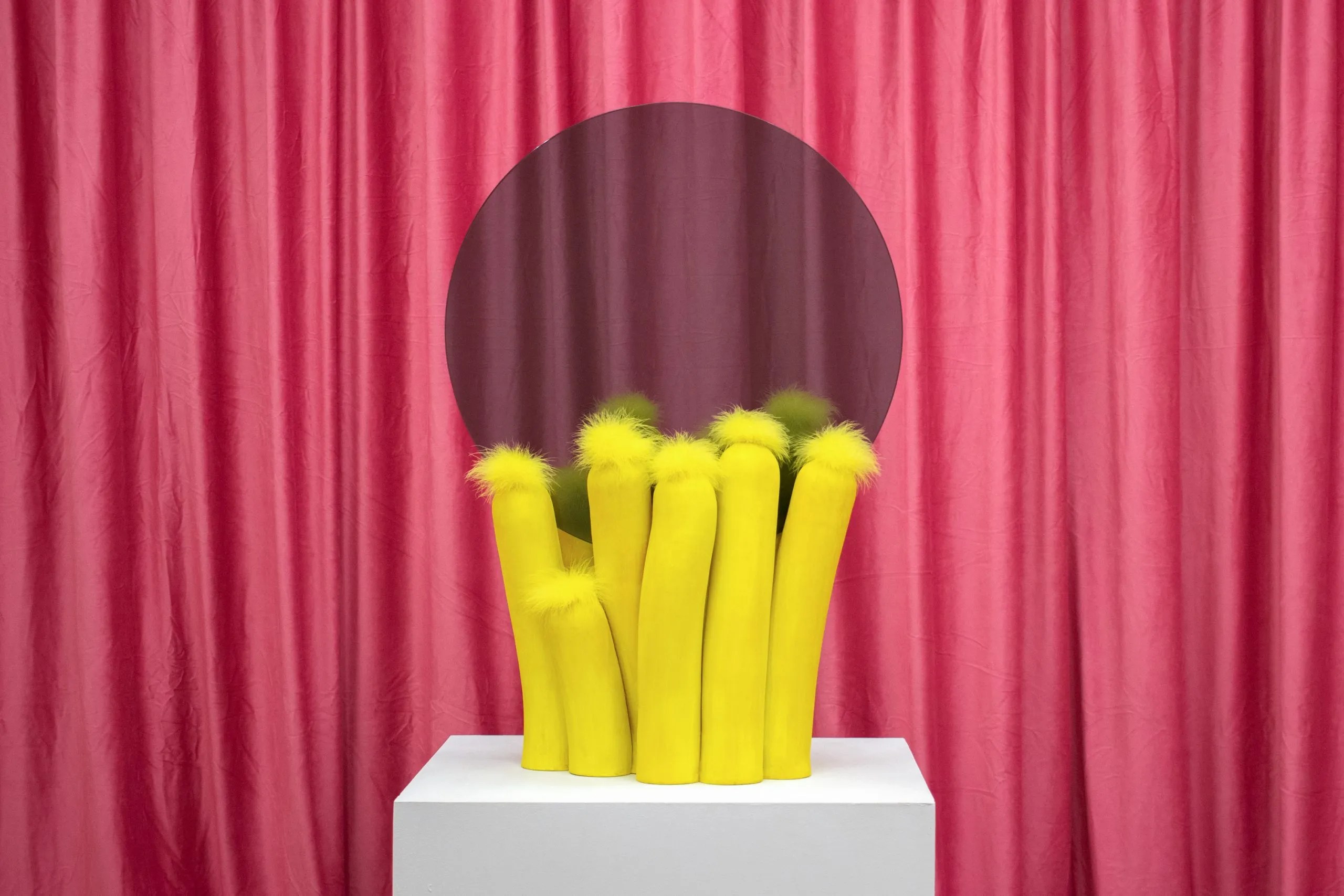

Work by (from left) Jenny Bonner, Kevin Kao and Flavia Lovatelli.
The artists in part one are: Dylan Bannister, Rock Hill; Jenny Bonner, Spartanburg; Colleen Cannon-Karlos, Columbia; Michael Cassidy, West Columbia; Brooks Harris Stevens, Pendleton; Kevin Kao, Greenville; Morgan Kinne, North Charleston; Flavia Lovatelli, Columbia; Kate Hooray Osmond, Charleston; Drew Sisk, Clemson; Keith Tolen, Columbia; and Nathalie Watson, Summerville. Seems like a decent statewide representation.
According to Tabitha Ott, recently appointed executive director of the center after a year of being part time director, the artists are at various career stages.
“Some are fresh out of college,” she said, “But there are older more established artists as well.”
This year entries were down considerably, only 60 when usually there are 100. That’s probably due in part to the center being without a director for an entire year, having only a part time person for the last year, and the loss of Wim Roefs, one of the founders and leaders of the center, who died in 2022. It takes effort to encourage artists to submit to exhibitions like this which is one of their great shortcomings.
Biennial artists were selected by a three-person panel, which consists of one local person, one regional and one national: Sade Ayorinde, curator at the Columbia Museum of Art, who in her short time there has been making her presence felt; Floyd Hall, executive director of Atlanta Contemporary; and Deirdre Visser, a San Francisco writer, artist and curator.
Part One runs through Oct. 5. Keep an eye on the Center’s website and social media for programing that is still being finalized. Part Two opens Nov. 6.
S.C. State Museum art gallery reopening in September
The other really big SC arts news is the reopening of the S.C. State Museum Lipscomb Art Gallery at the end of September. The exhibition, titled “Homecoming,” will be made up of up to 100 works drawn from the museum’s extensive collection of South Carolina art spanning centuries. The gallery has been closed for a couple of years for upgrades to the building. I’ll write more about it when the museum has more details.
In the meantime get the Sept. 25 opening and an all-day event Sept. 26 celebrating the collection and the state’s artist with tours and talks on your calendars
A stunning surprise at Columbia College
I thought those two exhibitions would provide a nice package to highlight SC art, then a couple more popped up.

One is at Columbia College: Together, Here: Work by South Carolina Educators which recently opened at the Goodall Gallery. In it, you can see work by 10 artists who have influenced and encouraged many budding artists and who are, as this exhibition readily reveals, significant artists in their own right.
I was planning to simply mention the exhibition since it fit into the larger theme, then I saw it. It is a stellar show with incredible individual works by all the artist. The work is not only excellent and exciting, there are nearly 50 pieces which means that we get to see several works by most of the artists. There is a wide range of styles and content from landscape inspired paintings to clothing-like sculptures with human hair to print work, figurative paintings and works with political and social commentary, sometimes pointed, sometimes not. It’s fantastic to know that there are artists of this level teaching our children, but I’m thrilled to know about these artists as artists.
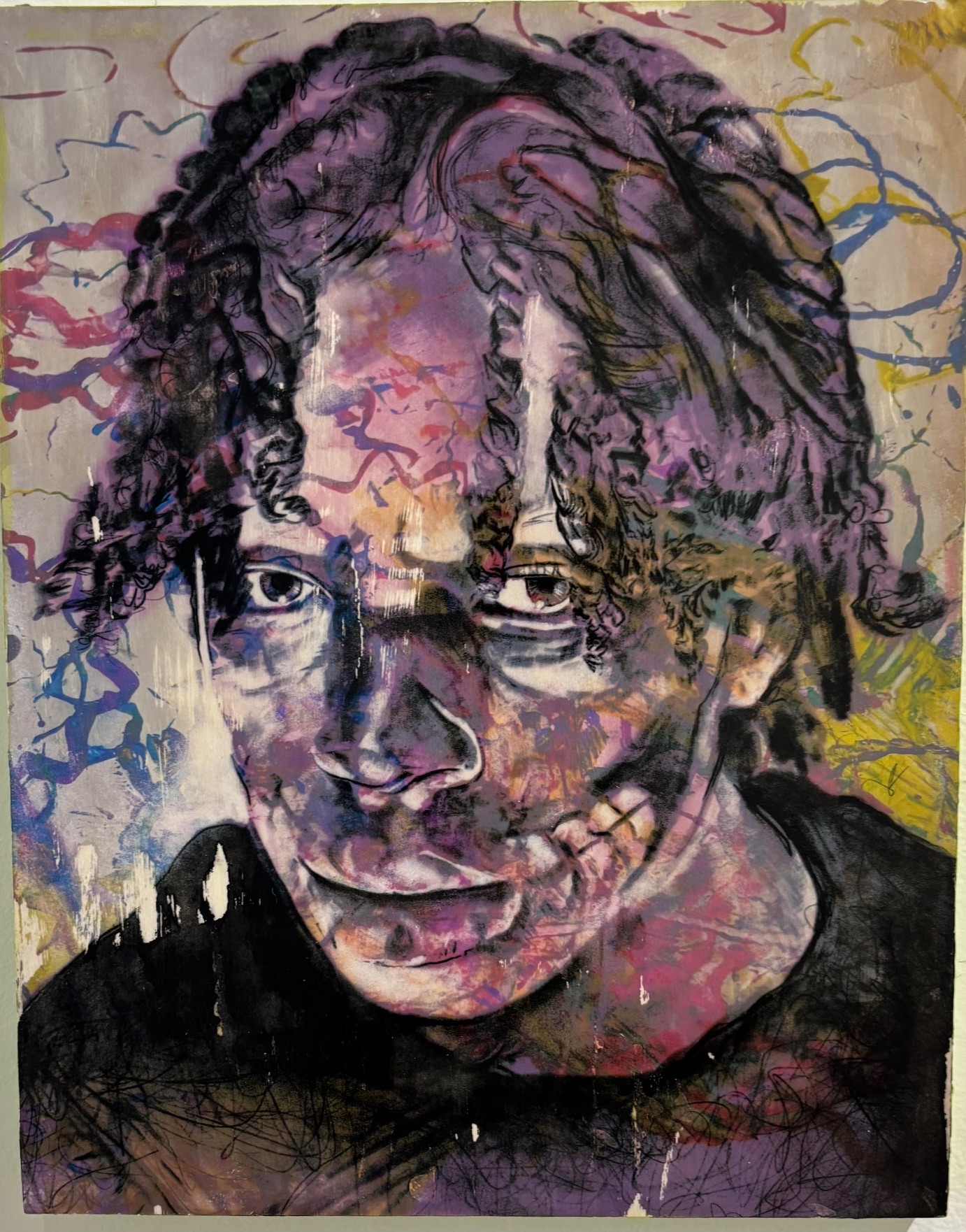
The exhibition was organized by Martin Lang, studio art program chair at the college, who recently learned the college had mounted art educator exhibitions for a decade and felt it worth revisiting.
“I see it as a great opportunity to connect with educators and schools and bring a new audience to campus and to our gallery,” Lang said. “I am interested in exposing our students to a range of creative paths for them to take after graduation, and this exhibition is a great example of one of those paths. I come from a family of art educators … am personally familiar with the challenges of maintaining an active studio practice as a professor and I believe that can be challenging in different ways with the demands of k-12 education.”

I’d add that in the case of this show, it’s a fantastic opportunity for all of us to see quite accomplished art.
The participating artists are: Jenny Bonner (who is also in the Biennial), Spartanburg Day School; Mark Brosseau, Greenville Senior High School; April Dauscha, Fine Arts Center, Greenville; Joshua Drews, Spring Valley High, Columbia; Lane Jordan, Ridge View High, Columbia; Katie Karban, Dorman High School Freshman Campus, Spartanburg; Ryan McClendon, Hyatt Park Elementary, Columbia; Kevin Morrissey, Fort Dorchester High, Summerville; Alyssa Reiser Prince, S.C. Governor’s School for Science & Mathematics, Hartsville; and Ian Welch, Estill Elementary and Hampton Intermediate, Hampton.
The show is only open through Sept. 10 and gallery hours are limited to weekdays from 10 to 5, but make the effort to see it. There will be a reception Sept. 4 from 6 to 8 that many of the artists are expected to attend. You can also contact the gallery to arrange visiting at other times.
Some greats from now and the past in Greenville
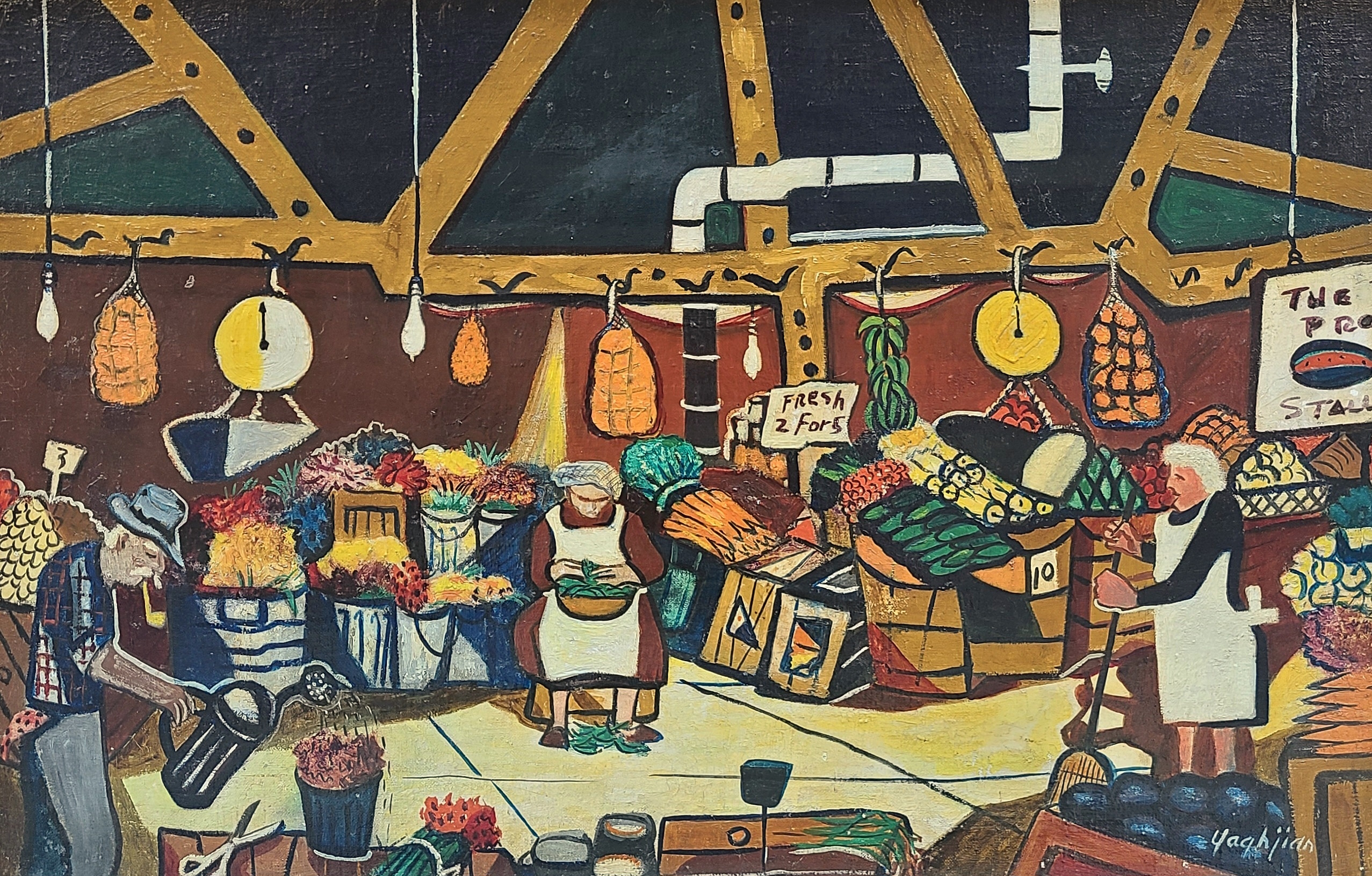
Hampton III Gallery, the longest operating gallery in the state, has a show by 17 artists, 15 from South Carolina, opening Aug. 15. The gallery just outside Greenville, has been showing the state’s progressive artists for decades when there were very few of them. This exhibition will include work by some of the artists long with the gallery along with newer additions. Some of the giants of contemporary art since the 1960s and earlier in the show will be the late William Halsey and Edmund Yaghjian, as well as Leo Twiggs, Ed Rice, Boyd Saunders and many others.
An opening reception takes place Friday, Aug. 15 from 6 – 9 and a curator tour and talk will be going on Sept. 1 at 11.
Lots of special sounds coming soon
July 23/2025
As some of you know, and many more don’t, Columbia has long had a thriving contemporary music scene. For years, decades actually, a few people have been organizing concerts in various locations and for a few years we even had a venue devoted to new music. And USC’s Southern Exposure series, started 20 years ago, put Columbia on the map nationally and is still going strong. The USC School of Music’s other concerts often also include newish music. (I wish I could find the big story I wrote about this years ago, but I can’t.)
Coming up are several concerts for those who have open ears or want their ears opened. (For full calendar but very little detail go to BigSound )

First up is Cheer-Accident, a rockish ensemble that has been around since ’86 and coming to Columbia for nearly as long. It’s been a long time since I’ve heard them, so I’ll share this description from Alternative Press: “Cheer-Accident meld difficult, angular rock with absurdist lunacy in intentionally disturbing ways that are just brilliant.”
The concert is at Transmission Arcade, 1712 Main St., at 8 p.m.

A couple days later, Aug. 2, Ahleuchatistas, according to that impeccable source Wikipedia, “is rooted in a wide variety of sonic influences and musical traditions. In addition to being an instrumental rock band, there are elements of noise, African music, ambient/drone, psychedelia, Chinese traditional music, garage rock, minimalism, classical music, and electronica.” The concert is at 8 at Godspeed Coffee, 711 Saluda Ave.
Just a couple more days wait, and you’ve got Toadal Package. I can’t find anything about the music, other than mostly it’s improvised, and there are toads involved in some way, which is a plus. That’s Aug. 5 at 8 at the Cola Jazz venue, 2123 College St.
BigSound has FIVE concerts already on tap for September so visit the site for dates/times/places.
Also, the USC School of Music’s concert calendar for the coming academic year is pretty darn full.
I am so excited to see that the first Southern Exposure series concert, Sept. 19, is by Splinter Reeds, a group I know from my time in California. The SF Bay Area group’s oboist Kyle Bruckman, taught at UC Davis where I worked (2014 – 2024) and I got to see him performing many times in other groups as well. (I pitched a Bruckman/percussionist duo to Southern Exposure a few years ago; like most of my pitches it went nowhere.) Full 2025-2026 SoEx.
Also on the Music School front, USC Professor and saxophonist Clifford Leaman and retired Furman University Professor and organist Charles Tompkins will perform Aug. 28 at 7:30. The concert will include If Thou Art Near J. S. Bach from 1725, but everything else they’re playing is from the 20th or 21st centuries. (the program should be available before too long on the Music School site.) This concert will be Shandon Presbyterian Church, 607 Woodrow St.

Master printer Lou Stovall (left) working with artist Sam Gilliam
Film on black printmakers; collaborative show at new studio/gallery; architecture center opening
In conjunction with the Sam Gilliam exhibition at the Columbia Museum of Art, there’s a screening of Black Printmakers of Washington, DC: Percy B. Martin & Michael B. Platt followed by a conversation with Susan Goldman, the film’s director. That’s Thursday, July 24 at 6:30 p.m. It’s included in museum admission which is currently free for SC residents.
From the museum’s website: the film “explores the pivotal role of two Black artists in shaping Washington, D.C.’s vibrant printmaking community. Percy Martin’s WD Printmaking Workshop and Michael Platt’s Platt Studios became essential spaces for Black artists to create, collaborate, and showcase their work during a time when they were excluded from mainstream galleries and universities.”
Along with being filmmaker Goldman is an artist, master printmaker, curator and writer and founder of Printmaking Legacy Project, a nonprofit dedicated to documentation and preservation of printmaking practice and history.
At the still spanking new Gemini Studios four artists have collaborated, including working on the same pieces together using the exquisite corpse method, for a show titled “Four Horsemen.” The artists, who will also be showing solo pieces, are Corey Davis, Michael Krajewski, Lucas Sams and Thomas Washington, three of whom have studios at Gemini. The show opens Friday, July 25, with an event from 5 – 9 and the artists will have a panel discussion Aug. 8 at 6. Gemini, 2847 Commerce Drive, is in the southernmost reaches of Rosewood, is open every Friday night and by appointment.
What else I’m looking forward to.
The Center for Architecture at 1530 Main Street opens Aug. 1. The center is “dedicated to advancing architectural excellence, design education, and multi-disciplinary engagement focused on the built environment.” The grand opening is Aug. 1 from 4 to 7.
The Artists You Should Know (TAYSK) Season 2 Showcase, opening Aug. 1 and running through the end of the month at RocBottom Studios is a collaboration with Bullets & Bandaids, a veteran-centric arts initiative. Go here for details.
Magnificent early Brian Rutenberg paintings back in South Carolina
Major donation to Greenville Museum, where the artist had his first museum show
July 20/25
Late last year, a collector donated 15 paintings by Brian Rutenberg to the Greenville County Museum of Art. They were up briefly, then down, now back up. If you are at all interested in the South Carolina native’s art, and especially if you saw his recent exhibition at the Sumter Gallery of Art, you don’t want to miss this.

“Spring,” 1993-1994
All but one of the paintings, given by long-time collector John Raimondi, were done between 1989 and 1995, and were inspired by and often named for waterways in South Carolina. Most are smallish, and while these are very good, several large paintings are truly outstandingly overwhelming.
Rutenberg grew up in Myrtle Beach, went to the College of Charleston, then in 1997 to the School of the Visual Arts in New York. He’s lived in New York since, but his work remains grounded in the water, earth and sky of South Carolina. He’s best known for large, colorful landscape-inspired works where the paint is often piled high. The Sumter Gallery show consisted of those paintings, done between 2016 and 2022. (Scroll down to May 1 to read a review and see images of that show).
Many museums have shown Rutenberg’s art and it’s in the collection of many, but his first museum exhibition was in 1993 in the basement gallery of the Greenville Museum. That’s where I first saw his art, first met and interviewed him, and first wrote about him and his art. Since then, I’ve seen a lot of his work, and wrote about it often during my years as a journalist. Two of the paintings in the current show were in that first Greenville Museum show and the others are from the same period so similar in approach. They’ve stood the test of time well.
The smallest and earliest works in the exhibition reveal an artist pushing the medium and himself. Like all his work to today, the paint is piled up in places but there are many delicate marks and often areas that are quite open. As in his current paintings, passages can feel gawky and colors muddy, but in a compelling, exciting way of someone doing serious exploration. In some of these, the canvases are also shaped, with the sides bulging as if they cannot be contained like the waters of a creek, and others have holes poked in them like raindrops on water or fish rising, but also nothing so simple.
The larger paintings, Spring and September from Four Last Songs (1993-1995), are a revelation. I saw Rutenberg’s art of this period around the time they were made as well as years later; these remind me of why I got so excited about his art in the first place.
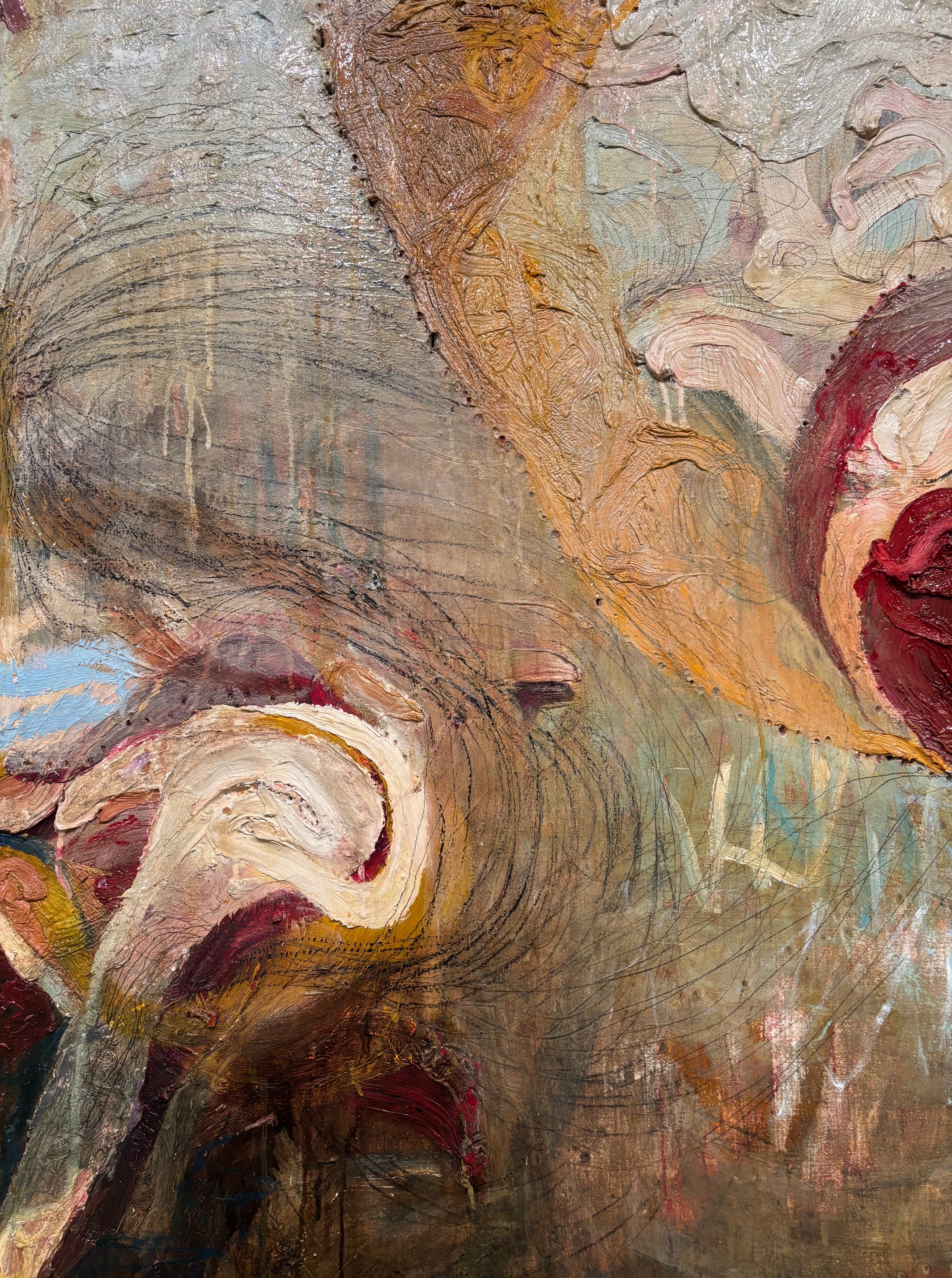
There is so much going on. Eddies and little whirlpools, sky and sunlight filtering through and reflecting off water and rock, light being swallowed by the water. Of course it’s all just paint, paint that is blood red and clay red, with patches of aqua and sky blue contrasting with deep blues and nearly black corners. Slinking through the paint are pencil lines like bending reeds or river grass, but also longitude and latitude lines of maps (detail right). These paintings give a micro and macro experience; are we looking from a satellite or through a microscope?

Two paintings in this show were in the 1993 museum exhibition with one, Saluda #4, 1991 (right), purchased by the Greenville Museum then. Until the recent donation, it was the only Rutenberg painting in the museum collection. This seems so odd considering the museum hosted his first museum show. It’s just as peculiar that this donation didn’t end up at a museum that already owns a significant number of the artist’s paintings. The art world is mysterious and the Greenville Museum particularly puzzling.
Along with the early pieces the museum now owns, the donation also included Green River, a 5-by-12-foot painting from 2014, which is much more like his current paintings and provides context in the exhibition. I’m guessing the museum will be filling in the gaps to have a more complete representation of Rutenberg’s career.
The exhibition does not yet have a closing date, but the museum has a tendency to move quickly and without much warning, so don’t dawdle. If you saw the Sumter Gallery show and see this show you’ll have had a great experience of this great artist in his home state and in a very short time frame. And if you’ve been a fan of or only familiar with Rutenberg’s art from the past 20 or so years, you owe it to yourself to see where it started.
William H. Johnsons added to the Greenville collection
Although I was at the museum to see Rutenberg’s paintings, I was almost as excited to see “Art for Greenville” which is made up of art the museum has purchased also a took to raise money for art acquisitions. These new acquisitions include 11 works by William H. Johnson, a native of Florence, S.C., who after years of neglect gained great attention starting in the 1990s. One of the first large exhibitions of Johnson I saw was at the Greenville Museum in a show organized by the Smithsonian Museum of American Art (which owns 1,500 Johnson works) in the late 1990s.
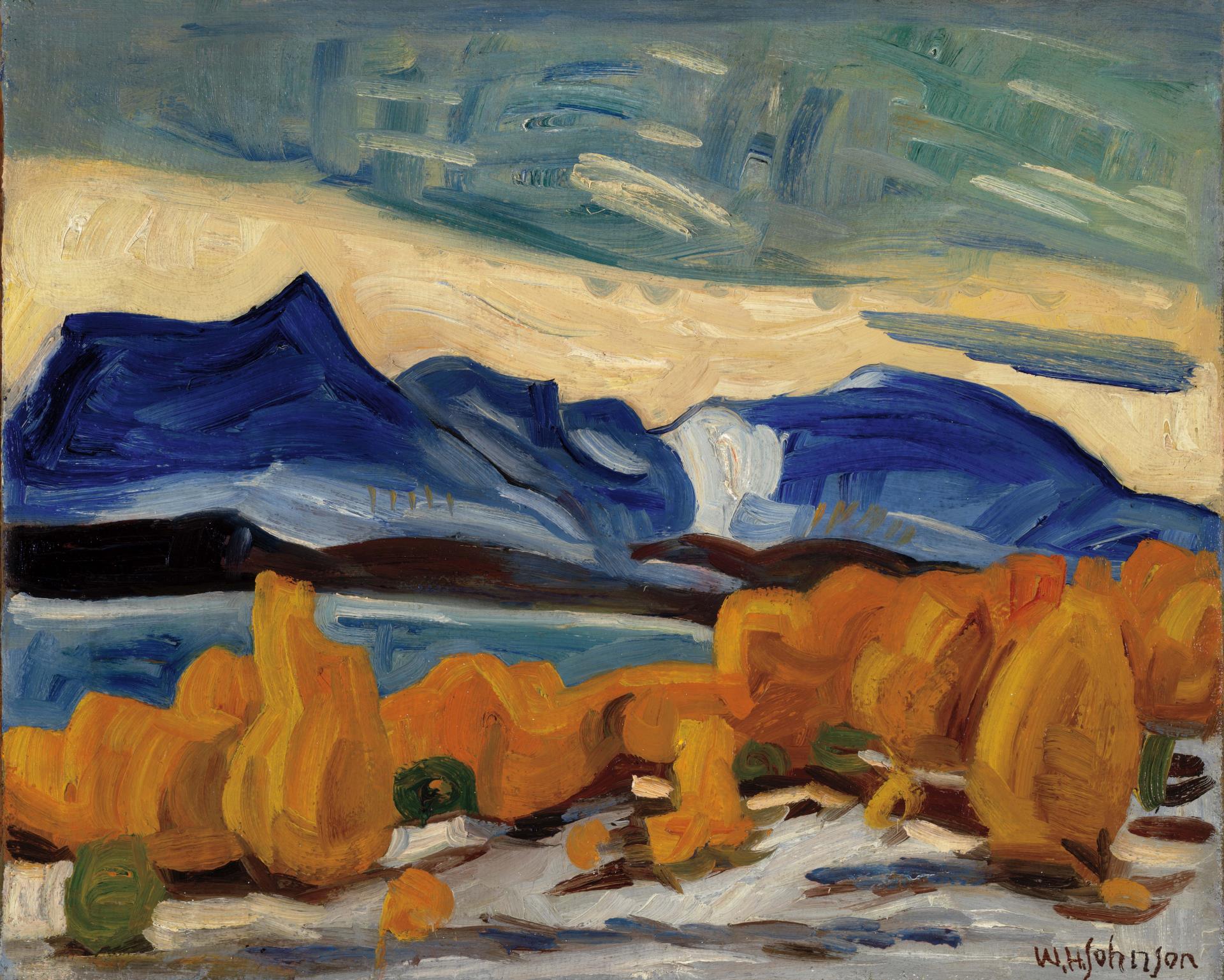
Volda Fjord, late 1930s.
These Johnson works include several important paintings from his years in Europe; I was shocked to see that paintings like these were still available to purchase and am happy to see they’ve ended up back in his home state.
Learn more about supporting art purchases for the museum – Art for Greenville
July 4/25
‘Let’s Have a Talk’ packs a big punch
WHEN I first viewed “Let’s Have a Talk: Black Artists from the Columbia Museum of Art Collection” I was kind of blow away by all the great work by artists including Sanford Biggers, MacArthur Binion, Betty Blayton, Merton Simpson, Lorna Simpson, Beverly Buchanan and others. Subsequent views were quick so I took more time this week and was still impressed, especially upon realizing this is a quite small show.
In one gallery there are 15 pieces and in the adjacent space two giant Gilliam paintings. The 15 are by mostly nationally and internationally recognized artists as well as a few more local. There’s a remarkable mix of mediums and materials and approaches: abstracted landscape paintings, expressionistic collages, minimalist grid paintings, big metal sculptures, small etching, fabric sculpture, and oddly enough, figurative works. Between the quality of the work and the variety, it packs a punch that will hit you everywhere. The museum deserves great praise for creating this show that not only complements Gilliam, but expands the discussion to a new level and stands strongly on its own.
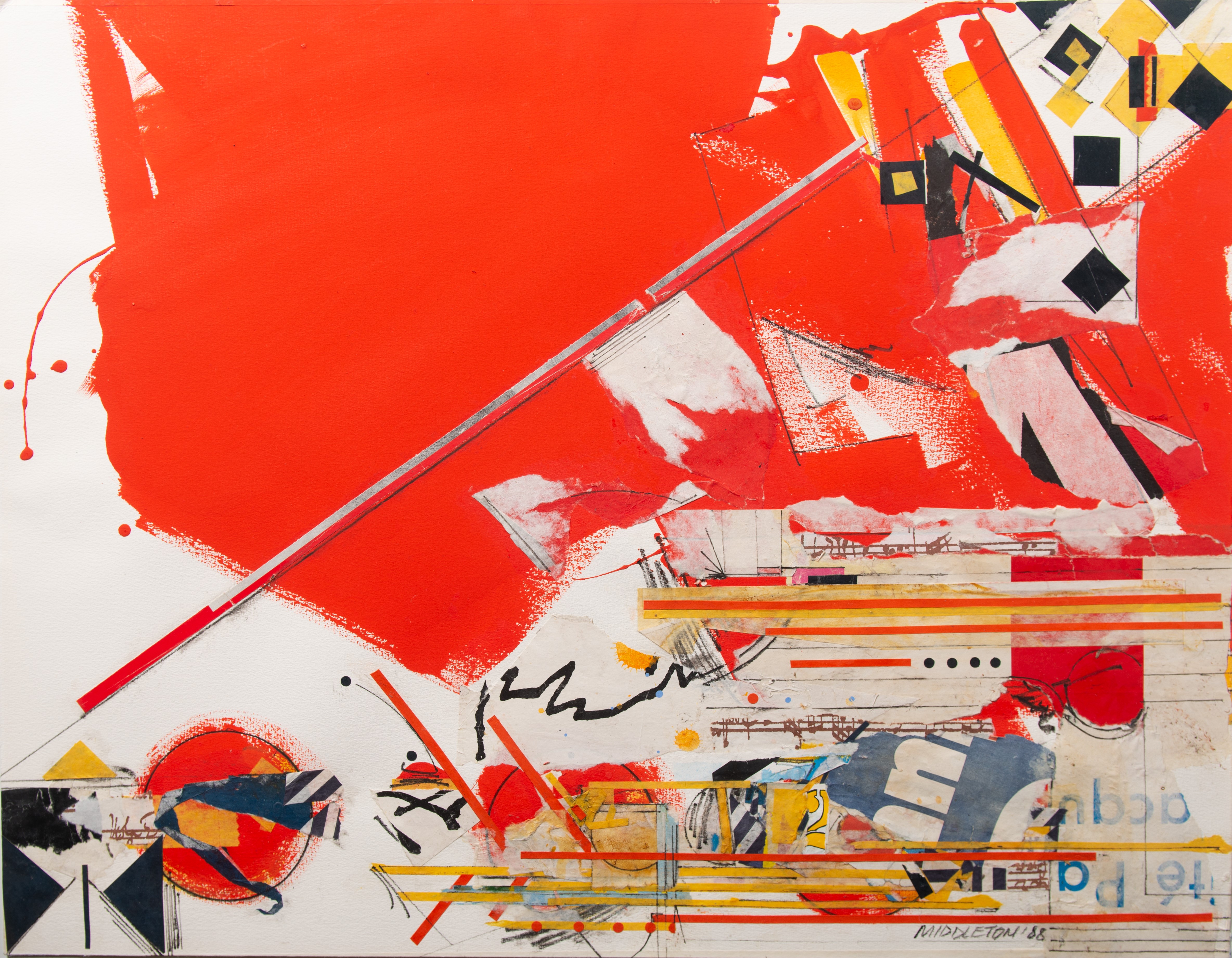
‘Symphony in Red’ (above) by Sam Middleton. ‘Yo-Yo’ by Sanford Biggers. (below)

The exhibition, according to the museum, “pushes against longstanding expectations that work by Black artists must present a clear message about their racial identity and experience, and it celebrates their crucial, yet often dismissed, role in abstract art.” There’s also an excellent statement at the exhibition entrance that says even more, as well as quotes from some of the artists.
But the art itself does most of the talking and it speaks through form and color and composition.
Although all art is abstract in some sense, there are several pieces in the show that are figurative/representational and that weaken the show and its premise. (We have a long discussion about what’s abstract and abstract versus non-representational, but let’s not.) It’s particularly odd to include John Wilson’s etching of Martin Luther King Jr. Not only is it not abstract, it is also an image many would expect a black artist to make, which this exhibition claims to want to change.
As a literal aside, just outside the exhibition in a hallway gallery are three works by Willie Cole that merge figuration and abstraction, just like the include price by MacArthur Binion does. (If nothing else this proves I’m openminded about abstraction.) They’d have fit into the show much better than the Wilson and several others.
At first, I didn’t understand why the big Gilliam paintings (a couple of the best and most important works the museum owns) hadn’t been incorporated into the print show. But they really deserved this whole gallery to themselves and should send visitors out of these two shows awestruck.
Since coming back to Columbia last fall, my visits to the museum have always included checking out the year artworks were acquired by the museum. It’s in the lower right corner of labels (See image.) It was encouraging to see among in the permanent collections galleries how much had been acquired since I left in 2014. In this show, the labels were particularly encouraging: six of the pieces had been acquired in the last five years. It’s strong evidence the museum is making a concerted effort to bring more work by African-American artists into the collection.
Like “Sam Gilliam: Printmaker,” (see review below) “Let’s Have a Talk” is up through August. Admission to the museum is free until then for all South Carolina residents. The museum is also offering many tours around these shows; check out its calendar for details.
July 1/25
Print exhibition by Sam Gilliam is solid, but doesn’t provide context for his overall greatness
When I heard the Columbia Museum of Art was reopening its temporary galleries, after a new lighting install, with a Sam Gilliam exhibition, I was excited. Then I learned the show was almost entirely of silkscreen prints, was organized by a private art touring company, and all the works were from one collection. My heart sank. But after a couple of visits I can say this is a solid show that only gets better with repeated viewings, always providing something new and engaging, although my initial concerns stand and I have others.

For “Xavier,” the signature image from the Gilliam show.
“Sam Gilliam: Printmaker” has 36 works spanning his entire printmaking career from the early 1970s until his death in 2022 at 88. Gilliam is best known for his large abstract stained canvas paintings that are sometimes draped rather that stretched, making them as much sculptures as paintings. As a printmaker, he covered a lot of ground, shapes and colors and never seemed to stand still and it’s hard to guess what was made when.
A few from the ‘80s are quite dark, gray and black gridworks with scattered blue bars and lines. Others with a similar overall color and tone can be found throughout the exhibition, but there is nothing boring about them as they draw you in with the richness of marks and layers. One wall of is dominated by three of the earliest works, from 1972, each titled Dance and made using the same screens, but each with a different dominant color. In approach the muted brown and gold of “New Bridges,” an oval work, looks to be from the same period, but no, it’s from 2004. What looks like it may be a piece from the 1970s turns out to be from 30 years later and vice versa.


Details of “BB.” left. and “Lightning Bolt,” right
Prelude to New Columbia, 1994, and For Xavier, 1990, appear to be sculptures, but they aren’t. There are several works that are sculptures or close enough which provides a good dash of medium variety to the show. These are as simple as BB, (detail right) a 1999 monotype print (one of a kind) with the letter shape B cut from the paper, or as complex as Flowers #2 that is a mix of collage, woodblock printing, painting, encaustic on handmade paper, and marble in a wooden box frame. Between these are some of the most engaging pieces in the show, two mixed media assemblages of printed matter cut up and overlapped, both from ’87, and Lightning Bolt, a collagraph (a print make using pieces of cardboard, wood or other objects) on handmade paper.
About a dozen of the screenprints, dating from the 1980s through the early 2000s, feel quite playful, decorative and even slight, but they stand up and keep giving with repeated viewings.
Much of the art might look like the work of several artists, but one can always find connections through color and shape and his manipulation of both, but never in ways nor the chronology one would expect.
Gilliam, who was African American, was sometimes criticized for not making art that directly addressed racial, social and political issues. But as he and others noted, he was African American so his art was too and his greatest expression of African American creatively and power was making the art he wanted to make. There is one surprise exception in this show of abstraction — a print of a t-shirt with a tag that reads “Equal Opportunity Is The Law.”
This exhibition shows what a great printmaker Gilliam was, something even those who know and admire his paintings may not be aware of. This is a surprisingly good show, but it’s not a showcase of Gilliam’s greatness. Those who know little or nothing about his work may not get much out of it. But the Columbia Museum doesn’t have the cache nor the cash for a Gilliam painting show. We are lucky that the Columbia Museum owns two very good, large Gilliam paintings that provides some context for the print exhibition. (Those paintings are in the companion exhibition “Let’s Have a Talk: Black Artists from the CMA Collection.” More about that exhibition at a later date because deserves attention.)
One element that this exhibition is missing is a good explanation of screen print and printmaking in general. It’s something needed for nearly every print exhibition, especially in a mid-sized museum in a mid-sized city. So here’s one from the Metropolitan Museum of Art. The museum has been offering a wide variety of tours of the show. Since all this work is drawn from one collecting couple, I’d love to see a tour or talk on collecting art in conjunction with it. Hint hint.
“Sam Gilliam: Printmaker” is drawn from the Michael K. and Marian E. Butler Collection of Miami, Florida. It is organized by Landau Traveling Exhibitions in Los Angeles in association with the Griots Gallery in Miami. There’s a very good essay on Gilliam on the Landau site.
Through Aug. 31.
June 23/25
A fitting farewell show for Peter Lenzo
Run, do not walk to see the exhibition of recent work by Peter Lenzo who passed away in October. “Peter Lenzo: In Memory of My Memory” at the USC School of Visual Art and Design Gallery closes Friday. The exhibition is a large collection of Lenzo’s elaborate face jug sculptures made during the past few years. Lenzo came to Columbia in 1992 and was a well-known and widely respected and collected artist. He lived in Columbia until 2018 when he moved to the Chicago area to be closer to family.


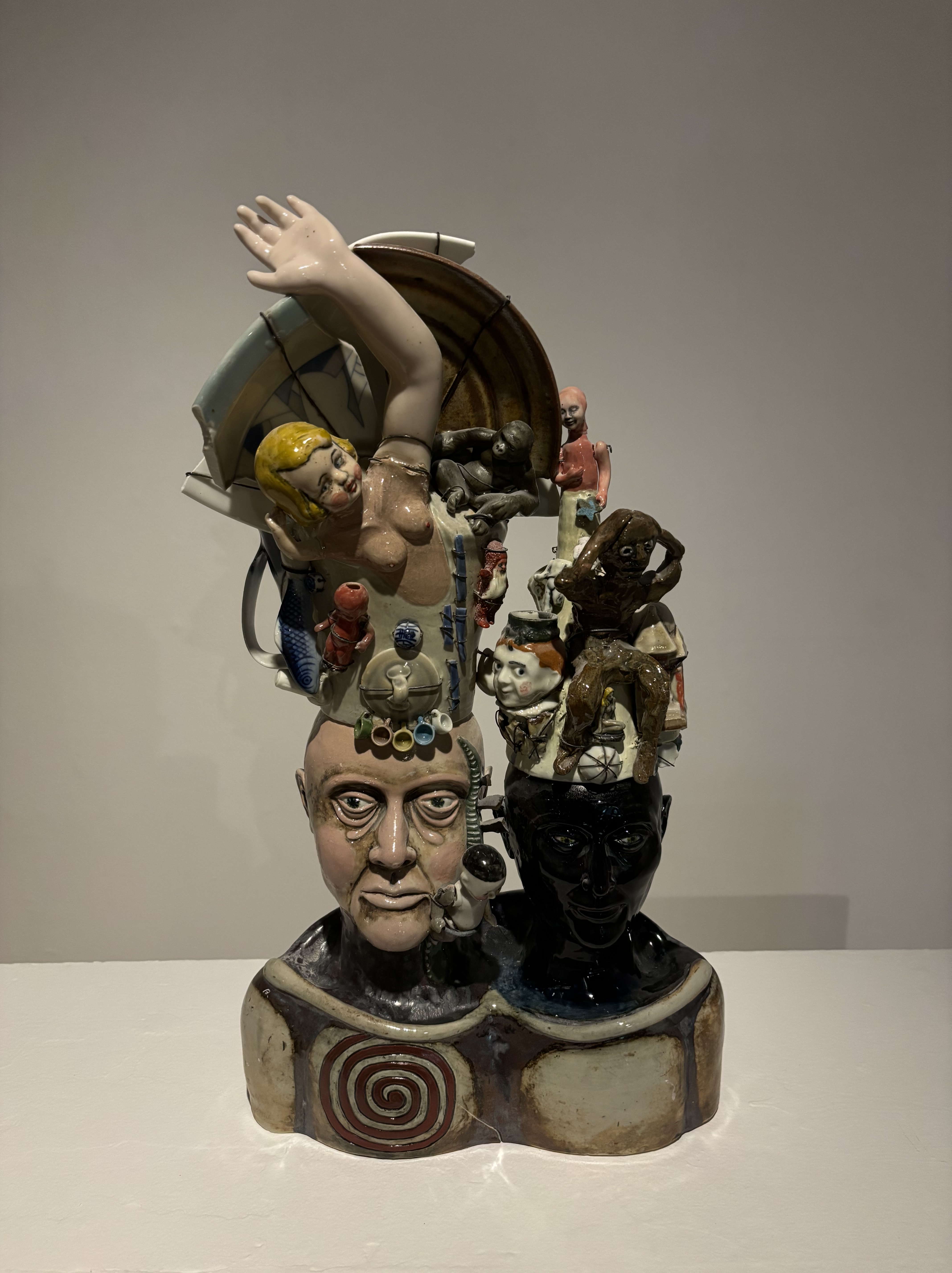
When he arrived in Columbia, Lenzo was making art that brought together ceramics and photography. He later created sculptures that were like altarpieces with medical devices as the central object. After teaching at the USC art department for a few years, he began teaching middle school, something by all accounts he was great at.
He first made face jugs as a demonstration for his classes to teach about Southern, African American, folk and ceramic arts. He told me once that he didn’t even like face jugs.
After a time, the face jugs became a way for him to explore the seizure disorder he’d long suffered, and the side effects of the seizures and the medications that kept them somewhat at bay. His face jugs often have several faces or even other heads growing out of the heads. To the main head he often attached found ceramic knick-knacks like human and animal figures and at times he wrote into the wet clay, often about what he was experiencing. The works are a kind of diary of his life.
The exhibition, organized by his family and colleagues, is not to be missed.
The gallery is open 9 a.m. – 4:30 weekdays.
June 15/25
Good news, bad news and old news in Charleston visual arts
As part of time spent at the Spoleto Festival, I always take in the visual arts on offer around town. On rare occasions they are connected to the festival in some way, but not often. Still, it’s a time when museums, galleries and art centers often put on their best— not the case this year — but let’s take a look anyway.
Museum class and world class at the Halsey Institute
A highlight of art in Charleston has long been the Halsey Institute of Contemporary Art at the College of Charleston. I was thrilled to go back to the gallery for the first time since 2013 and see that not much has changed, meaning it is still putting on museum quality exhibitions.

David Antonio Cruz: haunt me is compelling both visually and narratively with figurative paintings, layered drawings, fabric coverings on gallery furniture, wallpaper and a large installation that brings it all together. His art examines relationships through lenses of race and queerness and he does that in a celebratory manner that taps into a wide range of emotions. The several large group figure paintings are a jumble of faces, limbs and feelings revealing themselves to us in an almost photographic directness. His drawings are composed of many overlapping elements with figures revealed gradually and partially, emerging and receding, amid maps and foliage. They invite viewers to spend time getting immersed in every aspect. The drawings reappear as wallpaper and textiles throughout the gallery and as part of a room with many chandeliers.
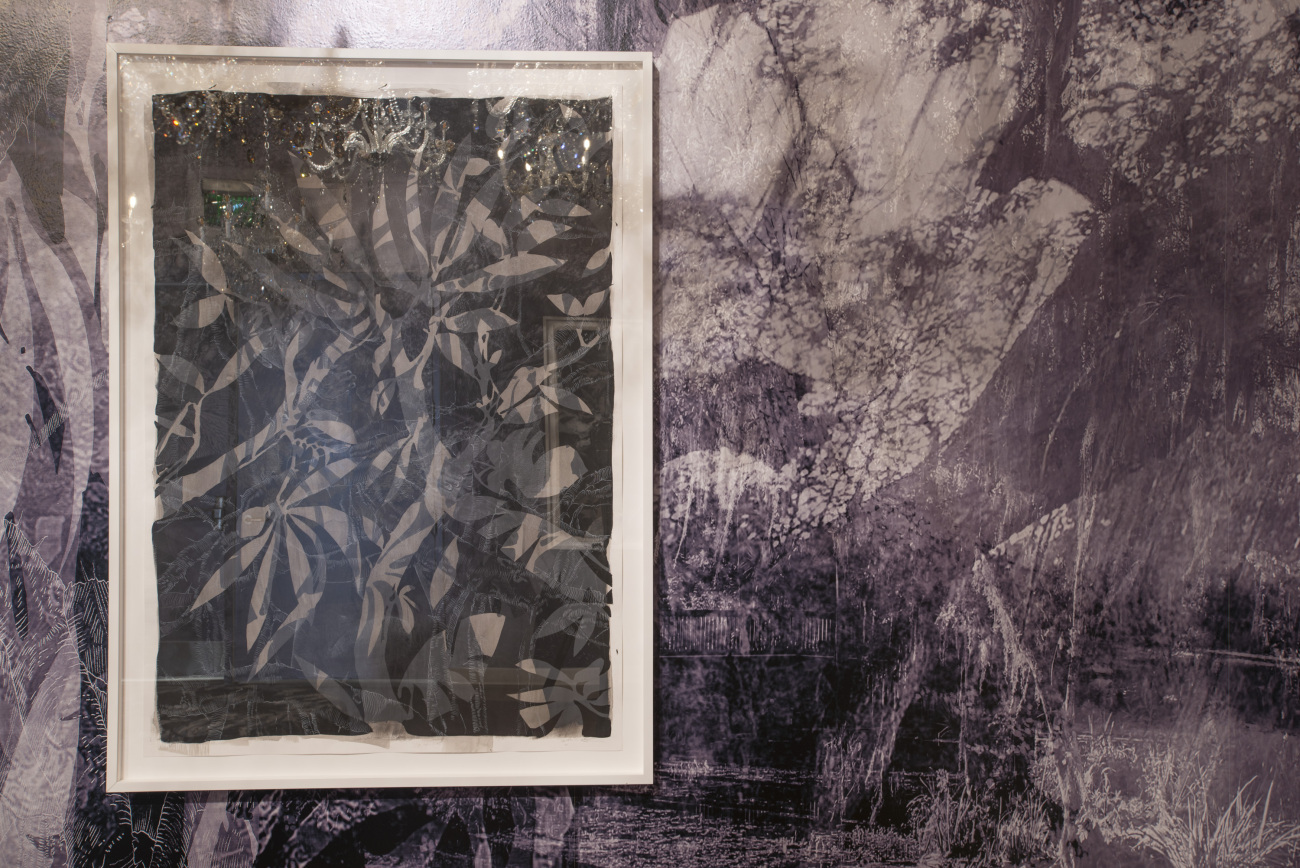
It’s amazing to have an exhibition of this importance in the state, but that it’s at the Halsey Gallery is no surprise.
There’s also a fantastic short video, created by the Halsey, you can watch in the gallery video room and online.
Also at the gallery is Born in We: African Descendants of the Atlantic World, a photo exhibition by Joshua Parks who uses black and white photography to explore his Gullah Geechee and Gulf Coast Creole heritage. He follows his own life and that of many other across the seas and back again. In these images he captures people and places, juxtaposing photos of people who are similar but live oceans away from one another and who are, his photo say, connected. (With another great video with the artist.)
Both exhibitions are up through July 26.
Art museum get lost in history’s waterway
Picturing Freedom: Harriet Tubman and the Combahee River Raid at the Gibbes Museum of Art aims to use art, history, documentary photography and videography to tell the story of the largest and most successful slave rebellion in the United States. It’s a noble goal, but the museum fails to bring the pieces together in a coherent and meaningful manner.
The exhibition was inspired by the recent Pulitzer Prize-winning book COMBEE: Harriet Tubman, the Combahee River Raid, and Black Freedom during the Civil War by Edda Fields-Black, a Carnegie Mellon University history professor with roots in the Lowcountry. The exhibition was curated by Vanessa Thaxton-Ward, director of the Hampton University Museum.
The exhibition has some good information and materials, but much is irrelevant and not of the best quality, and none of it, good or bad, is unified. The whole undertaking is ill-conceived and poorly executed.
The exhibition opens with a video that does a good job explaining the raid with images of the area where it happened by photographer/videographer J. Henry Fair. But it uses no art.
The first artwork we see also reveals that something is amiss.
It’s Faith Ringgold’s Coming to Jones Road Tanka #1, Harriet Tubman, a quilted image of Tubman. This piece is one of Ringgold “Jones Road’ works that are also about the artist moving to New Jersey where her neighbors were not exactly welcoming. That’s what the text panel next to the artwork is about, along with other things not related to this exhibition. Why not include relevant text? (even if this text has to be used as well per agreement with the lender.)
There’s tangential and anecdotal material included that doesn’t propel the story and sometimes undermines it. While facts about the brutal living conditions enslaved people endured are need for context they’re not presented in context of this exhibition. A text panel next to an artwork tells how Tubman used the spiritual Wade in the Water to alert raid participants when trouble was coming. Sounds like a complicated and noisy alert. Text alongside a river photo states “it is said” that an overseer killed a girl fleeing during the raid. Why use these tales when there’s good, solid history about this raid — including a Pulitzer-winning book on it. These stories are worth including, but framed within the mythology (not a bad word!) and oral histories of the raid. Also, some snakes a “venomous” – not “poisonous.”
While the introductory video is informative if not unique, a video a reenactment of a man freed by the raid and a plantation owner who “lost property” is close to cringeworthy.
Fair’s photos of the marshes, rice fields and the winding river are similar to those we’ve seen many times before. Likewise, much of the art doesn’t really stand out or isn’t even very good.
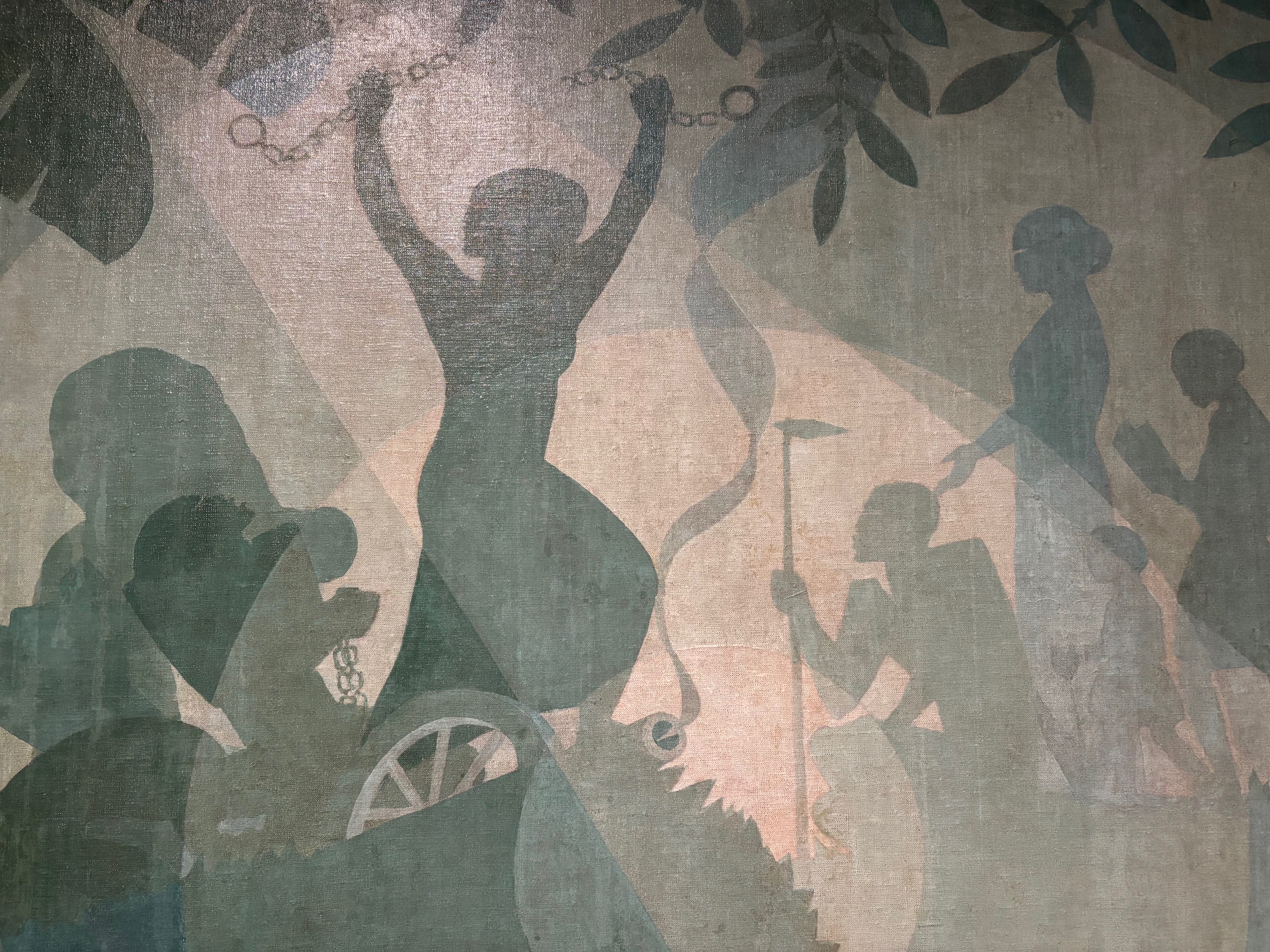
An exception is Aaron Douglas’s large painting of a silhouetted Tubman (detail, right) leading the enslaved to freedom. The 1931 work was commissioned for Bennett College for Women in North Carolina. For all the problems with this exhibition, it’s worth going just to see this painting.
While it’s encouraging to see an art museum like The Gibbes attempt to broaden how it uses art, this exhibition feels like an institution taking on a job it was utterly unprepared for.
Through Oct. 5.
Go see all these artists
Redux Contemporary Art Center is the home to nearly 40 artists of all sorts. The large facility on King Street (new to me, but open since 2017) has one large gallery at the front of the building, a couple in the back and other spaces.
Right now, you can get a decent idea of what goes on in those studios with “Creative Corridors,” a group show by all the resident artists. There’s a huge range of styles and quality. Each artist only has one work in the show, but sometimes that’s all it takes to know if you are interested in seeing more — or no more. It’s a good show to get a little taste of what’s going on in Charleston’s art community.
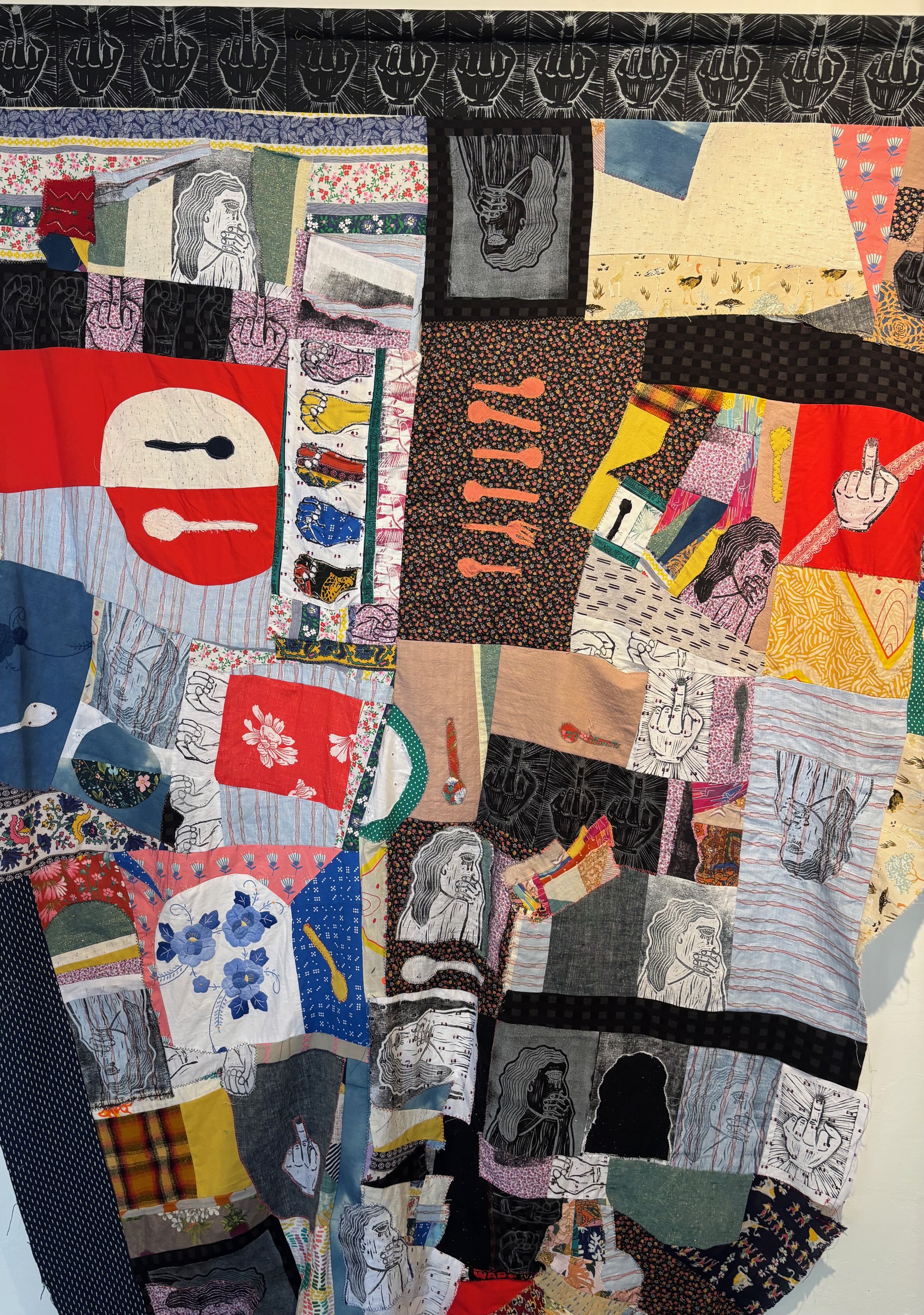

A sampling of what you’ll find at Redux
I went at the evening opening reception for the exhibition, which was packed. Some artists had opened their studios for the night and were around the chat a bit, so I felt like I got a bit more of an insight into the art of a few. AND, just learned that Redux artists are having open studios June 26 from 5 to 8 so you can do the same and more.
The show is up through Aug. 9.
Along with the big show is “Light Changes Everything” by Christine Patterson through July 12 and “Speaking in Color” by Nysa Hicks and Maggie Pennington through Aug. 9.
A continuing wasted opportunity and venue
Like the international Spoleto Festival USA, once in a great while the Piccolo Spoleto Festival run by the City of Charleston Office of Cultural Affairs has done larger, ambitious art exhibitions. But the main visual art offerings have usually been an arts sale/show in Marion Square Park, a craft show at another park, and exhibitions at the City Gallery at Waterfront Park.
I recall there being some solid curated shows at City Gallery during the festival, but apparently those days are long gone. The cultural affairs office tells me that since 2014 they’ve mounted a juried show of South Carolina artists in the space during the festival. Such open call juried shows are rarely good, but I can’t recall one quite so dismal. It’s insulting to the few artists with good work in the show, the many great artists around the state whose work should be shown in Charleston during the festival, and the Office of Cultural Affairs for allowing such a decline in what it does.
In case you didn’t know, juried shows usually have an entry fee and that’s what ends up covering much of the cost of the show and any cash awards. I knew that, but when I asked the city about this show they reminded how it works. I admire their honestly, but am shocked they think this is ok. Well, everyone else does it so I guess there’s plenty of no shame to go around.
(The entire Piccolo fest and office of cultural affairs issues will have to wait for more discusssion.)
June 10/25
Pop music at Spoleto
What’s gained, what’s lost, what’s the plan
A string quartet was making music one would expect from two violins, a viola and cello. Then they were joined by electronic beeps and blips more commonly heard in a gaming arcade. The sounds were coming from the Dock Street Theatre stage for the Spoleto Festival chamber music series. As far as electronics go, it was simple, but combined with the violins, viola and cello, the work titled Interface became what the composer calls “duets between musicians and code.”
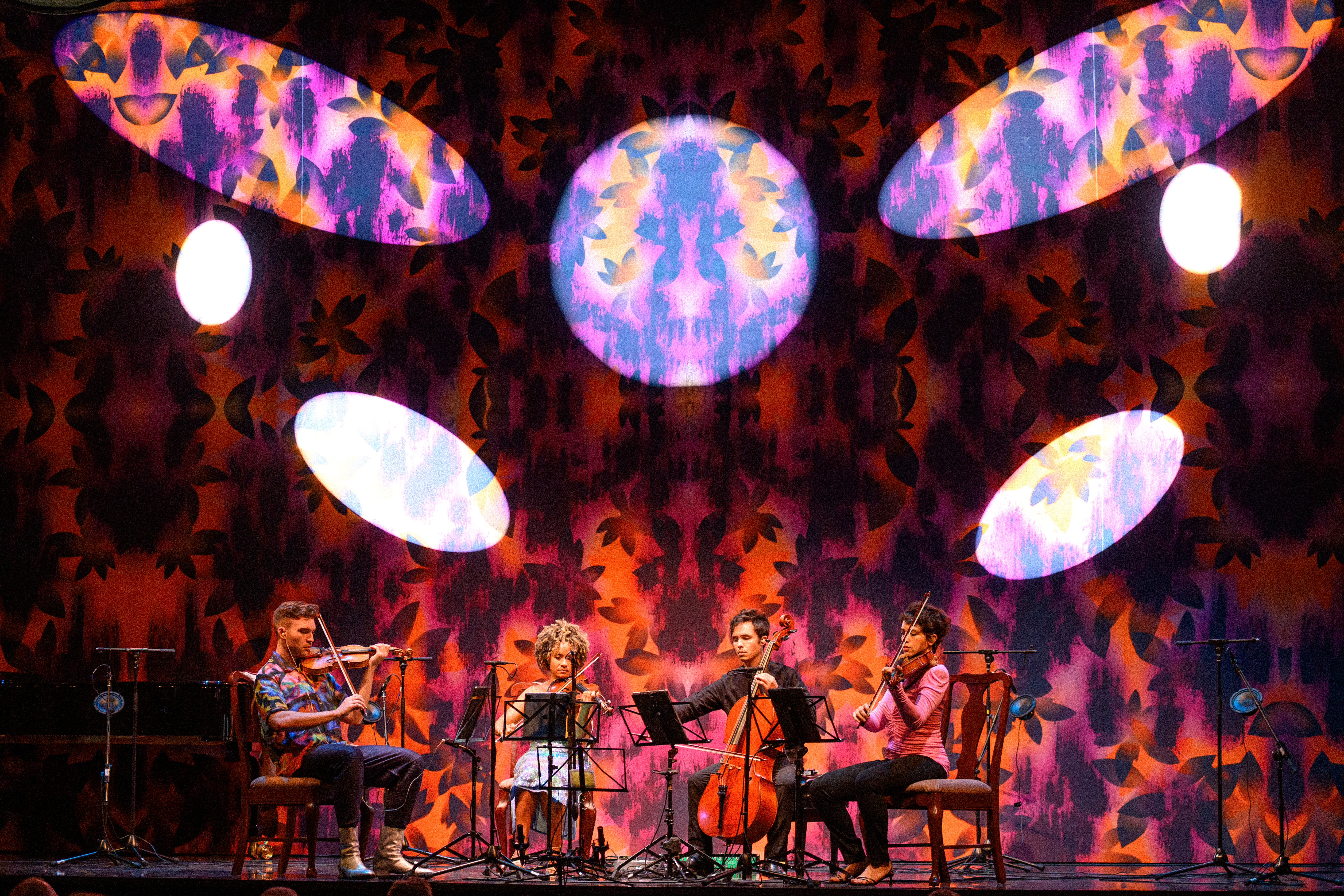
“Interface for String Quartet + 1-bit electronics” for chamber music series at the Dock Street Theatre
As I listened, I thought, wouldn’t it be great to get this music out to people who aren’t sure the classical programs at the festival are for them. It would be a way to build a bridge, especially to those who have been flocking to the greatly expanded pop-oriented festival series Front Row. Then I remembered, for decades the festival did have a series dedicated to more experimental music — Music in Time. Music in Time was a place for those wanted to expand their musical horizons and it didn’t matter if you arrived there via Beethoven or Led Zepplin.
The series was started by John Kennedy, who eventually became the festival’s director of orchestral activities and was a major force in bringing the work of living composers to all parts of Spoleto. At the end of the ’23 festival his contract wasn’t renewed, and with him went Music in Time.
Don’t misunderstand. There’s still lots of contemporary music at the festival. Chamber music director Paul Wiancko and orchestral music director Timothy Myers, both wrapping up their second year, have seen to that. Chamber concerts have had music by quite a few living composers; some very well-known and others that even new music fans don’t know. All three orchestra concerts this year included works by composers born in the 1980s. Cellist Alisa Weilerstein’s six-part “Fragments” paired pieces she’d commissioned by 27 composers with J.S. Bach. But even with all that, I don’t think Music in Time had become redundant.
Meanwhile the Front Row series of Americana, rock, blues and country has grown from three to four to seven to 12 concerts since it started four years ago. This year Patti Smith, Jeff Tweedy, Mavis Staples and Lucinda Williams, all artists I admire, were part of the lineup. (For many years, the festival staged more pop-oriented shows, but it wasn’t a major series.)
I don’t see how these concerts benefit the overall festival or enhance its brand. I don’t get a sense that most of those attending these shows are flocking to hear the orchestra play Mozart. I’m curious to see how and if the festival will leverage the pop series to benefit the entire festival and build its audience (Props to the festival for partnering with the Charleston Literary Festival to have a reading/performance by Smith at a church.)
It’s the prerogative of Spoleto leadership— almost completely new since 2022 — to reorganize and revamp and put its own mark on the festival. I’m sure a great deal of thought goes into it. But if the festival can have a big jazz series and a big pop series, then why not a small new music series, which is what Music in Time was.
I’m not knocking pop music. I got to classical music by way of it. Short version: David Bowie, Television, Talking Heads, Brian Eno leading to Philip Glass and Steve Reich and a backward march through music history to Johann Sebastian Bach and Franz Joseph Haydn. I like and admire many of the artists playing Front Row this year, but they were more a part of my life in the late ‘80s and early ‘90s.
Then I started spending a lot of time at the Spoleto Festival which greatly expanded my musical horizons. How ironic.
____________
Notes: You will not believe how many things I cut. Here are a few makeshift footnotes.
*I have not covered the festival since 2013 and cannot claim to be deeply knowledgeable about what’s happened there since (but I have done some research.)
*Geoff Nuttall, who directed the chamber series from 2010 until his death in 2022, greatly expanded contemporary music on the series and his work in that realm had an impact on the festival overall.
*Music in Time was never a particular favorite of mine and I never had a great deal of interaction with John Kennedy.
*The pop shows of the past never seemed part of the larger festival to me unless the artist was really exceptional like Chris Thile/Punch Brothers. The jazz series to me feels like a separate festival, but I don’t really know enough about it, and I do think it has more overlap with the classical core of the festival and Front Row.
* Leadership and $ challenges at the festival emerged last summer. The Post and Courier did extensive coverage of it.
*I’ve made requests to speak to festival folks about Front Row and other things, but they’ve not responded.
*Credit for the expansion of my musical interests must also go to the Southern Exposure series at the University of South Carolina School of Music, and the school and its faculty in general.
*I am sorry to use marketing jargon such as “enhance its brand” but it seems to fit.
*Also on the marketing front. While the Spoleto press photo box had photos from every Front Row concert the day after the concert, getting updated photos from the chamber series was like pulling teeth. This to me gives a good indication of what the festival’s priorities and that’s a cause for concern.
June 3/25
Rural Witnesses is a show not to miss but not easy to navigate
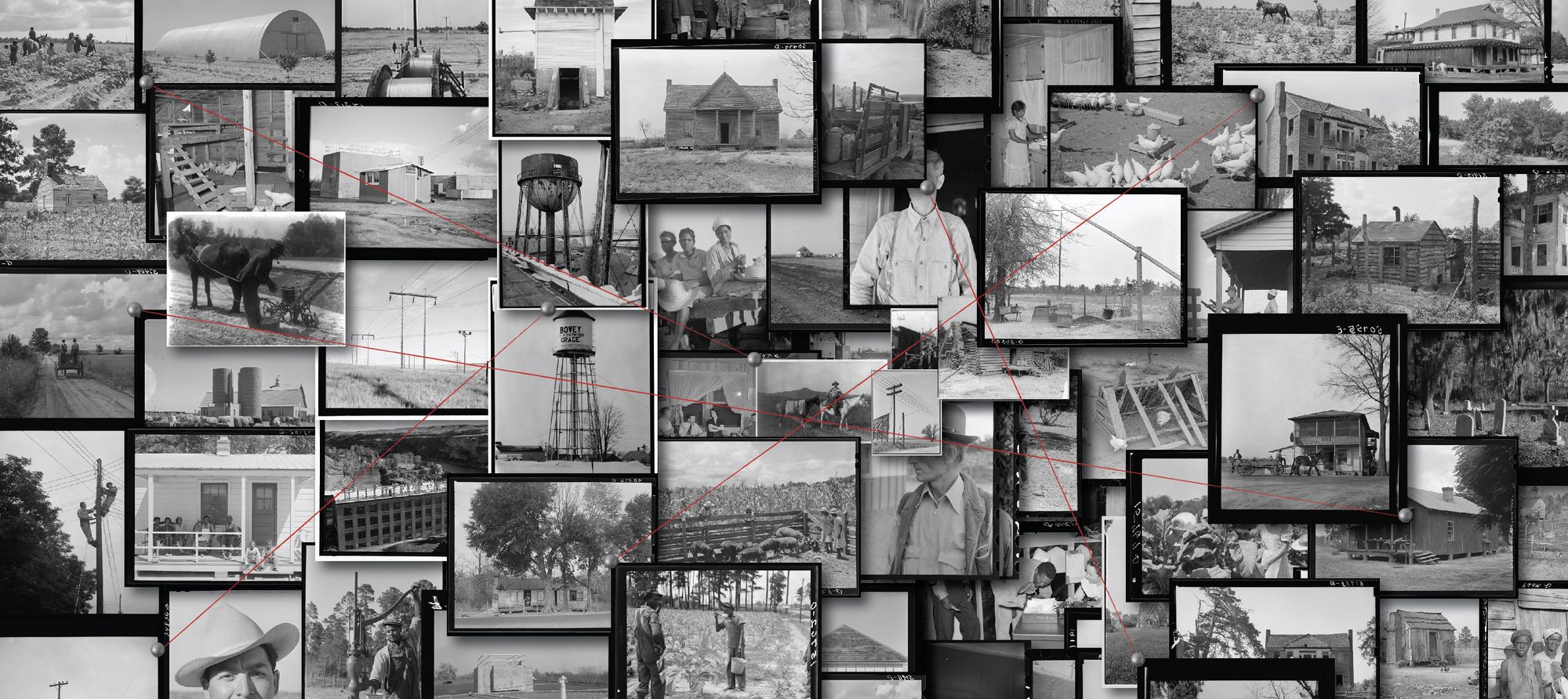
I’m very late getting to this, and if you’ve not been you will be as well. But do not miss Rural Witnesses: Retracing and Reimagining Rural Architecture at 701 Center for Contemporary Art. The immersive exhibition created through a partnership among CCA, the Clemson University School of Architecture, interdisciplinary design and research collective Partners in Place, and Clemson’s Lee Gallery examines and presents projects in rural areas that meld architecture, culture, the environment and community.
It includes audio and video interviews, photographs, models, drawings, project documents, lots of plywood and even bales of straw to sit on while watching the videos. There are models of major buildings and small houses, samples of building materials made from the leather industry and castoff chunks of.
If you want to get all this exhibition has to offer, and it is a lot, set aside a large slice of time. Along with so much to look at, watch and read, there are also many QR code links to take you deeper into individual projects. Like many architecture exhibitions I’ve seen, this one has so much detail and text, some of it small, that it can be daunting to try to take it all in. This one also covers so much and has so many partners and participants, it’s easy to lose the connecting threads to see the bigger picture. Mentally it is a lot to handle; physically too, since if you want to read some of the text you’ll literally have to get on your knees. This show is definitely not designed for those with mobility issues (ironic since so much of what it addresses is about poorly served communities.)
Rural Witnesses needs a much bigger space to do the material justice and to make it more understandable to viewers.
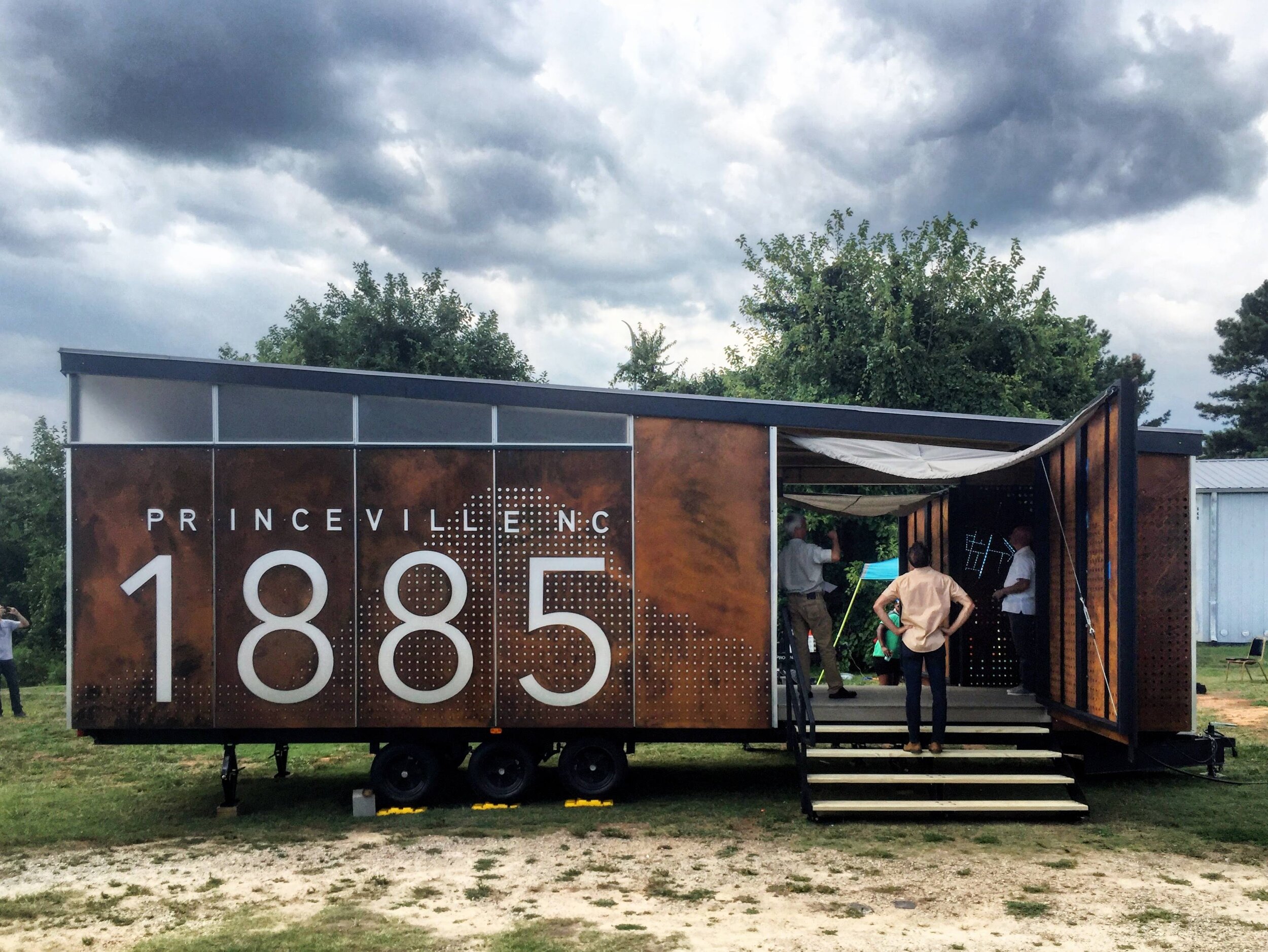
During the past few decades several architecture schools in the South have put an emphasis on rural development and redevelopment that involves community input and a respect for the places and people. This exhibition shows how that continues.
One of those projects, a mobile museum, was to be at the center, but has been canceled. David Hill, head of the School of Architecture at North Carolina State University, and students there created the museum on a flatbed trailer for Princeville, North Carolina, while its museum and visitors center was being renovated. Still he’ll give a talk about it June 12 at 7 titled Architecture That Tells a Story: Designing & Building a Mobile Museum with the Town of Princeville, North Carolina.
Hill will also lead a workshop Postcards from Carolina: A Sketching & Watercolor Workshop, inspired by the exhibition, the night of June 10 and a screen printing workshop Sheds, Silos, and Screened Porches. Those are $20 each for CCA members and $25 for non-members.
Pianos all day and all night all week
Now in its 23rd year the Southeastern Piano Festival at the USC School of Music kicks off this weekend, running June 6 – 14. While the festival centers on teaching pre-college students, there’s always a good lineup of concerts by music school faculty and guests.

In its second year being directed by Phillip Bush,(right) the festival has made some modifications including in the concert lineup.
The public aspect kicks off with a concert Saturday afternoon with a concert by students at the festival, followed in the evening by a USC jazz faculty concert.
One thing that hasn’t changed is the big Sunday concert with music school faculty wrapping up with a piece for many hands. This year that will be Valse Brillante by Moritz Moszkowski arranged for two pianos and four players. Before they dive into that you can hear works by Edvard Grieg, Wolfgang Amadeus Mozart, Béla Bartók, György Ligeti and Franz Liszt. I’m very much looking forward to this concert, especially since I’ll be hearing two music school faculty members, Omar Roy and Nicholas Susi, for the first time.
The festival will offer three concerts by guest artists:

Clayton Stephenson (right) didn’t have a piano at home when he began studying music and the first one her got was a battered upright found on the street. He’s in a joint college program working toward bachelor’s degree in economics at Harvard and a master’s degree in piano performance at the New England Conservatory. He’ll play compositions by Isaac Albéniz, Franz Schubert, Igor Stravinsky, and a song by Harold Arlen you may have heard about a girl from Kansas trying to get home.
Charlestonian Caleb Borick, 21, shot onto the international piano scene in 2023, winning first prize, the audience prize, and special prizes for chamber and contemporary music at the Telekom Beethoven Competition in Bonn, Germany. He’ll play music of Ludwig van Beethoven and Johannes Brahms.
Drew Peterson (right) received a great deal of attention as a child prodigy with his young life chronicled in the documentary Just Normal and the book Far From the Tree. He has gone on to a remarkable career, winning the Avery Fisher Career Grant and the American Pianists Awards. He’ll perform music by Mozart, Liszt, John Adams and Wang Jie.
Another highlight of the festival should be a concert by the Congaree Trio, made up of Bush and fellow USC faculty members violinist Ari Streisfeld and cellist Claire Bryant playing Gabriel Fauré, Gabriela Ortiz and Johannes Brahms.
Tickets for most of these concerts are $25, but there are some free concerts during the week along with open masterclasses.
(A personal/professional side note: I owe a great deal to the Piano Festival. After losing my newspaper job, the festival was the first organization to hire me to handle publicity. I have no doubt that helped land me a job with the University of California.)
Wrapping up the Spoleto Festival (for now)
June 1/25
Probably done with the Spoleto Festival for this year. At least the attending part. It was grand, although I have a million questions for the festival, others and myself. Last night after a performance wrapped up at 7, I drove straight back to a party in Columbia where I had a conversation with friends wondering what has become of the more edgy dance and music aspects of the festival. They said they weren’t very interested in what they’d seen on the festival schedule this year, something I’ve heard from others. More on that later this week (as you see, I’m not really done.)
After that Saturday morning chamber concert (read post from yesterday), I didn’t know if else could match up and I was more or less correct.
A signature work and new one that taps into company heritage
Deciding recently about what to attend, when I saw the festival chorus was going to perform with the Limón Dance Company. I knew that was one for me. The 20 singers performed with the company for one of its signature works. Missa Brevis, with music by Zoltán Kodály. Created in 1958, the large ensemble work commemorates the destruction of Europe during World War II and was directly inspired by a Budapest church ruin Limón saw when his company was on tour. Kodály wrote the work in 1945 as a commemoration of the war as well. (Missa Brevis in Tempore Belli translates as “Mass in a Time of War” and is a form dating back hundreds of years.)
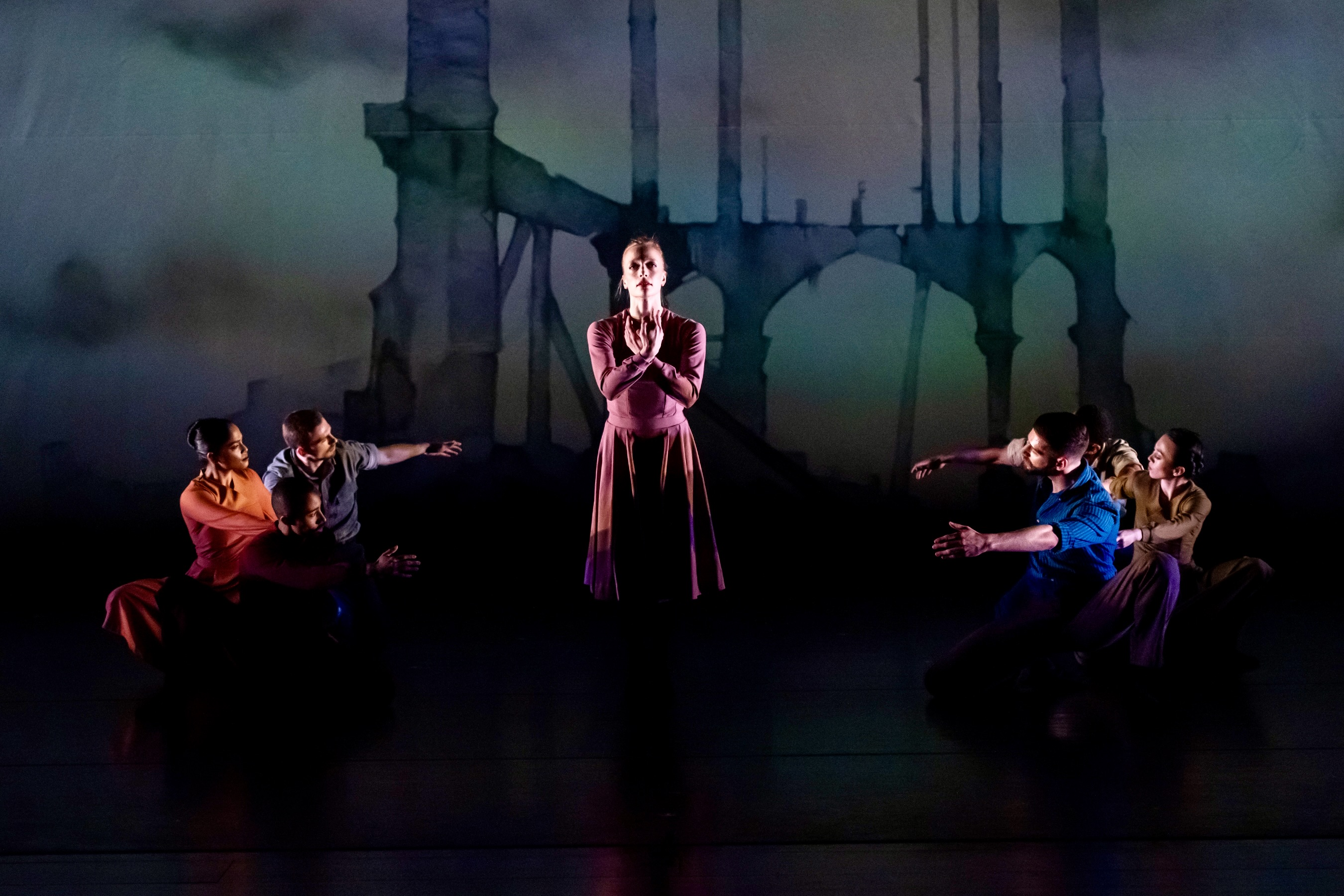
The choir stood on risers facing the audience and conductor beneath a simple but effective backdrop of silhouetted church ruins and smoky sky. The dancers appeared as a group, then one was lifted straight up, then another and another, rising from the ashes. Limon fully captured the pain and the resilience of what he saw in Europe and the company continues to fulfill his vision. Born of destruction, the dance and music are masterworks of hope.
For whatever reason, the festival has included no notes about the background or history of the work in the printed program. There’s one line about it in the online notes.
The festival also fails to spotlight the fact that the other major piece on the program, Join by Aszure Barton, is brand-new, having had its premiere May 21 in New York. Nor does it provide any other information about the work other than the basics. That’s a real oversight, when one learns that Join was inspired by Jose Limón’s memoir and his admiration for choreographer Doris Humphrey’s 1930s lost work Orestes.
Join also involves the entire company in movement that melds almost mathematic precision and mechanical motion with pure emotion and upmost grace and athleticism. Appropriately, the performance started with Two Ecstatic Themes by Humphrey, a gorgeous solo work.
The program book provides a bio of Humphrey, but doesn’t mention her connection to the new Barton work. Nor is there a even a bio of Barton! Why the festival wouldn’t highlight all the important information about the Limon performance is difficult to understand. (The Post and Courier did an interview with Limón Dance director Dante Puleio that sheds light on the overall performance and specific works. I’d glad the info was shared in some way.)
As I wrote a few days about Alicia Weilerstein’s six-part solo cello project, “Fragments,” you don’t need program bores or artists statements or bios to enjoy and understand art. Sometimes they can even get in the way. But Not including all the amazing background about the Limón performance is quite an oversight.
Bookended Fragments

After hearing the first episode of cellist Alisa Weilerstein’s “Fragments,” movements from Bach sonatas with music she commissioned by 27 living composers, I knew I wanted to hear more. Going to all six was out of the question so I picked the final one for a bookend experience, it was being premiere at the festival, and also because it included music by Andy Akiho, a Columbia native who attend the USC School of Music and whose work I’ve heard several times this year. (See the story I did on him last month farther down on this site.)
Since I’d experienced the first part, this final one wasn’t quite as surprising and powerful for me, but that may have more to do with me and the timing and what else I’d experienced that day. (See opening paragraph above.) But still an amazing experience.
What surprised me was that the first concert in the nearly 800-seat house was nearly sold out, but for the last one the place was about half empty. Maybe people decided to attend the festival orchestra concert with the outstanding violinist Alexi Kenney as soloist for the Jean Sibelius Violin concerto in D minor. But “Fragments” ended at 7 and the orchestra started at 8, so not sure that’s a good explanation. I was tempted, especially since the orchestra only does three concerts during the festival and because of Kenney, who I saw on the chamber series. (The final orchestra concert is June 5 with Felix Mendelssohn’s Third Symphony along with a 2019 work by Anna Clyne featuring cellist Inbal Segev for whom it was written.)
In all, “Fragments” is a genius project which is what one could expect from this MacArthur “genius” Fellow. I’ll be interested in seeing where Weilerstein and these works go from here.
May 31/25
Another masterful performance of a masterpiece at Spoleto chamber
Friday’s chamber series performance of Franz Schubert’s Piano Trio No. 2 blew me away. I felt like it was one of the best performances I’ve heard in a long time, maybe forever. Then I show up at 11 this morning for the chamber music concert and I get another performance for the ages, this one the Octet by Georges Enescu written in 1899 when he was 19.
It’s fairly rare for a large group of musicians to show up on the Dock Street Theatre stage for the series and usually means something special. In this case it was also spectacular. It is a monumental work and the players did justice and, for all their hard work, seemed to be enjoying themselves thoroughly. I’m not sure if I’ve ever seen so many bows flying around and three of the four violins were just kind of stacked up one on top of each other providing quite a visual spectacle. With violinists Alexi Kenney and Geneva Lewis next to one another it’s a wonder a fire didn’t start.
The piece has so much compressed energy that explodes and momentum that never lags. It lasts 40 minutes but feels like 15. Every second is breathtaking, brilliant and beautiful.
Apparently the 1899 premier of this work was cancelled because it was too hot for players and audiences to handle. It is a reputation that stands 125 years later.
Enescu wasn’t the only composer with a great work on this concert. It opened with Joan Tower’s Petroushskates , which allegedly brings together Igor Stravinsky’s Petrushka with figure skating. Sounds funny on paper; completely serious and wonderful when played. That high energy outing for violin, cello, flute, clarinet and piano, was followed by the more solemn and majestic J.S. Bach Sonata for Viola de Gamba in D performed on cello and harpsichord.
What a great morning of music.
(The festival hasn’t posted any chamber photos since the first concert so my live sketch will have to do.)
May 30/25
Turn of the Screw opera makes for a chilling eve
Is there anything more scary than scary children? Think of the twins in The Shining and those vacant-eyed tots in Children of the Corn. The young brother and sister,] in the Benjamin Britten opera The Turn of the Screw aren’t quite like those, they are more of playing hide and seek evil types.

The 1954 opera, based on the 1898 novella by Henry James, got a brand new production for the Spoleto Festival USA. It premiered Friday night and will have three more performances (June 1, 3 and 6) at the Dock Street Theatre. This ghost story is not full of big scares, but more of a gradual and artful elevation of terror that is disturbing in its own way. With an outstanding cast, fine sounding orchestra conducted by François López-Ferrer, superb and subtle direction by Rodula Gaitanou, this is great storytelling and music making. Adding much to the production are sets that look like they are part of the Dock Street Theatre. You won’t find a lot of high tech special effects here; a mirrored wall that most of the ghostly appearances.
This production is set in the time of the novella and having a traditional production serves it well, especially when its in the Dock Street, a 1930s recreation of a 18th century theatre.
In the opera a governess is hired to care for two children whose uncle/guardian wants them out of sight and out of mind. Although a little apprehensive, when she arrives, she finds two smart, sweet children, Miles and Flora, a welcoming housekeeper and beautiful estate. But before long, two others appear — the uncle’s valet and the former governess, both are dead but have enormous control over the children. When she finds them in a room full of burning candles set before a large picture of the dead duo, she figures something wicked this way comes. And so do we.
There’s not a weak link in the cast, not surprising since all have extraordinary resumes. Most remarkable are those playing the children. Only one is an actual child, the 7th grade student Everett Baumgarten, while Flora is played by adult Maya Mor Mitrani, who easily makes us believe she is a child. Both are scary in their roles and scary good singers.
On opening night there was bit of a twist. Mary Dunleavy, as the dead governess, lost her voice so she mouthed the words while another, off-stage soprano sang her part. It’s easy to imagine this being a directing decision; having the dead characters be voiced from beyond.
Britten’s score is more magical than scary and there is never anything obvious about it, other than using a celesta, which almost always indicates the supernatural has entered the hall.
You’ll not leave with nightmare, but you will leave feeling like you saw an opera that was thrilling in many ways.
A worthy farewell for Charles Wadsworth
This morning, I experienced what I’d rank as one of the best performances of my life— Franz Schubert’s Piano Trio No. 2 performed by pianist Inon Barnatan, violinist Geneva Lewis and cellist Paul Wiancko at the Spoleto Festival USA chamber music series. Just before performing, series director Wiancko announced that Charles Wadsworth, founder of the series, had died Thursday and the performance was being dedicated to him. No doubt that these three incredible musicians would have done an amazing job under any circumstance, but in this case it felt extra powerful and passionate.
Wadsworth at his final Spoleto performance in 2013 with James Austin Smith and Peter Kolkay
Wadsworth, a pianist, not only founded the chamber series at Spoleto when it launched in 1977, but also its Italian version in 1960 and in between started the Chamber Music Society of Lincoln Center. He’s widely credited with reviving chamber music for musicians and audiences. Much of the time he did that by developing more informal concerts where he would talk about the music. The series has always been a centerpiece of Spoleto with concerts about an hour in length at 11 a.m. and 1 p.m. Along the way, he discovered many young musicians like Yo-Yo Ma, who went on to have incredible careers.
Wadsworth turned over directing duties in 2009 to Geoff Nutall, violinist for the St. Lawrence String Quartet. (Nuttall died in 2022 and Wiencko took the posting last year.)
I interviewed Wadsworth many times over the years as part of Spoleto and also the chamber music series he started in Columbia. No surprise, he was always friendly, helpful and charming.
I had the good fortune of hearing Wadsworth’s last performance at the festival in 2013 when he was 84 playing Francis Poulenc’s Trio for Piano, Oboe and Bassoon. (The last year I attended the festival until this year.) I looked up what I wrote that day (for Charleston City Paper): “Coming out on stage, he tottered a bit and he fumbled around with his reading glasses. But his wit is still intact and after getting his glasses on he announced “84 IS 84.”
At that concert, the person sitting next to me wondered if this frail man could handle the performance; after she looked at me said “He’s amazing.”
Yes he was.
May 29-30/25
Minimal and maximal music and a play lost in the cold
Back to Spoleto Fest for another few days. Only one chamber music and one play today (Thursday), chamber and an opera Friday, and more chamber, more other music and some non-Spoleto art in there along the way.
But before that, a few days ago ran into an old friend from the arts and my former life nSouth Carolina. We were able to sort of catch up, in part, over very good lunch. I’m hoping next time she can get me more up to speed on so many SC arts things I’ve missed. Seeing her reminds me again of why it’s good to be.
Minimal and maximal mix
Again, the chamber series doesn’t disappoint in how varied the concerts can be. I recall how founder and long-time host Charles Wadsworth would almost apologize when something even slightly newish was on the bill (although he always did it in a charming manner.) After he retired, series director Geoff Nuttall added so much more new music (salthough I missed most of his tenure.) Now in his second year directing, cellist Paul Wiancko, keeps the trend going with some remarkable if not always successful concerts of the old and newish.

In the case of Program IV, titled “Reaching for the Cosmos” that started with started with Moreni for Clarinet, String Quartet and Piano, from 2007, by Dobrinka Tabakovam, then into modern music giant Terry Riley’s G Song from 1980, his first piece for quartet, and Gabriel Fauré’s Piano Quartet No. 2 in G minor, written in 1887.
Wiancko said Tabakovam is “having a moment” but on this concert that moment was overshadowed by the two giants in the room. By comparison, her work (in English the title translates to moraine, a geological formation) sounds rather obvious and almost conservative. The work did bring to stage two players familiar to me from long ago—pianist Pedja Mužijević and clarinetist Todd Palmer joining the immensely talents younger players.
Riley wrote G Song for the Kronos Quartet, of which Wiencko has been cellist for two years. (Another chamber series player, violist Ayane Kozasa joined Kronos last year. Kronos will perform at the festival June 2.) This is one of Riley’s most popular works and is quite accessible and beautiful. While he may be a minimalist (labels be damned) this performance brought the maximum to this great piece.
As did the players for the Fauré. It’s an imposing work, not always what one would expect from the composer of often restrained subtle music. This is a passionate piece, most of that emotion pouring forth in the second movement.
It also happened to be the birthday of violist Celia Hatton, so the musicians and audience played and sang happy birthday to her. Wiencko also did a short interview with her, asking as he has asked others, her most embarrassing moment on stage. She should have said having to answer that. Time to retire that question.
Lost in the Arctic
Since I’ve not been writing advance stories or doing interviews around the festival, I’m entering many performances a bit of a blank slate. Last week that meant I went into an opera thinking it would be a full production, but wasn’t. That worked out ok.
Going into the theatre work White Box I knew it was inspired by photos from a doomed 1897 Swedish exploration of the Arctic in a balloon and would have live performances, projections, dance and live music. I didn’t know that the creator, Sabine Theunissen had such a resume. She has collaborated with artist William Kentridge on many projects including several operas for the Metropolitan Opera among other great things.

I only discovered her accomplishments at showtime, so I don’t think it set my expectations unrealistically high. I objectively thought it was more of a black hole and a White Box .
The work starts with images of the downed balloon and other photos taken while the trio of explorers were stranded. Then hands appear, turning the pages, moving small objects and a woman’s voice begins telling the story of how she/Theunissen stumbled upon the balloon photo and became intrigued by it. She learned more about the expedition and how the photos were only discovered, along with the bodies, 30 years after the crash. The creator/narrator writes/says that the work was inspired in part by her dying father’s vivid memories. (This introduction is printed in the program book as Director’s Notes.) Along with photo projections White Box, having its U.S. premiere at the festival, uses stop action animation, along with silhouette-like figures on a scrim and back wall and then later actual silhouettes of three performers on stage, two of whom are dancers.
At first it seems the story will focus on the photographer, who we are given more details about than the others, such as the fact that he carried a photo of his fiancé. But it doesn’t. Since there were three men on the expeditions, one might think the two dancers represent them. But they don’t. Maybe they represent the struggle to survive although that’s spoken about very little in the narration. There are a lot of interesting visuals, but too many approaches to provide a coherent overall look. The live music played at side stage by a violinist and percussionist doesn’t seem connected to the story.
A theatrical work doesn’t need to provide a straightforward narrative. It doesn’t need to be obvious. That’s not what I want, certainly not from Spoleto. I do want to come away knowing what’s been said, by whom and given some indication of why it matters. It seems as pointless as that ill-prepared Polar expedition.
Another day at Spoleto; more music less rain
May 27/25
Tuesday was a more typical festival day for me.
Finished writing in the morning which always takes longer than expected. On to the Halsey Gallery at the College of Charleston to see two great shows (more on those at a later date), then Dock Street Theatre for chamber music, then almost running to get to the next concert. A little breathing room, meaning I get a very late 4 p.m. lunch (a banh mi, not bad, and watermelon and blueberries that have been in a cooler, mainly in my car, for two days) eaten under the Trinity Methodist portico overlooking a surprisingly deserted Meeting Street. Then an iced coffee, very good, that cost nearly as much as the sandwich, and another concert. Then the drive back to Columbia and more writing.
Does it all fit?
Feeling a bit warmer about Wiancko’s chamber hosting, which he often shares with some of the other musicians. This concert, titled “Inner Worlds, Tangled Lives” (you can find the concert titles online, but not in the printed book), Waincko explained is made up of pieces written during often difficult times for the composers. After talking about the quite varied pieces, he promises it will all make sense. A great variety of interesting music, but don’t think it made sense as a concert.
“Love Triangle” by Siri Lankan-Canadian composer Dinuk Wijeratne, for violin, cello and piano kicked it off. Indian and Middle Eastern influences weave throughout in this complex and mesmerizing work, but being unfamiliar and nearly 15 minutes long might not have been the best starter. Watching and listening to violinist Geneva Lewis and cellist Gabriel Cabezas play this, you know chamber music’s future is in good hands (literally). It’s great to see the festival keeping alive its long-standing tradition of presenting young talent. (The 22-year-old Yo-Yo Ma in 1977 is one example.)


Geneva Lewis and Gabriel Cabezas
Shifting to something more familiar and for Memorial Day, appropriate, Wiancko’s quintet Owls (with two cellos rather than two violins) performed Adagio for Strings by Samuel Barber, who was festival founder and opera composer Gian Carlo Menotti’s longtime partner. Written in 1936, the adagio has been called America’s semi-official music for mourning, used at Franklin Delano Roosevelt’s funeral and after John F. Kennedy’s assassination. It is played a lot, but always worth hearing when played this well.
From the quiet, powerful and familiar lament, the concert moved on to a piece by Dan Trueman and Monica Mugan originally written for guitar and Hardanger fiddle, a Norwegian violin with four additional sympathetic strings. First time for everything.
Wiancko handed the mic to saxophonist Steven Banks (right) to introduce a grouping of songs he’d put together (with soprano sax replacing voice). Banks brilliantly paired recent works by Caroline Shaw, youngest ever Pulitzer Prize for music winner, violinist, vocalist, co-producer and guest on a Kanye West remix, and Hildegard von Bingen, who died 1,003 years before Shaw was born and was a literal visionary and Catholic saint. Banks said he wanted to pair “the music of bad ass women.” Thanks to Banks’ brilliance for bridging the centuries.
Wiancko introduced the final work, Ludwig van Beethoven’s Quartet Op. 95, No. 11 as “a beast” that “no music festival should attempt…” Even Beethoven suggested it wasn’t for the general public, being too difficult and that he mainly wrote it for himself during a difficult time (refer back to the title of this concert.) Those expecting a very dark work would leave not all that depressed because it isn’t all dark, but it is a beautiful beast. Based on Wiancko’s strong introduction I didn’t duck out early to make it to my next concert on time. Good and lucky decision
Melding of old and new – what the festival does like no other

At 2:24 I hot footed it from the Dock Street Theatre to St. Matthew’s Lutheran, 20 minutes away according to Google maps, for a 2:30 concert. The concert by the festival orchestra was titled “Mozart’s 29th Symphony,” but before Mozart were works by two of my favorite contemporary composers, Arvo Pärt and Missy Mazzoli. While I hated to miss those, I’ve heard lots of their music live. But entering the church lobby the unmistakable sounds of Pärt were drifting out and a couple of minutes later the ushers allowed us to slip in. The church was a fantastic setting to hear this piece, Frates (Brothers) (see photo), or even part of it. And then the magnificent Mazzoli, These Worlds in Us, dedicated to her Vietnam vet father and appropriately played on this Memorial Day.
Like during the chamber series, this concert included a little interview, in this case by music director/conductor Timothy Myers with Spoleto conducting fellow Brian McCann, who conducted the Mazzoli. Again, great addition to the festival. McCann nailed it when he said what he loves about Spoleto is how it brings the old and new together; in this case older music with newer music performed in an old church. It sheds light on both. Myers also talked a little about how the orchestra is put together each year with live auditions held in seven cities (as well as virtual auditions) of 500 musician to select 90.
The Mozart, written when he was just 18, is everything one could expect and hope for from the youthful composer (although by 18 he had already written a lot) and the performance matched the music.
All in all, a perfect concert, even if some of us were running late.
Cellist brings all the Fragments together
For the festival, cellist Alisa Weilerstein is unveiling the entirety of her major project “Fragments” that consisting of six different concerts pairing new commissions by 27 composers with individual movements from J.S. Bach’s cello suites. She’s been performing sections of the series for the last few years, but the last two parts will have their world premieres at the festival May 31. Each Fragment has a title; Fragment I is ‘Wonder;” for 2 “Tumult;” 3 “Emergence” and so on. (The last Fragment includes a piece by Andy Akiho, a Columbia native and USC music school graduate. One of his works is also on the chamber series June 1 and 2).

Cellist Alisa Weilerstein, who first performed at the festival in 2005, is back with a six-part project merging the music of Bach with that of 27 contemporary composers.
Weilerstein has long been a performer in the chamber series; I heard her debut in 2005 and saw her many times after. She’s a dynamic performer and an audience favorite (also, a MacArthur ‘Genius grant” winner.) Her popularity was apparent by the nearly full 780-seat Sottile Theatre for her first Fragment concert. It’s a quite atmospheric setting as she’s surrounded by six pillars and ever-changing lighting which only adds to the magic of Sottile with its sky dome ceiling and murals.
I’ll admit to having been a little lost in the format, with music by the contemporary composers weaving in and out of the Bach and one another. Other than changing lighting, and a brief pause, there’s no clear way to place oneself or the music. Which is, in part, the point. I highly recommend reading Weilerstein’s notes on the project as well as those by director Elkhanah Pulitzer. It will add to the experience. Also the program lists the composers of each concert, but you’ll have to go online for titles and order. Again, not necessary to enjoy and understand the concert, but helpful for a different understanding.
I heard Fragment 1 which, along with Bach, is made up of music by Joan Tower, Reinaldo Moya, Allison Loggins-Hull, Chen Yi and Gili Schwarzman. The composers created multiple movements works that Weilerstein has interwoven by her own design, so each movement by a given composer is separated by movements by others. Although they all knew Bach was the unifying thread, it’s unclear how much direction she gave to each composer. They did know she was going to do with their music what she wished. They must trust and admire Weilerstein greatly.
It was an amazing experience; so intimate even in the large hall, so full in so many ways, with such conversations going back and forth and all coming together and to us as one. Weilerstein writes that since she began the project during the pandemic, it has “taken on a life of its own … What we’ve created together has … transformed into a fully immersive experience – one that invites audiences to engage with concert music in a different way.”
With the festival presenting premieres of Fragments 5 and 6, this will be the first time the entire project has been unveiled and comprehensively performed in a compressed time scale. (Two sections were performed Monday, one each will be played Wednesday and Thursday, then the last two on Saturday.)
I’d liked to have been able to hear part two on Monday as well and wish I could attend them all — to be immersed. I’m now rearranging my Spoleto schedule to see what will fit.
Back to the Spoleto Festival after 12 years away
May 26/25
If I recall correctly, during one of my times at the Spoleto Festival USA I brought my bike, but rarely rode it because it rained so much. My first day at the 2025 festival was like that – very wet. But a wet Charleston is a pretty Charleston, except for all the tourists wrapped in plastic bags.
I’m not here to talk about the weather but about this grand 17-day arts festival (mostly driven by classical music and its relatives, some theatre and dance, a long-standing jazz series and a greatly expanded Americana/pop/rhythm and blues/world series.)
My first day I only attended a chamber music concert and the opera Thaïs by Jules Massenet (I did see a couple of exhibitions, but those can wait). Since this is my first time at the festival since 2013, along with writing about individual events, I want to also talk about background, what has changed, what has not and what it means (as well as I can this late Sunday night.)
Chamber music core
A centerpiece of the festival has been the 11 a.m. and 1 p.m. hour-long, sort of informal chamber music series. The series was founded and hosted for many years by Charles Wadsworth. In 2010 he passed that post on to Geoff Nuttall, violinist of the St. Lawrence String Quartet, which became regulars on the series in 1995. Wadsworth was no slouch, but Nuttall brought new life to the series, both in his presentation, his expansion of the series to include more contemporary music, and his performing. And suits and socks. He was a dynamo. Tragically, Nuttall died in 2022 at 56.
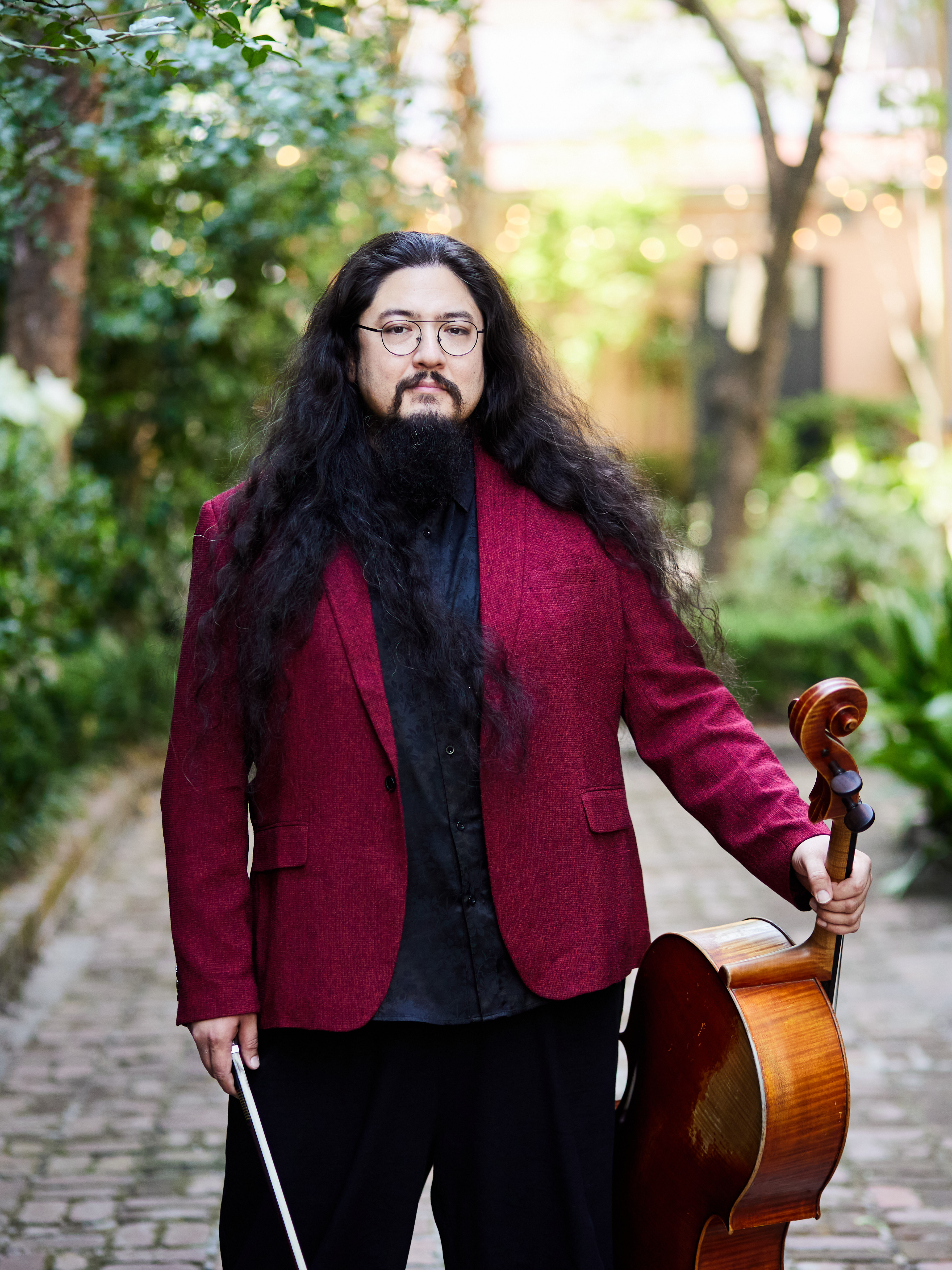
Last year, composer and cellist Paul Wiancko was named director of the series. Wiancko (right), who first came to the festival in 2019 as composer in residence, is also a member of the Kronos Quartet (playing at the festival June 2).
I’d of course seen what pieces were on this concert and it looked like the kind of mix I like – something old, something new, something out of the blue. I wasn’t sure what to expect from Wiancko and the overall feel I’d come to love as well as the music.
He has his own style of presentation, but my first takeaway is more reserved than his predecessors. A new element he brought was a mini-interview with a couple of the players and also opened it up for a question or two from the audience. It adds much adds to the entire experience, certainly much more so than just reading bios, and furthers the informal and intimate feel.
The concert certainly gave a sense of the range of the series. It started with a 2015 piece, commissioned by Kronos, by Azerbaijani composer Franghiz Ali-Zadeh, ended with an 1893 piano quintet by Afro-British composer Samual Coleridge-Taylor and in between had Antonio Vivaldi and a tear jerking 1961 pop tune. Ali-Zadeh’s Reqs translates to “dance” and that’s what it was but so much more as performed by Wiancko’s quartet Owls. They followed with a quiet, small and mysterious piece by Francois Couperin.

The concert added a twist with an aria from Antonio Vivaldi’s 1727 opera Orlando furioso with the saxophone, not invented until 1840, subbing for flute or oboe. Wiancko got hosting support from countertenor Anthony Roth Costanzo (right) with somewhat informative, somewhat lengthy and somewhat humorous introductions. The saxophone, performed by Steven Banks, was more than fine. Standing ovation and all that.
Costanzo talked about castrati (countertenors are their more humane replacement) and how they couldn’t reproduce, but they could perform, making them safe lovers. Of course he did. Then he proceeded to sing another Vivaldi piece, followed by Roy Orbison’s “Crying.” That also included a long intro about recording a schlocky version of the song many years ago and many years later creating a less schlocky version and this was it. Well, not quite. Stick with Roy’s version.
An operatic conversion
I parked near the Charleston Gaillard Center, which, last time I saw it, was the closed and partially demolished Gaillard Auditorium. From the back, it still has the 1968s exterior of the old hall, but front and center it’s a new place made to look old (yeah that’s Charleston and I don’t actually know how much is new and how much is old). Since the new/reworked hall has been open for a decade, I’ll not bore you too much with it. The outside looks good, the interior pristine, but unimaginative. Sounds great, which is all that matters.
Taking my seat, I was a little confused; the entire stage for the 1894 French opera was occupied by the orchestra. I remembered reading something about this and seeing photos, but I figured they’d be on part of the stage or move or something. Nope. They stayed put and the singers played on the front 15 feet of the stage. The only set was a bench with everything else done by projections. The most recent opera I saw, almost exactly a year ago, was W.A. Mozart’s The Magic Flute at the San Francisco Opera. Lots of projections and almost no sets; it felt made for a movie theatre. I was underwhelmed. But at least the orchestra wasn’t on the stage.

At the end of Thaïs I was chatting with a woman seated nearby, who said she hadn’t come to see a concert version of the opera. I replied, “Me neither.” Then we agreed that this performance was incredible and the projection production worked as well.
Even before my fellow listener and I came to that conclusion it was apparent that something good was happening. The festival orchestra, composed of young musicians from around the country, and the chorus sounded great. Festival music director Timothy Myers, now in his second year, and chorus director Joe Miller, in his 19th and final year, drew every bit of power, nuance and emotion from the fantastic music. And when the singers arrived, especially Nicole Heaston in the title role, it really took off. The opera was directed by Crystal Manich with projection design by Greg Emetaz for Spoleto and the Austin Opera.
The opera tells the story of a Christian priest who decides he’s going to convert Thaïs, a courtesan and follower of the goddess of love Venus. He succeeds but at a huge cost to them both. The opera begins with the priest/monk Athanaël leaving his desert dwelling brothers for the big city, Alexandria, with the goal of finding Thaïs. It’s not clear why he wants to do this exactly, other than his ego, and is warned against it by an older monk. Arriving in the city, he connects with an old friend, Nicias, who is having a very good time all around, to make an introduction. What follows is a spectacular give and take between the priest and courtesan, like an intricate chess game, during which she toys with him and his one-size-fits-all view. And although he’s a bit of a bore who has a one-track mind, its apparent that he’s getting distracted from his duties by the beautiful woman and she’s also finding him appealing.
When they are done and each alone, they are haunted by what has transpired. Thaïs, looking at herself in a mirror, wonders about the meaning of her life and fears death. Athanaël dreams of Thaïs.
During her character’s torment, Heaston is a tour de force of acting as well as singing throwing her entire body into the emotion. Athanaël’s emotions are more internal and in the role Troy Cook is also excellent and eventually gets our sympathy.
As in all stories, and most operas, it gets a while to get from where we started to where we must go, in this case back to the desert, where Thaïs will enter a cloister. Although we may know the outcome from the start (how can we not given the time and place this was written), one always has the feeling, in this production anyway, that the outcome is not a set in stone. The production is well paced and never flags even though the intermission doesn’t come until nearly two hours into the two-hour, 30-minute work (with intermission it was close to three hours.)
As noted, this production is, other than that bench, without sets. The projections first show the “fairy chimney” rock formation houses of Asian minor (where the early Christian monks actually did live), then moves on to a cityscape. Along the way, these projections include fire and water, stars and seas, and videos of Thaïs, sometimes closeup of her face, other times dancing slowly, sometimes with the latter superimposed on the former. It’s very effective.
As the opera continues, the projections just get better and better, culminating in a thunderstorm which moves out into the audience with flashing strobes.
Although the entire cast was strong, most of the time it’s all about the two leads and anything the others provide seems to fade into the background, even the excellent Michael McKermott as Athanaël’s flashy friend. There are a couple of long ballet sequences that go on a bit long.
And while initially disappointed by the concert like production, in the end of music and story won out. I can’t be mad about that.
Not sure why, since it must have been cheaper and easier than building sets, it was only performed twice at the festival.
Celebrate the Columbia Museum reopening its temporary exhibition galleries starting Saturday
Prints by Sam Gilliam and free admission all summer
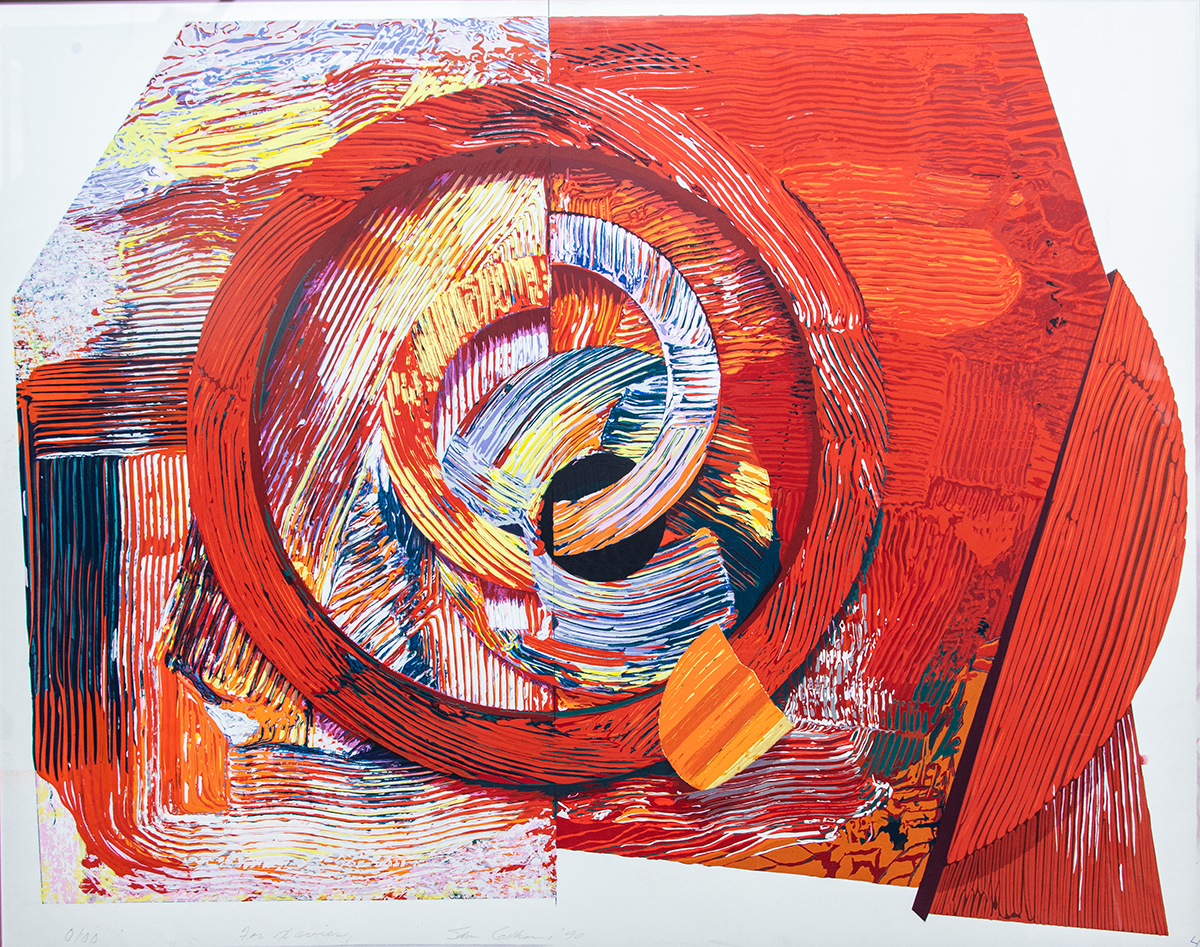
For Xavier, 1990 serigraph, 32 1/5 x 40 1/8 inches
While the usual fall through winter art season winds down, things really wind up with the reopening of the Columbia Museum of Art temporary exhibition galleries with “Sam Gilliam: Printmaker.” Gilliam is best known for his large poured abstractions, but this show spotlights his printmaking with 37 pieces, mostly silkscreens and assemblages, created between 1972 and 2009. The gallery reopening and the show get a celebratory kick off at 10 Saturday morning. Another reason to celebrate is admission to the museum is free from Saturday through Aug. 31.
(The galleries have been closed since mid-January for installation of a new lighting system. The permanent collection galleries reopen in January.)

Gilliam is best known for his abstraction paintings that are often draped rather than stretched. They might as well be described as sculpture and since the way they were hung could change from location to location could be viewed as installation works. Regardless of what term you use, they are often beautiful, remarkable and ground breaking works. The Greenville County Museum of Art owns one of his larger “drape” paintings (usually displayed in the central atrium) and the Columbia Museum has two significant paintings by Gilliam.
With this many works made over such a long period, this exhibition should provide a good overview of art, or at least one part of it. (right: Prelude to New Columbia, 1994,
silkscreen)
Gilliam, who died in 2022 at 88, was born in Mississippi, grew up in Kentucky and spent most of his life in Washington D.C. where he was a major figure in the color field group of artists there, but he transcended that role. In 1972, he became the first African American artist to represent the United States in the Venice Biennale. In a period when many African American artists used their work to directly explore and address political and social issues, Gilliam operated in a world of form and color.
With this many works made over such a long period, this exhibition should provide a good overview of a least one aspect of his art.
In conjunction with the Gilliam show, the museum has organized “Let’s Have a Talk,” an exhibition of works from the museum collections by 15 Black artist spanning several generations. The museum drops only a few names on its site about who is in the show, but says the art “pushes against longstanding expectations that work by Black artists must present a clear message about their racial identity and experience, and it celebrates their crucial, yet often dismissed, role in abstract art.”
Looking forward to having a talk about it.
Columbia Museum of Art curator Sadé Ayorinde will give a talk about both exhibitions June 1 at 2. Artist and gallerist Michaela Pilar Brown of Columbia will give a talk titled Growing Up in the Shadow of Black Abstraction on June 26.
Back to Spoleto after a decade (and a year or two) away
Also back starting Friday is the Spoleto Festival USA in Charleston. I wrote about the festival over 24 years, but haven’t been back since moving to California in 2014. I won’t be doing the deep dives I did my final visit in 2013 when as overview critic for Charleston City Paper I went to about 50 performances and exhibitions over the 17-day festival. (I actually only made it 16 days.) I will be seeing considerable fewer shows this year.
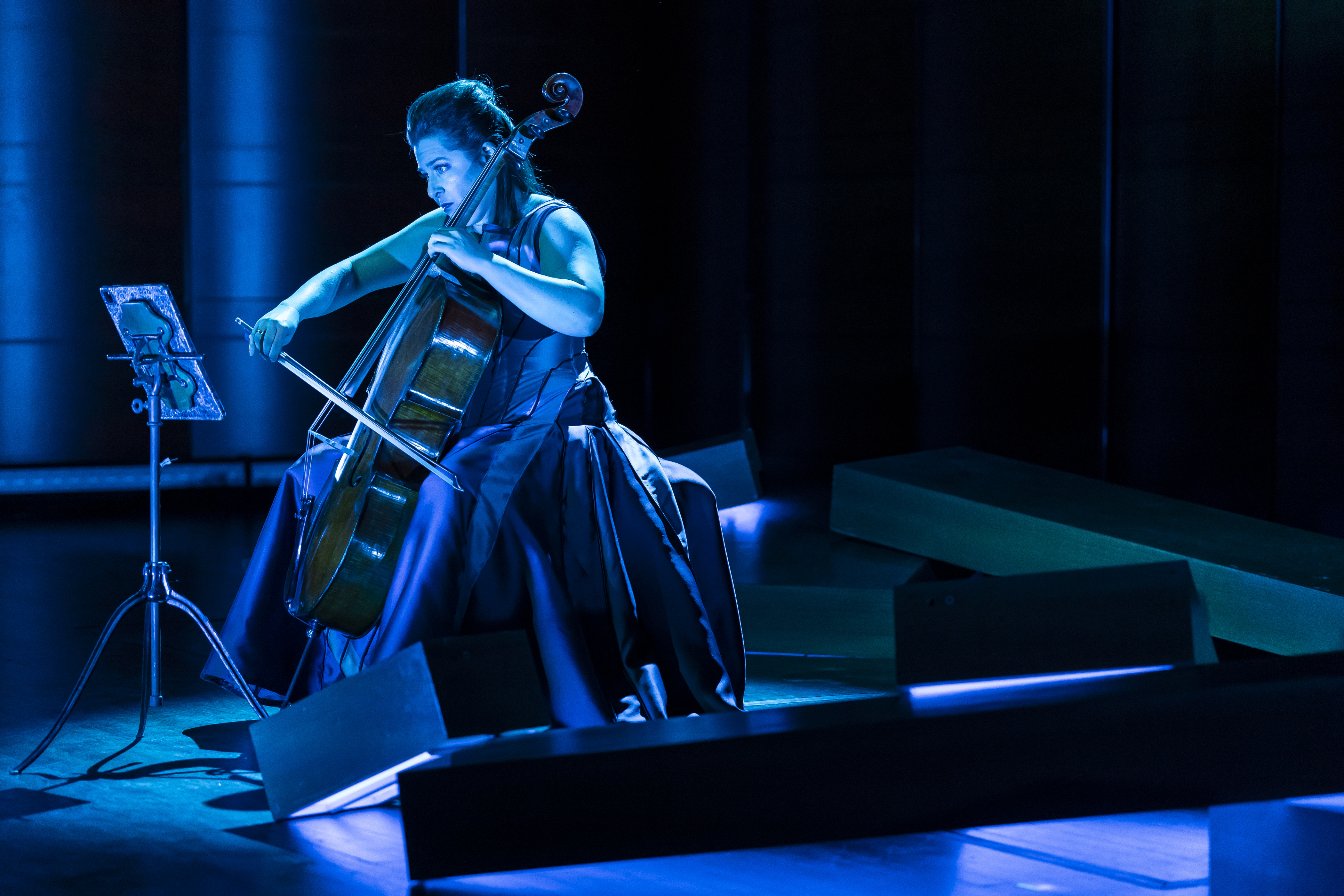
Alisa Weilerstein’s six recitals will pair Bach’s cello suites with new works by 27 composers.
While I missed many things about South Carolina during my time away, Spoleto was what I missed most; there is really nothing else quite like it. Not in California anyway and as far as I can tell not anywhere else in the U.S. In Northern California, I could go to some of the best opera in the world, see great orchestras from around the globe (a 15 minute bike ride from my house), listen to chamber music in a winery, experience amazing dance, and see a ton of ground breaking new music. But not all part of the same big festival.
A great deal has changed at the festival in the past decade, including the leadership, a big expansion of the Americana/pop/world music lineup, and fewer contemporary dance offerings, but there is always a full plate of a main course — chamber music in the Dock Street Theatre.
I’m looking forward to the Spoleto experience again and will be writing about it here.
Some catching up
Hello all (whoever you are).
For a moment, I feel that there’s not anything pressing I need to write about. This gives me a chance to introduce/reintroduce myself and make a few observations.
Background: I came to Columbia in 1989 to cover the arts for The State newspaper which had a long history of giving significant coverage to the arts across the state. I basically did that for the next 19 years and nine months, eventually covering just about every art form. Then that day came in March 2009 when our arts staff, except for the pop music writer, was let go. About two weeks later I started a blog, Carolina Culture, did that for a year or so, then pieced together writing and media relations jobs for the next few years. In 2014 I headed to the University of California, Davis, to be a writer for website/magazines/social media where I wrote stories that weren’t all that different than what I wrote as a journalist. (My resume is on this site if you’re interested in details; my UC Davis stories have disappeared in my re-organization of the site, but I hope to get them back.) I retired from UC Davis in January ’24 and in September’25 came back to Columbia, a place I never wanted to leave. (But I’m very happy to have spent a decade in California!)
A lot has changed here and a lot has not.
One of the things I always bragged on about Columbia was that it has three museums showing art, each with its own mission: the Columbia Museum of Art, the S.C. State Museum and the McKissick Museum at the University of South Carolina. But since I’ve been back, they’ve all three mostly been closed which is kind of hilarious and kind of annoying. Each of these is worth talking about in some depth, but not today.
The thing is, even with these three major places closed, there is SO MUCH GOING ON in the visual arts specifically. When people have asked about my impressions of the arts scene here after being away for so long, that’s what I say.
All this is happening in a mix of places that have been around for a while, several that are the children of earlier spots, some brand new. Among them: 701 Center for Contemporary Art, Stormwater Studios, Lewis and Clark, Mike Brown Contemporary; Soul Haus; Columbia College’s Goodall Gallery; the USC School of Visual Art and Design gallery; various venues where the Jasper Project mounts shows; most recently studio/gallery complex Gemini Arts and RocBottom studios. First Thursdays on Main Street seems only marginally connected to art any more, but they’re still fun. During my time away it appears I missed both the high points and low points of Tapp’s Art Center and the same for West Columbia/State Street arts district.
Since the fall, I’ve also been busy with great concerts, most of them at the USC School of Music, so many of them incredible (read my story on Columbia native and USC alum Andy Akiho in an earlier post) and a few literary events. I went to a couple of stellar dance performance, USC with Joffrey Ballet dancers and the Columbia Classical Ballet with guests from American Ballet Theatre and San Francisco Ballet. I have also ventured out to see art in Greenville, Sumter, Charleston, Augusta, Buena Vista, GA, and, of course, Lake City (see review of ArtFields posted a few weeks ago below).
But really, Columbia is keeping me busy. I’ve reconnected in Columbia and elsewhere with a lot of old people (read that as you will) and a lot of new people too, and all that is energizing. Is everything these places showing great? Hell no. But the energy and excitement is great. It feels good.
My goal going forward, is to contribute a bit to the arts conversation in the area.
Stay tuned: what doesn’t feel good.
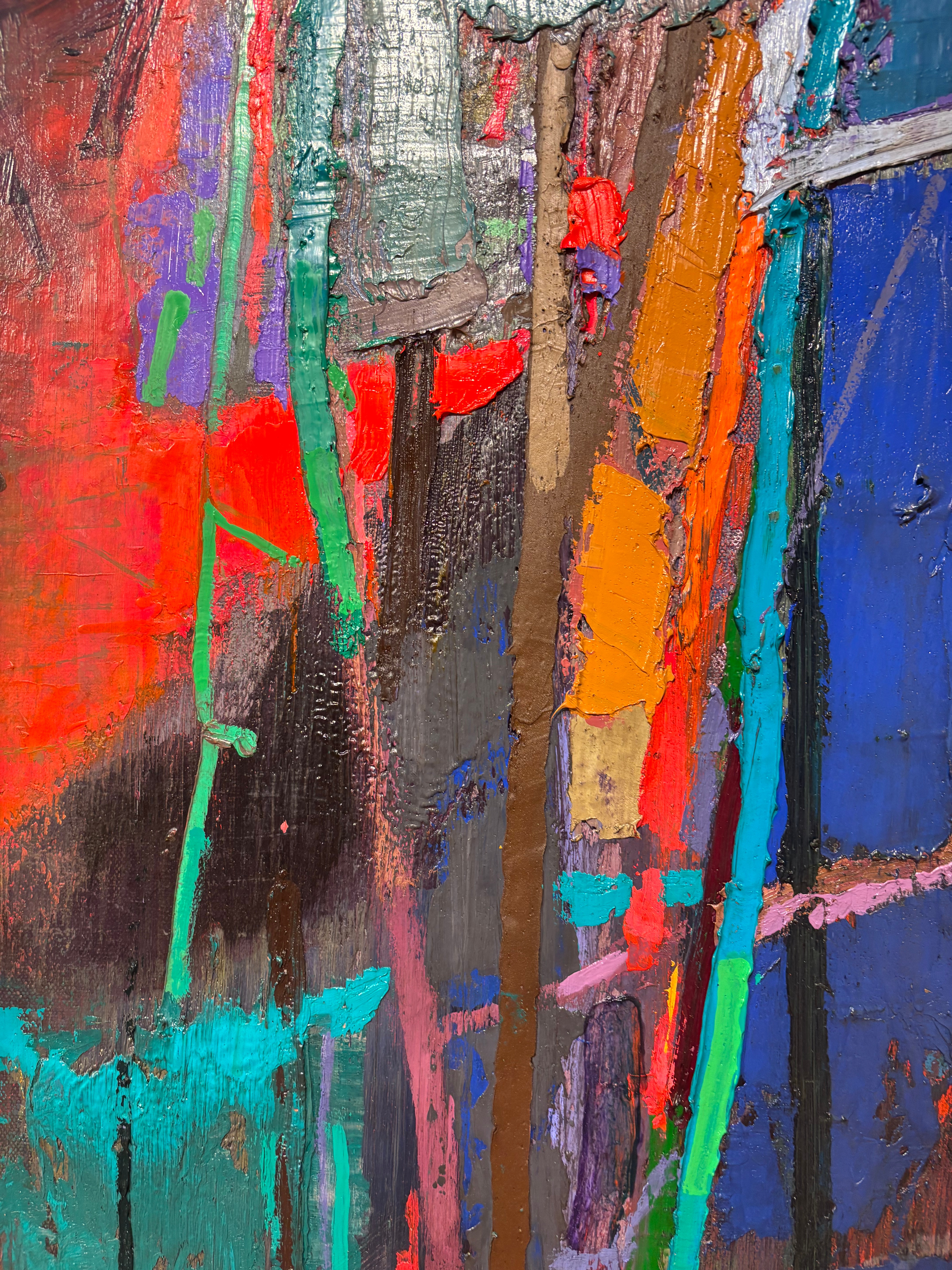

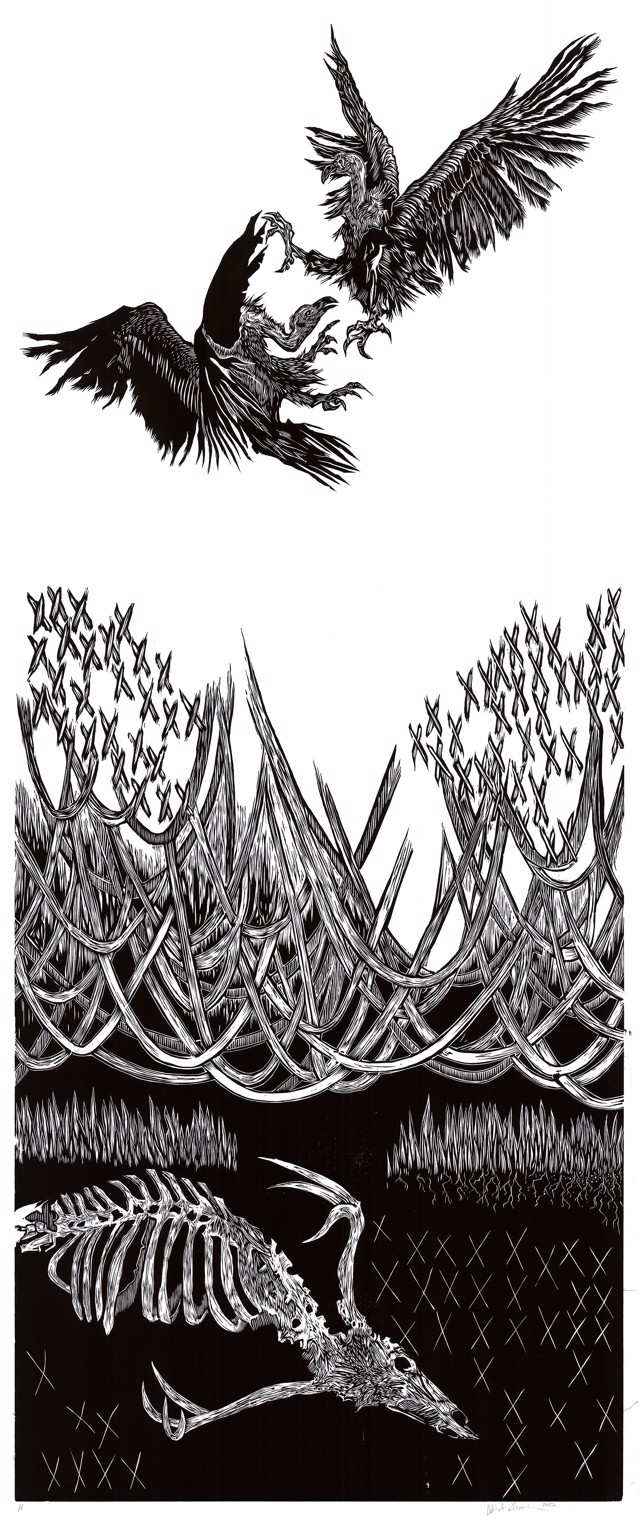
Details of art by (from left) Brian Rutenberg, John Acorn and Adrian Rhodes.
Take a deep dive into South Carolina art through three solo shows spanning several generations
May1/ 25
Three concurrent solo exhibitions around the state offer great insights into South Carolina art over time and in many ways. The exhibitions by John Acorn, a sculptor and a professor at Clemson University from 1961 to 1997; Brian Rutenberg, a Myrtle Beach native who draws heavily on this place, although he has lived in New York for nearly 40 years; and Adrian Rhodes, who grew up and lives in Hartsville, are all excellent in their individual ways and provide a bigger picture of art in the state with their varied approaches and backgrounds.
Early pioneer and teacher
Like many artists/professors, Acorn arrived in South Carolina from elsewhere as colleges and universities across the nation were establishing art programs. He quickly became part of the small, mostly imported group of artists forging new paths in South Carolina. He and others were, and remain, stalwarts of Hampton III Gallery in Taylors, which was founded by some of those same artists. Since the gallery opened in 1970, one of Acorn’s cast aluminum sculptures, Interactive Forces, has stood guard at the gallery entrance making a bold statement for what the place is about.
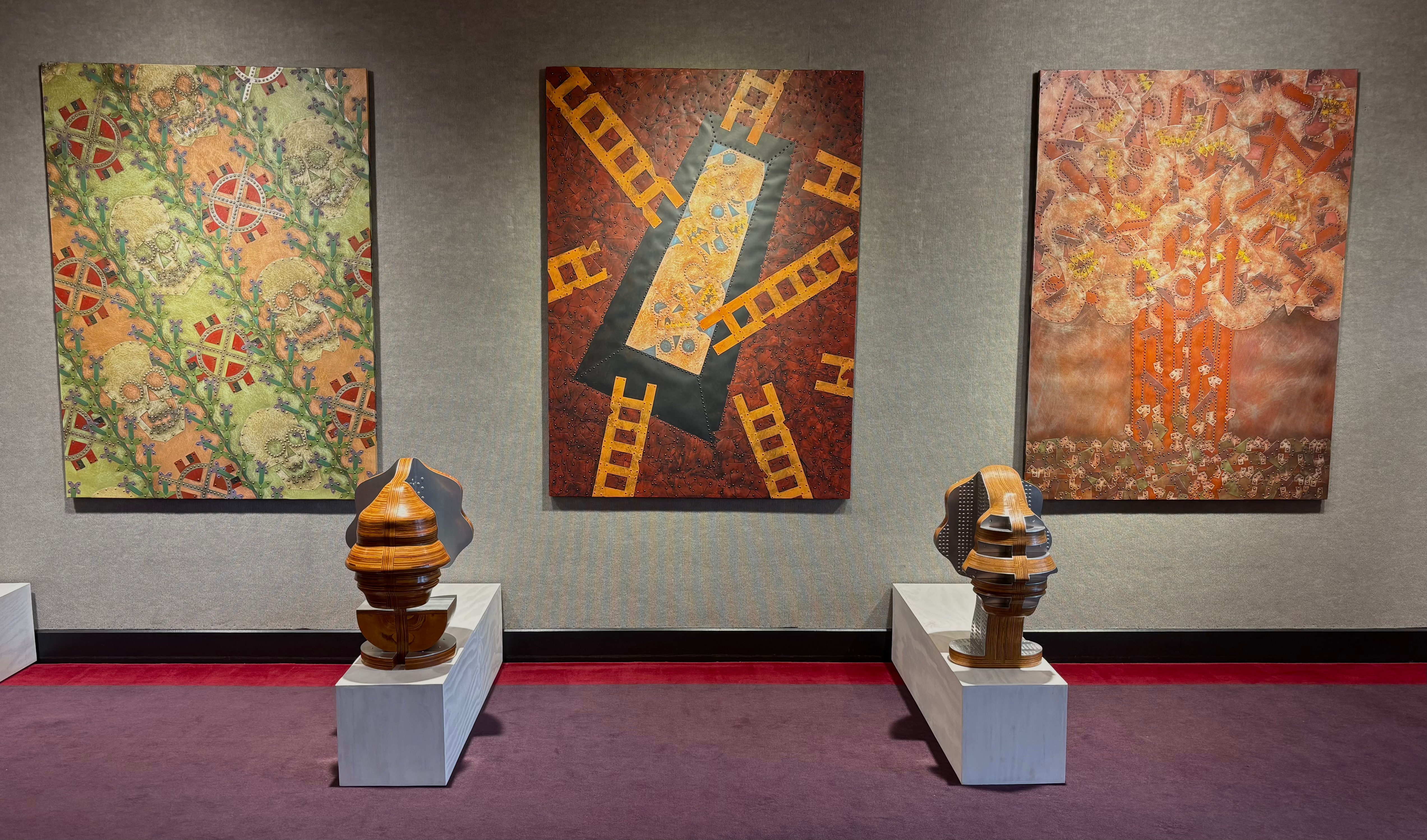
For the exhibition titled “20th Century Man,” Hampton III is showing about 45 pieces of Acorn’s work from the 1970s – 1990s: a few early cast aluminum sculptures, a couple of painted wood abstract masks, a series of laminated wood and metal plate heads, larger than life standing figures, and burnished metal relief sculptures, many of the later depicting skulls piled high as if in killing fields or catacombs.
Acorn’s art has frequently been rich with political and social content and this is nowhere more evident than in his relief works from the 1990s. In these he has cut various shapes, often skulls, from thin metal, then composed with these pieces, nailing them to a wooden backing. The metal has been painted, often black, but sometimes with colors, burnished and sanded and at times subtly embossed. The way they are made and the content perfectly align in a controlled chaos of sharp edges, scuffs, nails, all overlapping in mad but perfectly composed ways. (Right: South Pacific I, 1993)

Titles give some hints, but don’t say too much. The partial title South Pacific appears in a few, including a literal pile of skulls and skulls impaled on poles. Others go by more prosaic, but also disturbing names — Wallpaper, speaking to the horror we are surrounded by daily, but don’t even see. One of the most recent is a beautiful window with light shining through surrounded by nearly hidden skulls. The title Kristallnacht refers to a wave of Nazi provoked violence against Jews in 1938. The glow is not the sunset or sunrise, but the fires of the attacks and the ovens to soon follow.
The relief works that hang on the walls are kept company by Acorn’s dissected heads, made of layers of wood with insets of metal plate. He’s pushing the material in inventive ways, showing the outside and inside of the heads, what we show and what we hide, and how looking at a head/human from different angles can provide a very different idea of what that head is about.
His larger societal concerns, from gun violence to environmental degradation, are expressed in his Camouflage Man series, although the large human body shaped sculptures in this show are not as pointed as some (like ones made entirely of handgun shapes.) Going back to the start of his career, the exhibition includes two early cast aluminum works that refer to nature in the largest terms and express it in the most basic geological ways, as does the very volcanic method of casting.
While there are no recent pieces in the exhibition, titled “20th Century Man” the work feels entirely of our times, often frighteningly so.
The exhibition is up through May 31.
A deep immersion into place and paint
Brian Rutenberg was recently in Columbia to officially donate a painting to the University of South Carolina (see it at the Koger Center for the Performing Arts). Although he moved to New York to attend graduate school in 1987 the South Carolina Lowcountry continues to be a touchstone of his art. But don’t be mistaken and think that’s all they are connected to; his paintings are just as linked to artists across the centuries as they are to barrier islands, marshes and rivers.
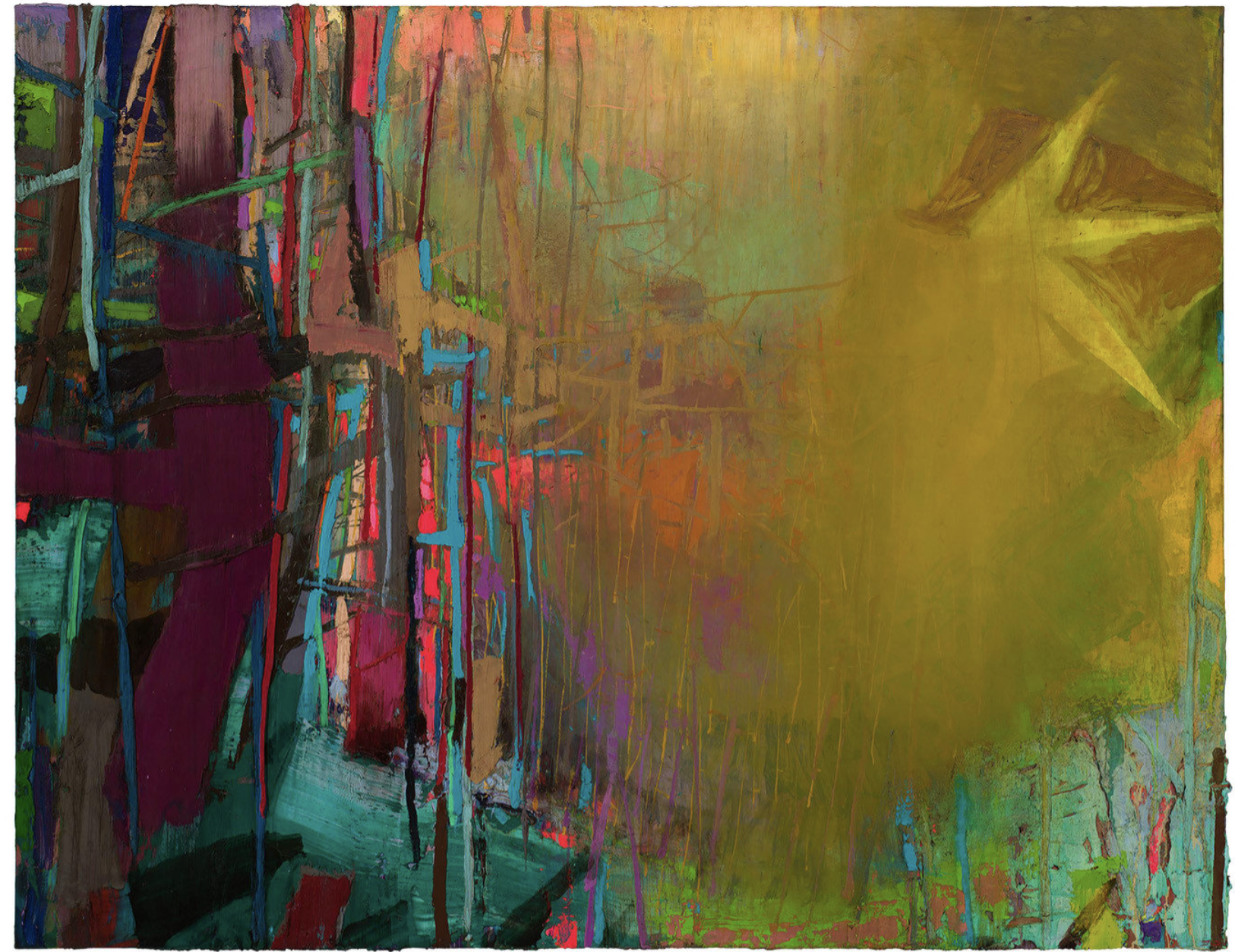
Banner of the Coast (Sandspur)
About half the 22 paintings in the Sumter Gallery of Art exhibition were done in 2022, with one from last year and others from a few years earlier. Most are large, meaning four to five feet tall and six to eight feet wide, with a scattering of smaller works including two on paper.
One experiences Rutenberg’s paintings very physically, the large size and the horizontal nature embracing one, with heavily painted vertical lines pulling you into the work, through a deep central space that leads, if you’re willing, to the open ocean, sky and outer space and inner space. Experiencing Rutenberg’s paintings is like listening to a beautifully complicated piece of music that washes over you, draws you in and maybe knocks you around a bit.
I looked at nearly all those in Sumter for a long time, especially Banner of the Coast (Sandspur). If it had been the only painting being shown, I would have felt satisfied. But it isn’t and there are these are as good as any he’s ever done.
It’s difficult for me to separate Rutenberg’s art from my experience with it and him. I first saw met him and saw his work 1992 when he had a small show at the Greenville County Museum of Art. Since I’ve seen many of his shows, visited his studio numerous times and interviewed and written about him and his work from time to time (well, maybe many times.) Still, I think I can stand back and look at his art objectively and also say something about it that may be meaningful, if only to encourage you to see it.
(Just so you know, the gallery is small, has a low ceiling, moveable walls and the largest painting is in the hallway; it’s not ideal. But good art can overcome a less-than-ideal environment and this art certainly does.)
Through June 13.
An all-encompassing exhibition

Adrian Rhodes, who earned a master of fine arts degree at Winthrop University in 2011, is first and foremost a printmaker. But her exhibition, “Adrian Rhodes – End Figure” at Mike Brown Contemporary in Columbia, has everything – prints, drawings, paintings, sculpture and installations, all compelling individually and together.
As a printmaker, what a printmaker she is — woodcuts, linocuts, lithography, etching and more Her art is filled with wildlife, fruit, plants, scissors, strings, some floating in air, decaying underground, interacting in a world that is both real and magical. Some are crowded, others full of space, with the various elements bumping against one another literally and figuratively in captivating and thoughtful ways. There are moments of quiet and stillness, other times chaos, but in all cases there is a dynamic flow of energy in various directions of space and time.
Her several large paintings in the exhibition cover similar content and in execution have a look closely associated with the prints as well as with lush and powerful paint application.
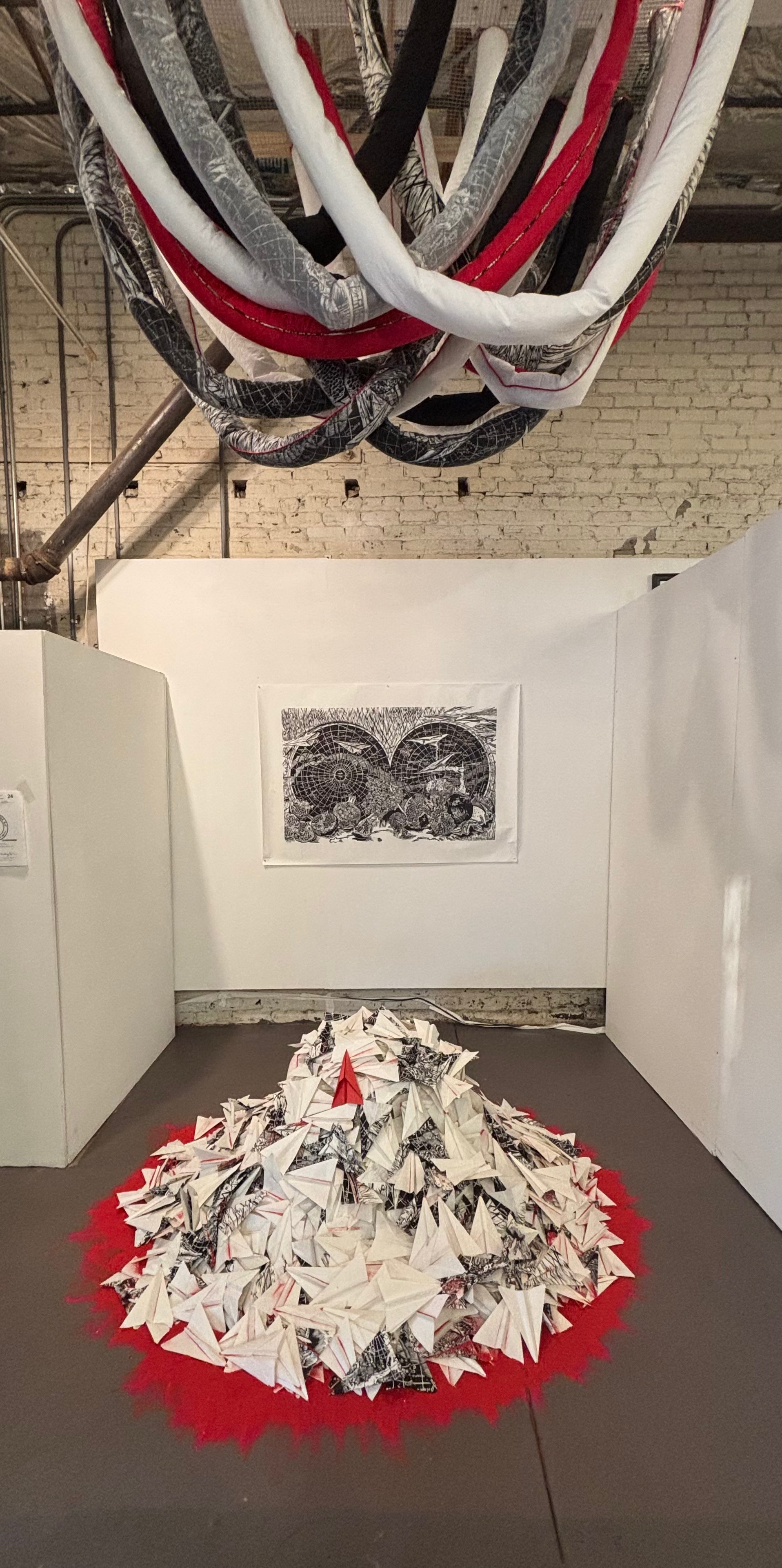
Several small gouache drawings/paintings, mostly of dead, but beautiful, animals provide a somber counterpart.
If that’s not enough there are also several sculptures/installations of ceramics (pomegranates, paper airplanes), fabric and more. One couldn’t ask much more of an artist or an exhibition.
The small gallery is well used, with individual works perfectly placed for creative conversational interaction among them. It could have felt cramped and noisy, instead it feels intimate. This same collection of Rhodes’ artwork would be just as effective and communicate in other ways in a much different space. This is art that could and will keep on giving wherever it is shown.
The exhibition runs through the end of May.
Once more into the (Art)Fields
A place to be simultaneously overwhelmed and underwhelmed

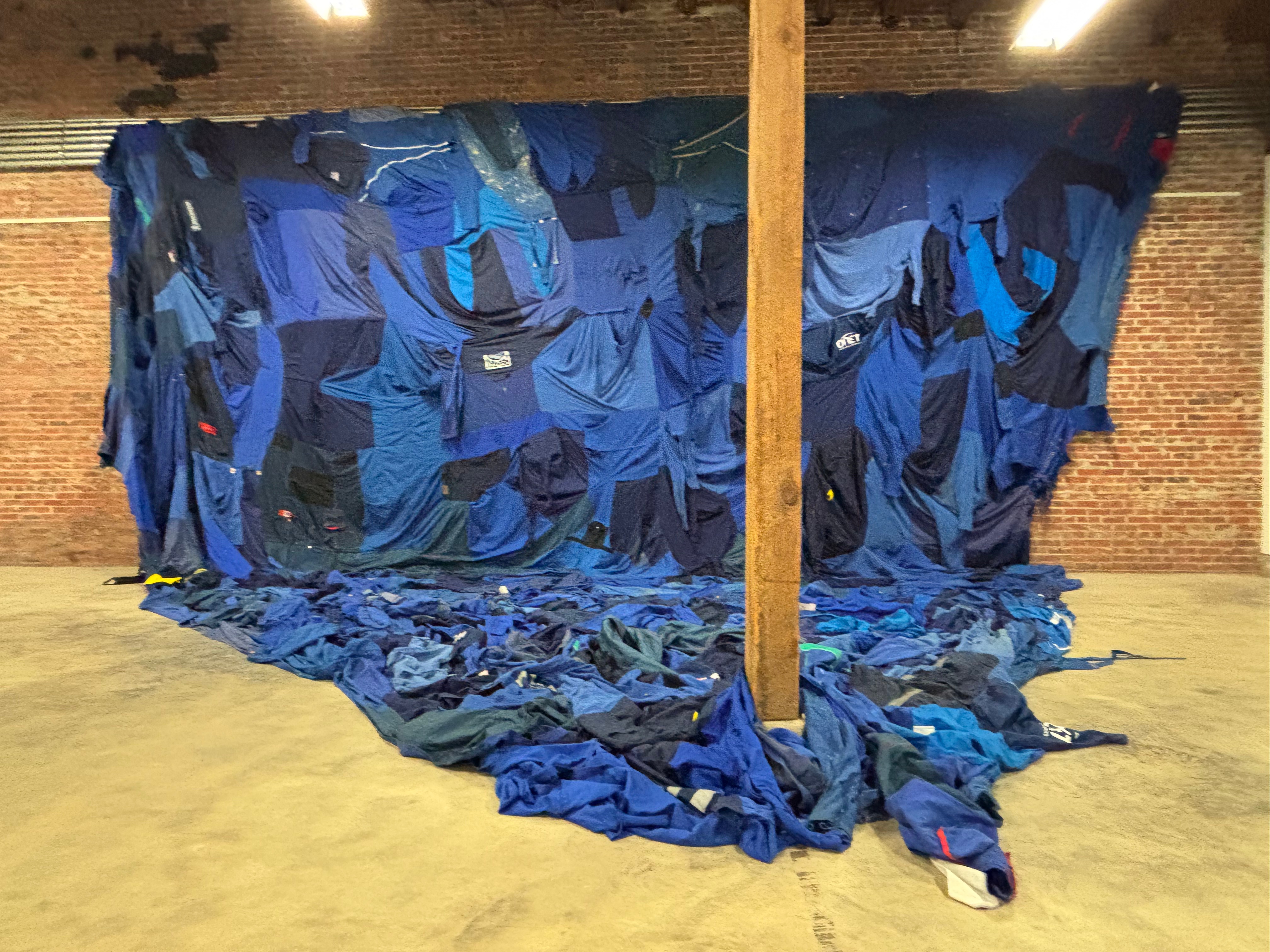
Overseersucker by Colin Quashie, Essential Workers by Kasia Ozga, Drift (detail) by Eric Standley
April 26/25
The first time I went to Lake City’s ArtFields was in 2013 — its first year. I’ve been living elsewhere for the last decade, so my second visit wasn’t until this year. It felt about the same, for both good and ill.
The annual ArtFields festival and competition, with a top prize of $50,000, brings together about 400 works (one per artist) made during the past three years, from 12 Southern states. During the 9-day festival, ending May 3, the art goes up in about 35 shops, a few outdoor spaces, and several larger gallery-like venues. It was founded by Darla Moore, a Lake City native, who made a lot of money and has given a lot of it away.
I highly recommend going, just make sure to hit some of the big venues early and don’t try to see everything. (Looking back, it appears I missed a few places by accidents and know I missed a few individual pieces, but I swear I tried to see it all.)
Ducking into barber shops, bridal boutiques and real estate offices to find art and talking to the owners/employees who are excited to be part of it gives ArtFields a delightful scavenger hunt vibe. Even though most places can only show a few pieces, can’t always display it well and lean toward the traditional and more conservative, the uniqueness offsets most drawbacks. In the larger venues (Acline Studios, Jones-Carter Gallery, Traxx Visual Art Center, The ROB, the Continuum) the art is better displayed, in a more traditional art show way, and the quality overall is higher and work more challenging.
But none of this matters when the real issue with ArtFields is that a lot, maybe most, of the art isn’t very good. Too much of the work is poorly executed, gimmicky in technique, obvious in content or with little content.
Before getting into all that more, let’s take a look around (If you want to get into all that now, go to the last two paragraphs)
First let’s duck into some shops.

One of the most delightful pieces in the entire show is hallow (oven) by Patricia L. Cook (Durham, NC) who has made a life-sized old-fashioned kitchen stove and cooking gear of pink fabric. Tara Thacker’s Remiges; Ivory Gull (West End, NC) does one of my favorite art tricks; it looks like one thing but it is something else. In this case it appears to be fabric, but is porcelain.
Power Object by Jasmine Best (Athens, GA) was inspired by folk practices to create an artwork that turns a handmade broom into a magical object. to define.
Revelation by T. David Downs (Brunswick, GA) is a delightful, large painting of a standing bear surrounded by plants and animals and being annoyed by a flying saucer. His statement says the painting “addresses what I think is a great omission in contemporary painting: the unidentified flying object.” (More on statements later.)
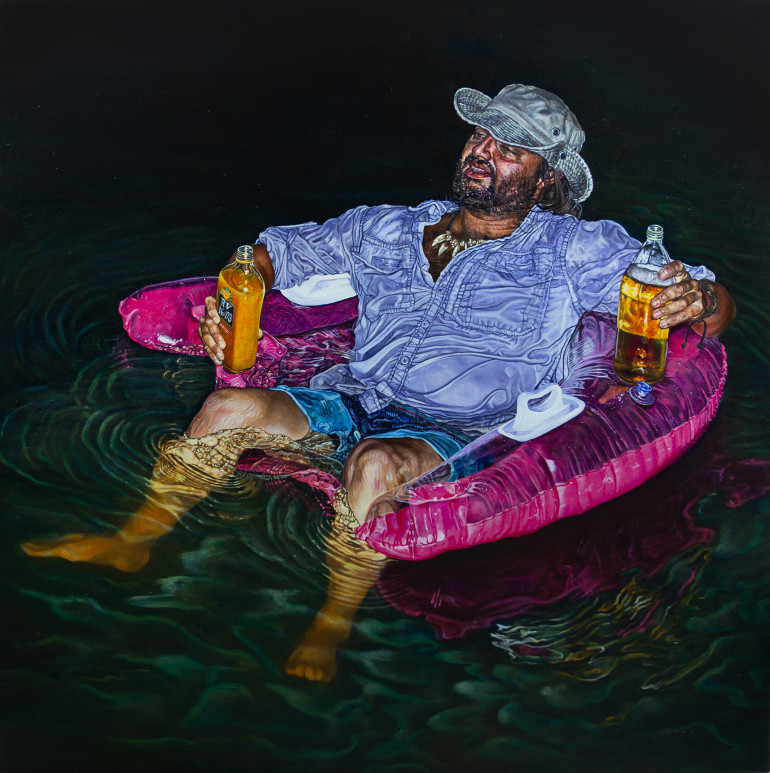
Also coming in high on the humor scale is “Floaty Man in the Bardo” by Lucius Nelson (Darlington), a highly detailed painting of a heavy-set bearded man relaxing and enjoying a drink on a pink pool float. The bardo is a Buddhist concept of being between phases of consciousness or existence, or as the painting illustrates, suspended and floating in an undefined space. While both paintings are funny, they are also completely serious.
The Ronald McNair Life History Center, honoring the Lake City native who died in the space shuttle Challenger explosion, isn’t a shop nor an art venue, but that’s where you must stop for Overseersucker by Colin Quashie of Charleston. In Quashie’s re-imagined seersucker suit, the blue stripes are composed of the names of people enslaved at a Charleston plantation and the lining and vest are toile fabric depicting enslaved people working the fields with a white overseer looking on. Quashie has long been one of South Carolina’s most important artists, far ahead of almost everyone. His art is always thoughtful, thought provoking, masterfully made —and grossly underappreciated and/or actively avoided by organizations and individuals alike.
Andrés Bustamante’s large inflatable sculpture Sol Naciendo.Renacer (rising sun. reborn), located outside The Continuum, has sound, light, lots of reflection, and you can draw on it. It would be nice to see more larger scale outdoor works like this. Bustamane, of West Palm Beach, is the only artist I met during my day at ArtFields. While I wish more had been around to chat with, if that was the case I’d probably still be in Lake City five days later. The Continuum is also a very cool building and has other excellent works.
A further look around at the larger venues.
At Alcine: Remnants From a Hurricane by Chole Compton of Simpsonville uses a print found after 1989’s Hurricane Hugo to build a narrative sculpture of steel, clay and earth. Sequence, by Thomas Campbell of Asheville, is a geometric sculpture of tiny steel plates with a rich variety of hues and surfaces that also digitalizes right before our eyes.
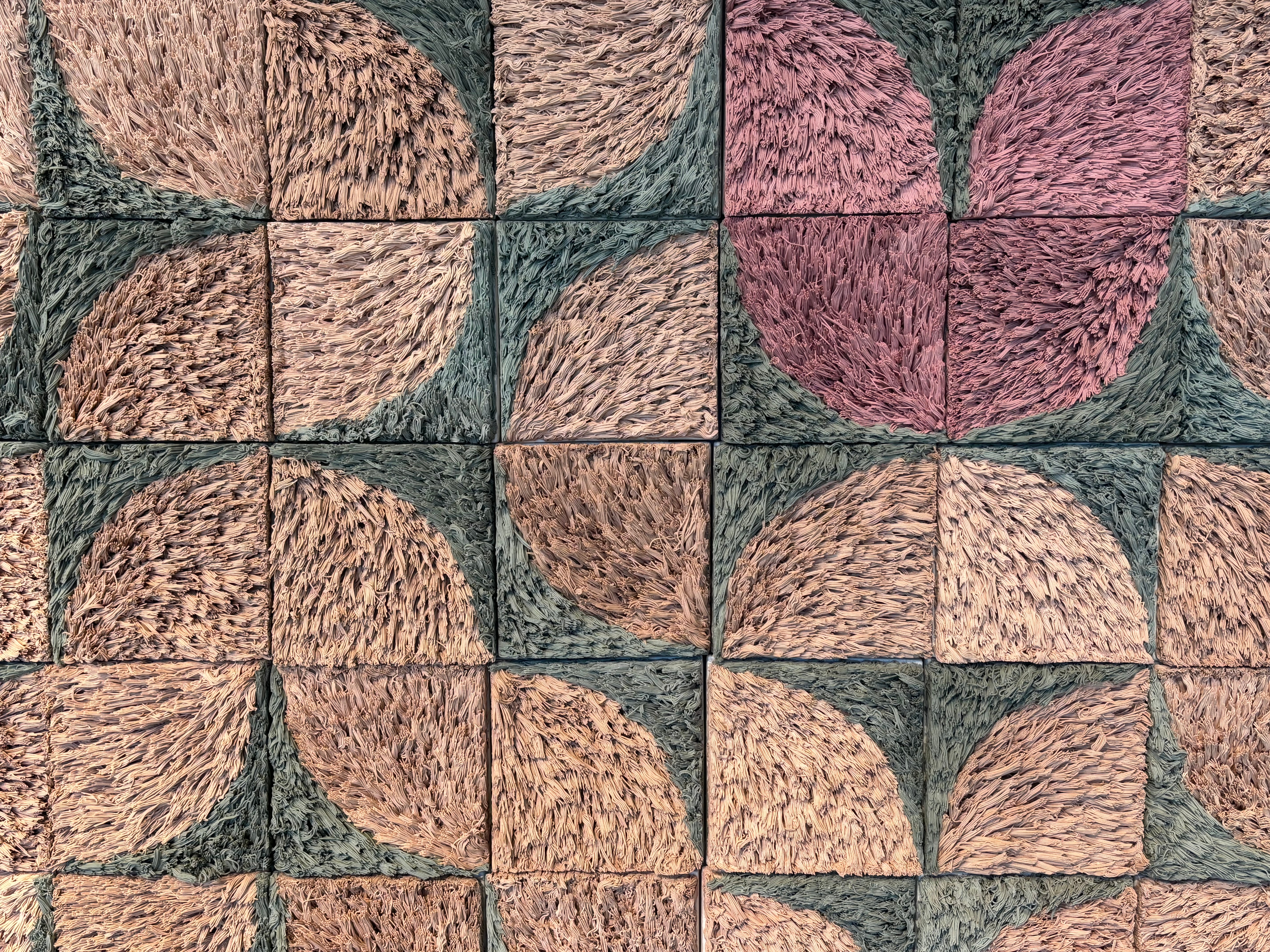
Similarly, Dissonance by Risa Hricovsky of Knoxville is an undulating rug-like ceramic sculpture that provides delights in detail and from afar.
Trax Visual Art Center is the place to see art in mediums that are well represented throughout ArtFields: textiles and wood sculpture.
The ROB: Here you will find one of the few works that feels like an installation made for the space. Essential Workers by Kasia Ozga of Greensboro, NC, is a wave like construction built of used blue overalls, jackets and pants, that covers the floor and climbs the wall in an homage to those who work and keep things running, often invisible, usually underappreciated.
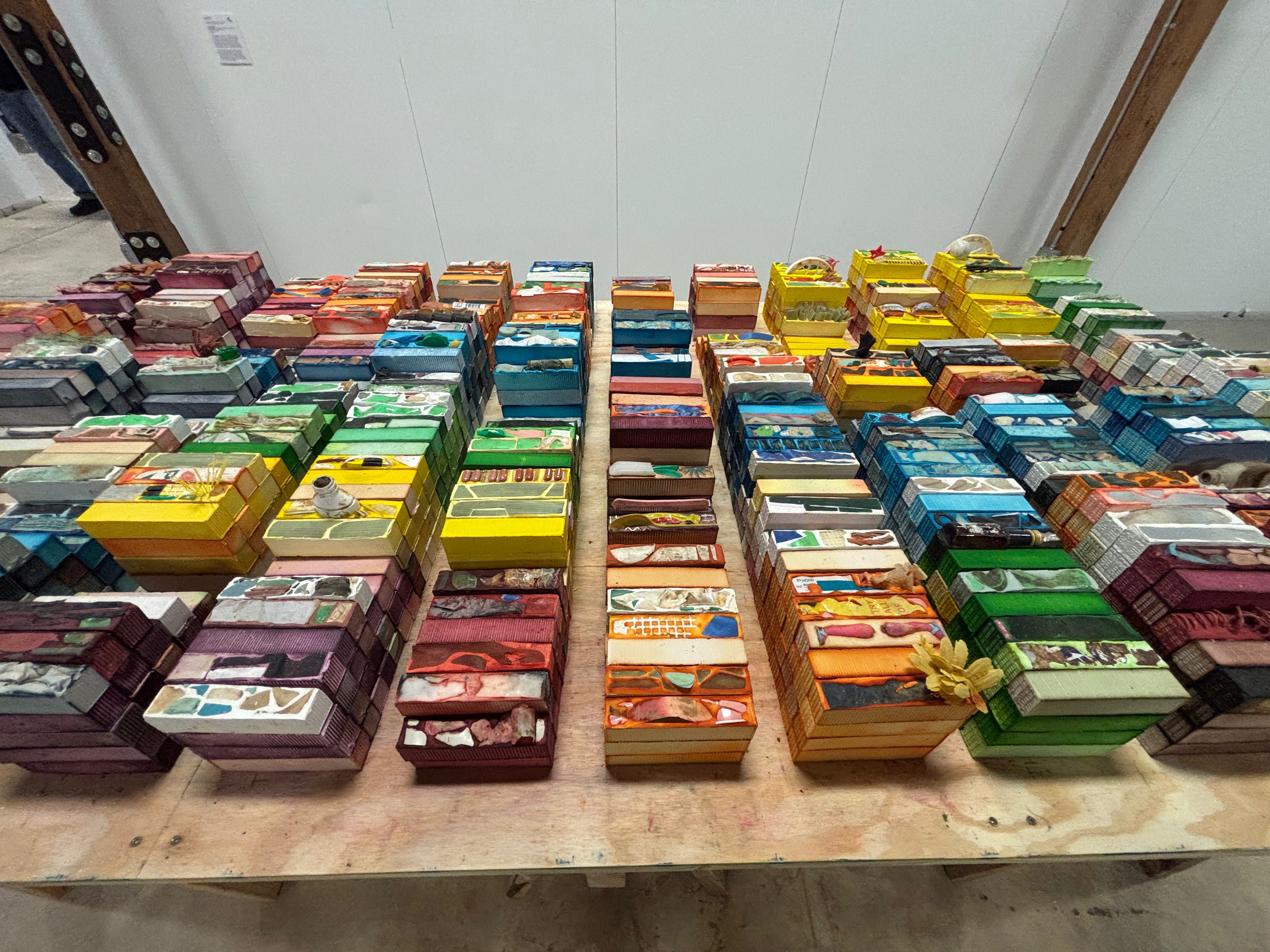
Stack Collapse by Nora Hartlaub of Asheville is also connected to a hurricane from a few years ago. Her sculpture is made up of 1,400 scale models of shipping containers, many including detritus washed up by the storm.
Dirt, the Body and the Blood by Cheryl Hazelton of Memphis covers the floor with hundreds of handmade mud bricks that incorporate testimonies from laborers.
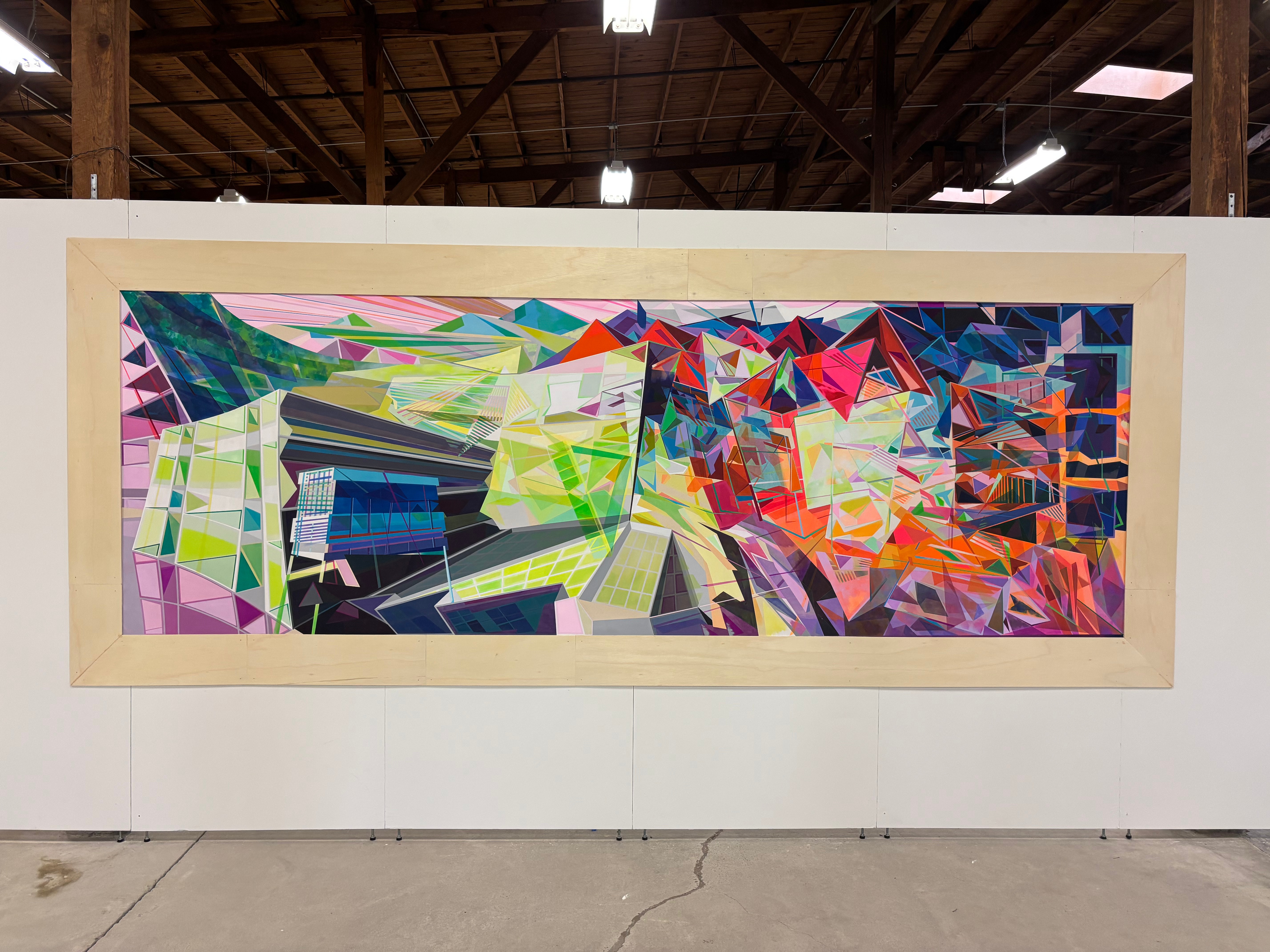
The 15-by-5 -foot painting idiomas de la naturaleza by Peter Marin of Raleigh mixes abstract geometric elements that merge into the architectural. The beautifully rendered and subtle marks move from an intense densely-packed red-orange area on one side to an airy space dominated by soft blues and greens, taking the eye on a delightful visual journey. Faint by Lily Tilton of Columbia, NORTH CAROLINA, looks like a black, curved wood bench, and that it is, but it is so much more. Last but surely not least (maybe most) is Drift by Eric Standley, an installation of 25 intricately cut and constructed small paper sculptures that must be seen to be believed.
And there are many more good ones and not so good ones at The ROB.
Every piece in ArtFields has an artist statement next to it and I don’t recall seeing labels that tell so much about a specific work. I guess the intention is to make the art accessible to the many people for whom the festival is their main art experience. One of the most important and enjoyable things about art is for the viewer to have their own experience and to decide what it means to them. How can they do that if the statement tells them everything? Of course no one is required to read these statements, but there they are.
Time for a refresh?
The ArtFields festival is fun and exciting and exhausting (in a good way), but I leave it with an empty feeling as an art lover and voracious viewer and as one who is interested in the role something like ArtFields can do in developing an informed arts audience. The way ArtFields presents the art and the art it presents doesn’t do a great job on either front.
It is difficult to understand how, after more than a decade, with solid selection and prize panels, and offering so much money, ArtFields doesn’t end up with more good art. Yes, 400 artworks is a lot, but surely there have been 400 and many more great artworks created throughout the region recently. Why aren’t those in Lake City? Are the best artists just not entering? If not, why not? Is the amount of the prizes, which are purchase awards, too low for established artists? Are some opting out because they don’t support or take part in juried shows/competitions? Don’t like the display environment? (I’d love to hear from artists about this.)
Maybe it’s time, or past time, for an ArtFields reevaluation and refresh. Keep a big juried show for the shops and some larger venues. But also mount curated, thematic exhibitions of invited artists, commission temporary/installation works, include a wider variety of mediums (aren’t we in the video/ digital media century?). Make room for conversations with artists/jurors/curators panels. Yes, the galleries and other spaces in the city do more focused exhibitions, panels and other events years round, but most people are going to be in Lake City to see art during the festival/competition. Why not give them the best?
MORE IMAGES FROM ARTFIELDS: Power Object by Jasmine Best; Overseersucker, detail, by Colin Quashie; idiomas de la naturaleza, detail, by Peter Marin; Sol Naciendo.Renacer by Andrés Bustamante; Stack Collapse (detail) by Nora Hartlaub; Dirt, the Body and the Blood by Cheryl Hazelton; Remnants From a Hurricane by Chole Compton and Sequence by Thomas Campbell.


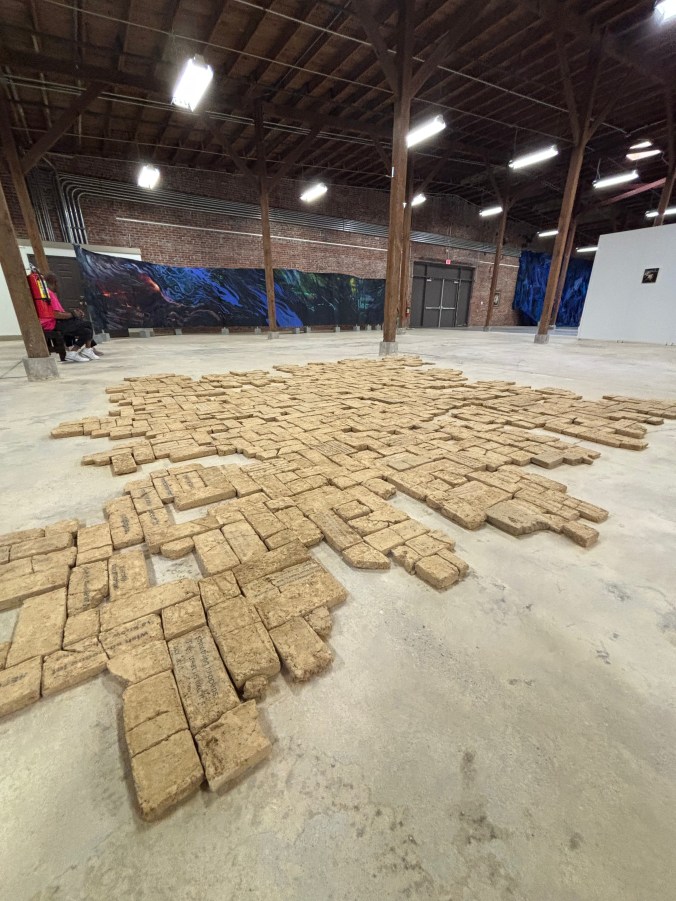
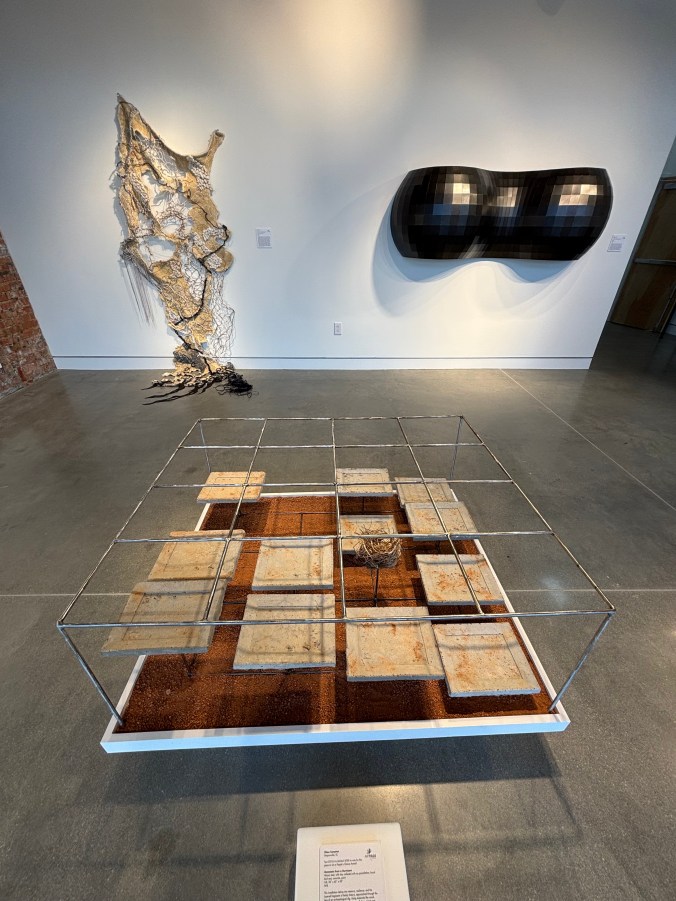
April 23/25
Columbia native, USC alum, Pulitzer finalist brings his music home

SC Phil plays Andy Akiho’s newest work and he’ll perform his steel pan concerto with the orchestra too
This year has been a homecoming for Andy Akiho. The Columbia native who studied at the University of South Carolina School of Music has been back in town recently for performances of his music, and if he hasn’t been in town, his music has been. This Saturday, April 26, Akiho will be doing double duty with the South Carolina Philharmonic. The orchestra will play his newest work, Nisei: Concerto for Cello and Chamber Orchestra, and he will perform with the orchestra on his Concerto for Steel Pans and Orchestra.
“The steel pans concerto was my first piece for orchestra and Nisei is the newest, so it feels full circle,” said Akiho, a virtuoso steel pan player who graduated from USC in 2001. “These are the bookends of my orchestral writing so far.”
The recent Columbia concerts (including Copper Canvas – watch here) have also been a moving and reconnecting experience for him.
“The school recital hall is the first place I played in public,” he said.
Akiho has seen faculty he studied with, got to know others for the first time, met with and worked with students, and visited family and friends in the area.
“A lot of years I haven’t been back and I feel grateful I can be where it all started.,” said Akiho, who lives in Portland, Oregon, and New York. “I had all these mentors at USC—it was a real life-changing time for me. The people at the music school are amazing humans.”
Time at USC “life changing”
While a student at USC he met other curious musicians with whom he has remained friends and colleagues including composer Baljinder Singh Sekhon II, Charleston based jazz drummer Ron Wiltrout, and composer and percussionist Kennth Salters, who he later shared an apartment with in New York.

“I’m still working with some of my best friends and that all started at USC,” Akiho said.
While Columbia and USC have been celebrating Akiho, his acclaim is hardly local. In 2022 he was one of three finalists for the Pulitzer Prize for Music for his 2021 piece Seven Pillars, written for Sandbox Percussion. It was performed the next year at the School of Music Southern Exposure series. (Watch here with intro by Akiho in which he encourages the audience to clap, yell, dance and stage dive.)
He also has seven Grammy Award nominations and is the only person nominated for Best Contemporary Classical Composition in 2022, ’23 and ‘24. One of those was for the recording of his BeLoud, BeLoved, BeLonging with the Imani Winds. (Watch a performance of it here.) A few days ago, Sound Box, San Francisco Symphony’s experimental series performed his music, and his trio, which includes his USC classmate Salter, played a full evening at UCLA in early April. Since he started composing in 2008, his music has been performed by … well the list is long. Very long. And impressive.
Exploring Identity in newest work
The title of the new piece, Nisei is a Japanese word meaning “second generation” and refers to children born in the U.S. or Canada to Japanese immigrants. The work was co-commissioned by the S.C. Philharmonic, Sun Valley Music Festival in Idaho, ProMusica Columbus (Ohio), Bozeman Symphony Orchestra and Oregon Symphony, where Akiho is current resident composer. The Columbia performance is the final of the year plus of rolling premieres of Nisei from west to east coasts.
Nisei developed through his long friendship and musical partnership with cellist Jeffrey Zeigler and their shared Japanese heritage. Zeigler, a member of the acclaimed Kronos Quartet for eight years, like Akiho, has worked with a long and impressive list of composers, orchestras and organizations.

Zeigler grew up in the San Francsico Bay Area and only learned as an adult that his family has roots in South Carolina and he has connected to relatives in Orangeburg. Early this year he created “We Were Fridays,” a work-in-progress that explores the Gullah culture of the sea islands of the Carolinas and Georgia.
The term Nisei is often associated with Japanese Americans who were imprisoned by the U.S. government during World War II and in the current political atmosphere of immigration, deportation and imprisonment, one might be tempted to look for political content in the concerto. But it is, said Akiho, about him and Zeigler, their personalities, friendship and shared heritage. The piece also marks a new page in their collaboration and for Akiho’s music, in that it is for the most traditional of orchestral instruments, with no sound manipulation and not even any percussion.
“We wanted to do something we hadn’t done before and see where we could take it,’ he said. “I wanted to accept this challenge to have only strings, woodwinds and brass to explore places I’d not gone before, and that Jeff and I haven’t gone before.”
The S.C. Phil brings another Japanese American connect —music director and conductor Morihiko Nakahara, although unlike Akiho and Zeigler, Nakahara is a native of Japan who first came to the U.S. to attend college.
“I first became fascinated by Andy’s work before I found out that he is a Columbia native with all these local connections,” said Nakahara, who first programed Akiho’s work with the Spokane, Oregon, symphony where he is a conductor. The S.C. Phil performed works by Akiho in 2016 and 2017.
“Andy’s music definitely is very rhythmic, as you might expect from his background as a percussionist,” Nakahara said. “I think his music challenges orchestras, but the fact his motifs are very groovy helps — it’s not a random assortment of difficult-to-digest or decipher rhythms. We can get his ideas in our heads, and then it’s a matter of working out the logistics on our instruments. It’s great to showcase both of his earliest orchestral work and the latest. Still rhythmically energetic and virtuosic, but also highlighting his lyrical side in the new piece.”
The immediate future looks as busy for the composer as the last few years. He’s creating a new piece for Sandbox Percussion, writing a concerto for tympani for the Houston Symphony, collaborating with composer Kenji Bunch and actor, author and activist George Takei on a multidisciplinary work inspired by autobiographical accounts of Japanese American incarceration during World War II. Among other things. With any luck, some of it will be in South Carolina.
It sounded promising, but art exhibition at historical Charleston home forgets its site
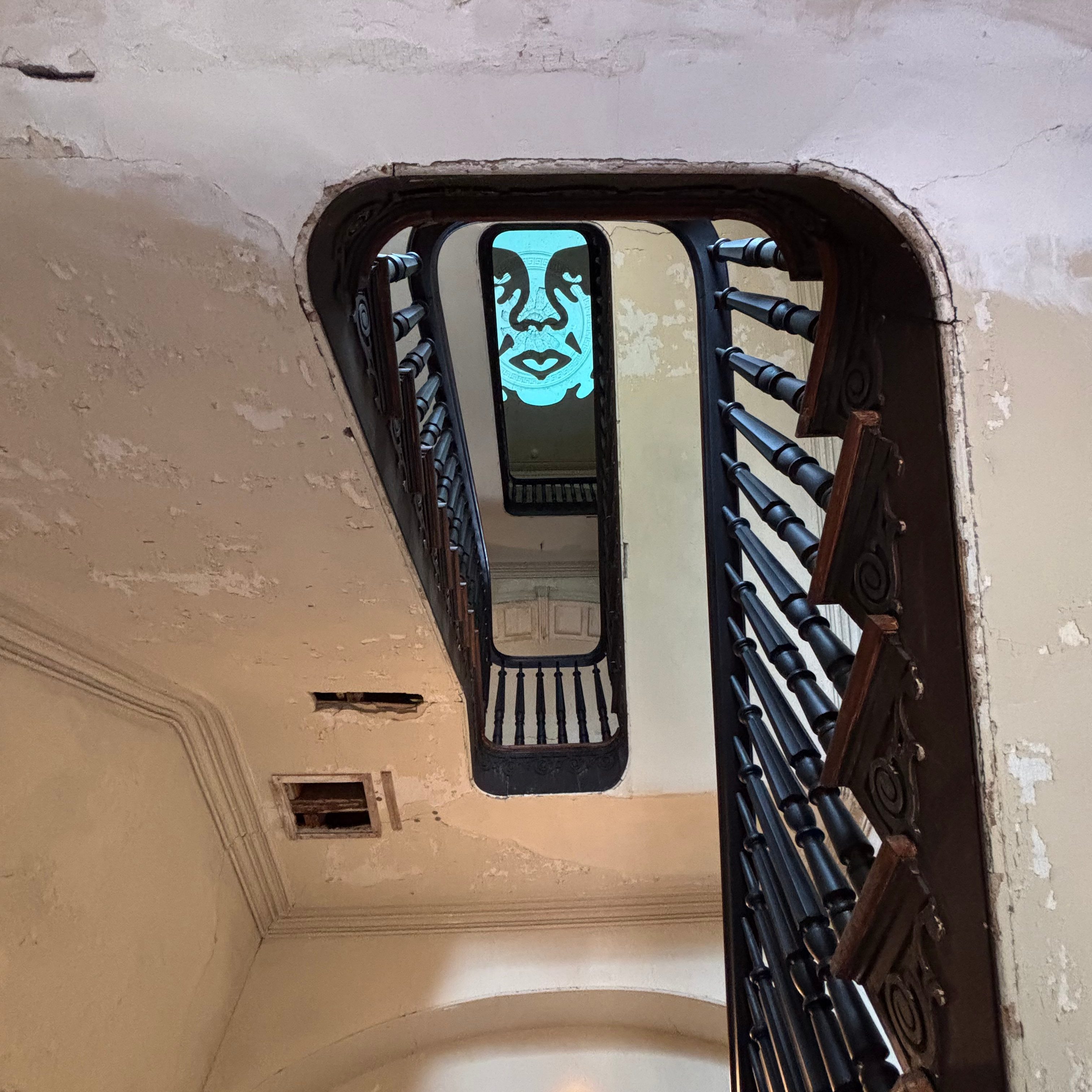
April 2025 – It sounded like a good idea and got my attention: “Fragments + Facades,” an exhibition at the 1820 Aiken-Rhett House by Charleston-natives Shepard Fairey and Tim Hussey, and Atlanta-based artist Masud Olufani. What also got me is that it was described as being “Created exclusively and ONLY for exhibition…” at this location. Apparently this means the exhibition was created for the exhibition — an odd way to put it — not that the art was created just for this. (The house is part of the Historic Charleston Foundation. The exhibition is up through April 13.)
The few installation pieces by Olufani, whose had a recent excellent exhibition at 701 Center for Contemporary Art, appear to have been made specifically for the house. But most of the graphic works by Fairey (best known for his Obey Giant works and the Obama “Hope’ image) and mainly large and powerful paintings by Hussey did not. The art doesn’t serve the space and the space doesn’t serve the art. The works by Fairey and Hussey have QR codes alongside them with info for purchase making this feel like a sale showing rather than a thoughtful exhibition in which the art addresses the place it is located. None of the text in the house nor on the Historic Charleston Foundation and exhibition websites speak to the artists’ interaction with the house.
Much of Fairey’s work, and there is so, so much of it, is not recent. There are a couple of large installation like works but only an “Obey Giant” projection seen on the ceiling at the top of the staircase is impactful. Fairey’s generalized political and social commentary can be relevant in any setting, but it’s too general for this site. (The McKissick Museum at the University of South Carolina had a magnificent exhibition by Fairey in late ’24-early ’25.)

Hussey’s muscular and dynamic paintings, semi-abstract with figurative elements, are quite powerful. The house is all peeling paint and wallpaper, cracked plaster, and weathered floorboards and Hussey’s painting are similarly full of layers and in that sense it’s a good match. But few of the paintings are well integrated into the environment; in fact they get in the way of it. Still, these are some great paintings, but they’d be better seen in a more traditional gallery setting.
Olufani’s work includes a ghostly video in a ghostly first story room and other pieces that include rice and cotton, two crops along with hundreds of enslaved people, that made the Aikens some of the richest people on the planet. Too bad there are not more of them.
This was my first visit to the Aiken Rhett House and I have to thank the organizers of this exhibition for getting me in the door, if not for the exhibition. It is an amazing place.
WELCOME TO SPRING
DAMN THERE’S A LOT HAPPENING.
Jacolby Satterwhite: From Columbia to everywhere and back
March 19.2025

Columbia native Jacolby Satterwhite, arguably the most important artist to come out of the state since Jasper Johns, is in town for screenings and talks Thursday and Friday thanks to the USC School of Visual Art and Design. Satterwhite’s immersive video commission, “A Metta Prayer” was recently on view in the Metropolitan Museum of Art’s Great Hall, and over the past decade his work has been at the Contemporary Art Museum, St. Louis; FRONT International: Cleveland Triennial for Contemporary Art, Haus der Kunst, Munich; Gwangju Biennale, Gwangju; Wexner Center for the Arts, Whitechapel Gallery, London; Museum of Modern Art; Minneapolis Institute of Art ; Museum of Contemporary Art, Chicago ; Fondation Louis Vuitton; New Museum, New York ; Public Art Fund, New York; San Francisco Museums of Art, San Francisco. His work is i in the collections of the Museum of Contemporary Art Kiasma, Helsinki; Museum of Modern Art, New York; Studio Museum in Harlem, New York; and the Whitney Museum of American Art, New York, among others. He was awarded a commission in collaboration with the Studio Museum in Harlem and the Public Art Fund to inaugurate Lincoln Center’s new David Geffen Hall.

Installation views of The Great Hall Commission: Jacolby Satterwhite, A Metta Prayer, The Metropolitan Museum of Art, October 2, 2023 – January 7, 2024.
Courtesy The Metropolitan Museum of Art, Photo by Hyla Skopitz
THIRD THURSDAY IN THE VISTA (AND A FEW MORE DAYS TOO)
All these places are having opening events Thursday eve starting around 5. Visit individual sites for details.
SOUL (Haus) all day and night

The gallery/art space Soul Hous in the Vista is giving everyone a spring break with talks, exhibitions, performances, hands on experiences of all sorts. Kick off Thurday from 5:30 with hang time, presentation by muralist Lauren Andreu. Andreu will also give a participatory dance workshop Friday with other Friday goodies including a guided “neurographic art session,” (don’t ask me, I don’t know) with Ija Monet, boxing lessons! (personally I need to punch something), and Atiba Smith shows how he turns driftwood into artwood or art works and how you can too. And it keeps going until 9 or something. Then back Saturday with plant workshop and art market. Also mark your calendar for next Thursday when comics artist Sanford Green will be talking and showing a recent video made about him.
File under Fire
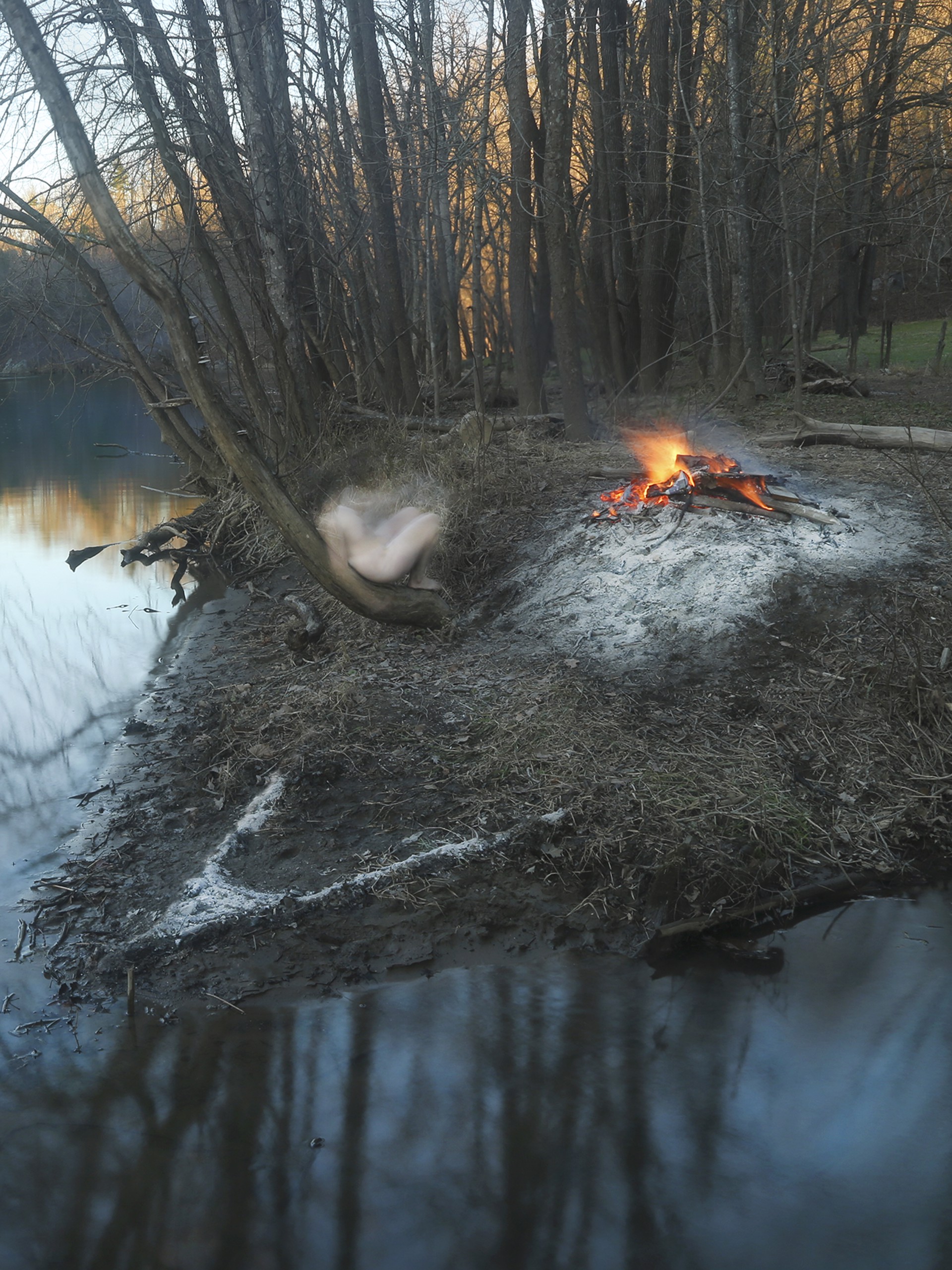
Donna Cooper, whose work spans photography, drawing, and sculpture, has a solo show at Mike Brown Contemporary. Cooper engages fire and other elements—water, air, and earth—as active participants in her creative process. (Image: Days End, 2025)
Short window to see work by Mexican artist
Miguel Milló, from Península de Baja California, Mexico, has a solo exhibition at Stormwater Studios, Throbbing Life. It is made up of photos of people he has transformed with clay, flowers and other materials. It opened Wednesday and is up only through March 23. (WHY oh why?)
And at Columbia College (opening and artists talk Thursday eve)
Can’t tell you much more but there’s some info on the One Columbia website

And don’t miss this one! AT THE CENTER FOR CONTEMPORARY ART ending March 23
A Sorcery of Sustenance by Masud Olufani – “a collection of recently completed sculptures that trace the cultural retentions of the African Diaspora through food… This diverse gathering of mixed media works examines food production within the Black community as an alchemy that satiates the body as well as the spirit. In this
context, nourishment or sustenance, has a double meaning that refers both to the corporeal and
the incorporeal–to this world and to “other” worlds.
In this exhibition, traditional African American food sources such as grain, yams, black
eye peas, okra, rice, and others, are reinterpreted in sculptural forms inspired by my travels
through west Africa. The connection between the physical and the metaphysical is a belief
deeply imbedded within many indigenous cultures around the world. Food carries the promise
of life as well as the seeds of multi-generational memory and cultural identity. It is a mediator of
meaning, connecting the past to the present–the world of the living to the world of the ancestors.”
A lot of art to see and catching up to do
Oct. 6, 2021
A recent trip to the Bay Area took me to Shimon Attie’s floating video exhibition “Night Watch;” “Mothership: Voyage Into Afrofuturism”; a show of large paintings by the late William T. Wiley; a magnificent Joan Mitchell exhibition; an unusual show about singer/songwriter/poet Leonard Cohen; a batch of gallery shows; and a concert by the St. Lawrence String Quartet. It was a busy couple of days and I’m running way late on writing about it. I’m going to hold off on Mothership, Cohen and Mitchell, because this would all go on for too long and they’re both up for many more months.
Quietly powerful and profound

Shimon Attie’s work is what prompted me to head to SF because along with the floating presentation “Night Watch,” he was also taking part in a panel discussion. I became familiar with Attie’s work in 1999 when I did a little work for a projection project he did on the Lower East Side in NYC. I ran into him a couple of years ago at the Headlands Center for the Arts where he was an artist in residence.
Attie was born in Los Angeles and earned degrees at UC Berkeley and S.F State, but has lived in New York for a long time and his work is much better known there and (probably) outside the U.S.
In his installations that include video and/or photography and usually a live, site specific component, along with stand alone photos and videos, Attie explores displacement, history, memory, drawing from sources ranging from the Holocaust to recent refugee crises. It is visceral work that packs a lasting emotional punch, but never panders or preaches. It speaks volumes, but does so quietly. (Attie said during the panel discussion “I’m not an activist.”
The floating exhibition, along with his videos and photos at the Catharine Clark Gallery (and elsewhere) make up his most extensive appearance on the West Coast.
“Night Watch,” first staged in New York in 2018, is a water borne exhibition of a barge on which videos of refugees are shown. Each person is seen first in the distance then slowly walks toward the camera/screen/viewer until their impassive face fills the screen. (The barge made a few stops over a period of days; I saw it in Warm Water Cove in Dogpatch following a panel discussion with Attie and others at the Minnesota Street Project). One way or another many refugees made it to the shores of what they hope is a safer place over water. In “Night Watch” they come to us that way again and this time we see their faces.
The Clark Gallery’s Attie exhibition “Here, not Here” covers several decades and is of the level that these works together would make a solid museum exhibition.

With the earliest project, “The Writing on the Wall” (1992-93), Attie projected found pre-World War II images of Jewish street-life in Berlin onto the same or nearby addresses in the city. In “The History of Another” he projected images of individuals on Roman ruins.
A silent group of elegantly dressed young people surrounds a roulette table in “The Crossing (2017).” The “actors” are Syrian refugees who recently arrived in Europe, many on rafts over the Mediterranean, some just weeks prior to filming. As with the people shown on the barge, their faces give nothing away and one has to wonder what horrors they are hiding and what kind of “luck” they had in the journey.
Feeling more engaged in politics is “Facts on the Ground” for which the artist placed light boxes with enigmatic phrases (striking gold, part of the plan, a problem of logic) in Israel and Palestine. One doesn’t have to be a scholar of the conflicts there to understand.
The gallery exhibition is up through Oct. 30. It includes photographs related to the 2018 presentation of “Night Watch” and a new video “The View From Below” that grew out of “Night Watch.” You can also watch some of the videos online at the Clark Gallery website.
Although the on the water live show is over, you can still view videos from it at the Minnesota Street Project and the Berkeley Art Museum/Pacific Film Archive through Oct. 31.
The art from a big artist
The William Wiley exhibition at the Hosfelt Gallery is appropriately titled “Monumental” because all the paintings are in fact monumental and so was Wiley, who died early this year. Wiley’s work is always full—various mediums, writing and artworks within artworks — and with these large paintings each is like an exhibition in itself. I prefer to see a range of Wiley’s work beyond the paintings such as Hosfelt did in 2019. But you may never have a chance to see this many large paintings by Wiley, so don’t miss it. Through Oct. 16.

For a more in-depth review, I suggest this one from Square Cylinder.
In additional, Charles Desmarais,former art critic for the SF Chronicle and president of the SF Art Institute, recently penned a long appreciation of Wiley for Alta.
There’s also a Wiley exhibition, “fort phooey: wiley in the studio,” at the di Rosa Center for Contemporary Art that I’ve not had a chance to see. Through the end of October.
A new plate for a favorite artist
While there is always a lot of good (mostly) art at the Minnesota Street Project what really got me and caught me by surprise was the Richard Shaw show at Anglim/Trimble.
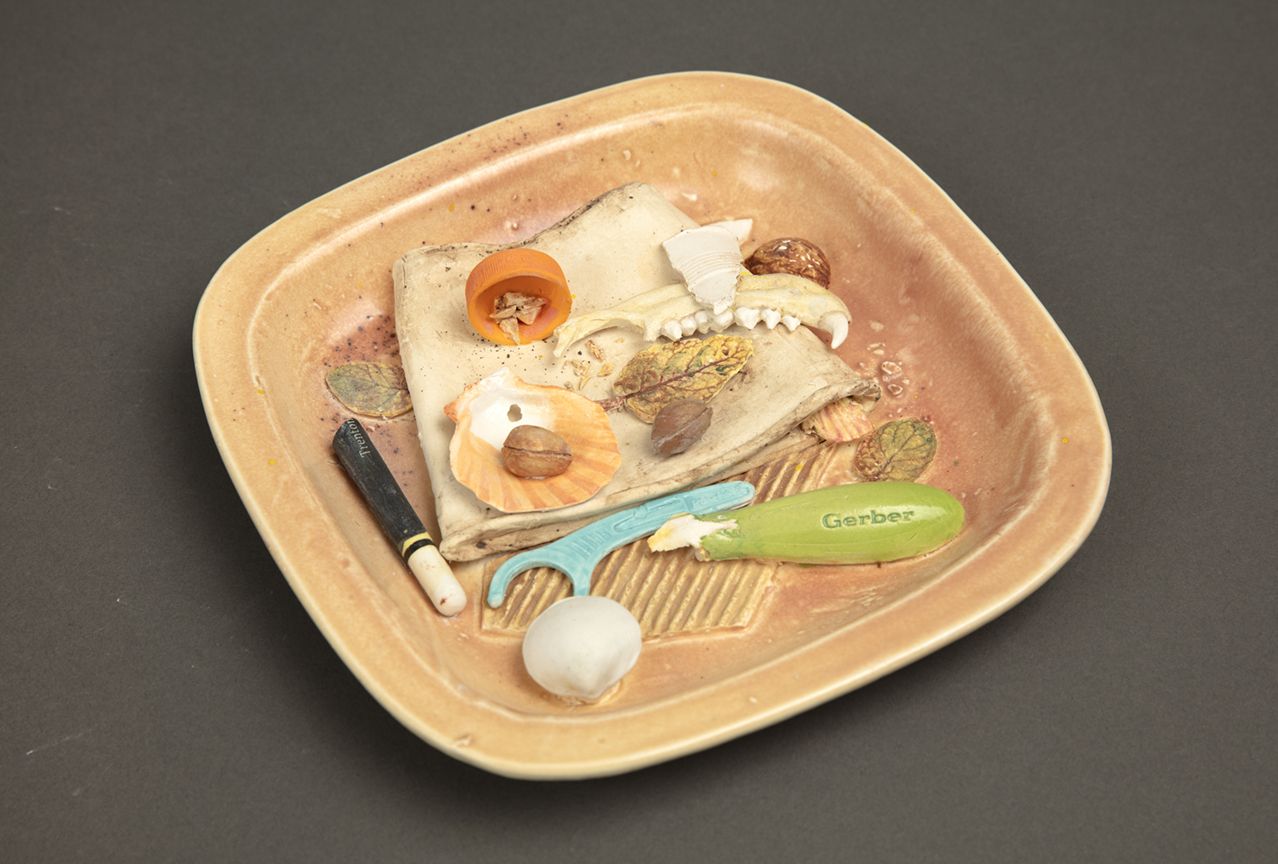
Many people know Shaw’s fool the eye ceramics that are held by many museums in the region. In these he stacks books, soda cans, pencils, playing cards and other objects that look quite real, but are ceramics and usually one single piece. He’s also created figurative work with bodies composed of wine bottles, food cans, sticks, books and more, all ceramic of course.
For the past two years or so he has headed in a new direction, making platters filled with seashells, bottle caps, fish, lizards, crab claws, dental floss picks, used up markers, buttons, cigarette butts and more. He’s been working hard because they are all very intricate and there are about 30 in the show. (Shaw, who earned a MFA from UC Davis in ’68, recently turned 80.)
They celebrate the variety of natural life in the world that we stumble across, both living and dead and also how humans make a mess of this world with all their plastic and other junk. And they also celebrate the artistic process and the joy of making something so unique. The works are also a nod to the 16th century artist and engineer Bernard Palissy who also made ceramic platters cover with animal and plant life.
Through Oct. 31.
Aug. 25/21
New gallery a much need addition for struggling gallery scene in Sac
This seems to be turning into the Faith McKinnie blog even though I just met her this week. My last two entries were on exhibitions freelance curator McKinnie juried and this one is about the just opened Faith J. McKinnie Gallery in Sacramento.
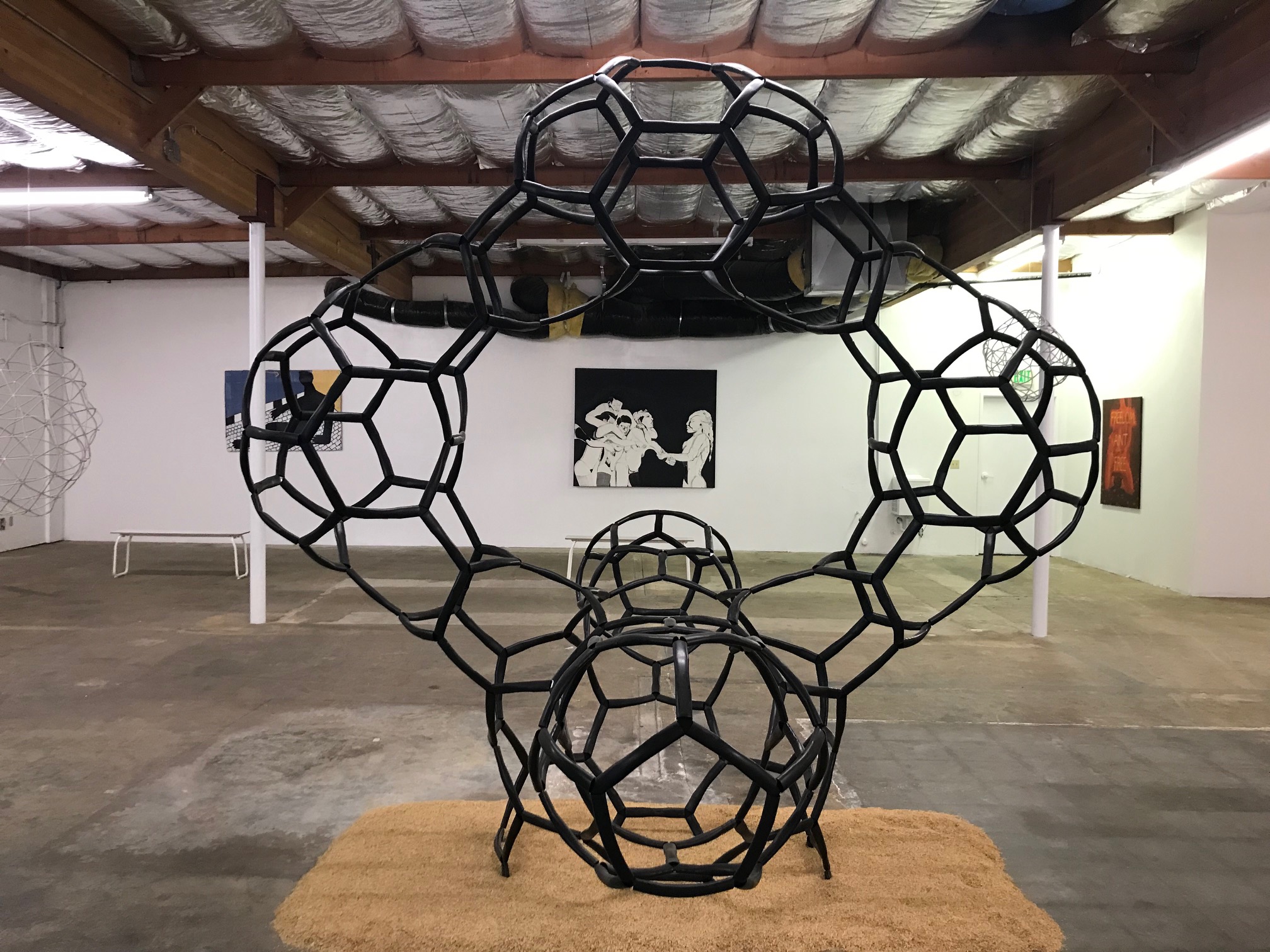
It’s a thrill to see a nice big gallery with a solid, if very local, first show in a busy area of town and opening on the heels of closures of the two of the most important galleries in the capital city (ArtSpace and Jay Jay.)
The first exhibition, “Gather Together In Our Name” brings together a wide range of works by eight Sacramento based artists. The show is ambitious both in the variety and quality of the work even if it falls short in overall organization and gives a very uneven representation of the artists.
In sheer quantity, Dan Tran’s sculptures on the walls, on the floor, hanging from the ceiling, standing on pedestals define and take over the space. Fortunately, they are open sculptures (so the space can breathe) made of small intersecting pieces (of various materials) that can be spherical, look more like body parts, that can have lots of curves or sharp angles. Tran creates a remarkable range of works using similar processes. Tran had a solo exhibition at Axis Gallery late last year, but there much more work in this exhibition including several large (7-by-7 feet or so) pieces.
While his work is always compelling, this is too much work by one artist in a group show —especially when two of the artists have only two pieces in the show and three others have only one.
Daniel Alejandro Trejo’s two graceful small ceramic sculptures have real presence but they get a little lost. Trejo recently had a solo show at Axis of much different and larger sculptures that would have been perfect for this space although a few – like 10 — more small ceramic sculptures would have worked also. On a far wall looking lonely is N’Gina Guyton’s large black and white drawing/painting of figures packed together and trying to escape/make contact does make contact with the viewer.
A few years ago, I saw a small show by Brandon Gastinell at the hallway space that Wal Public Market has the audacity to call a gallery. Even in that space, I was taken with the works that mixed photo collage (often of pop/public figures including Andy Warhol, Kanye West and Ruth Bader Ginsberg) with paint and other materials, the final product being a digital print. It was the kind of work that could go so wrong, but Gastinell made it go so right.

He’s now hit on a new way of working with the four pieces in the show. He has stacked glass plates with several images similar to what he has done earlier and these provide both a front and back view for a sort of see-through collage. I like the earlier works and I like these. They’re small (8 by 10 inches), but McKinnie says he’s working toward something bigger that will be shown at the gallery and that’s something I’m looking forward to.
Jupiter Lockett, who goes by Jupiter, has created a number of compelling figurative paintings that have simplified the form but also made it more complicated. There may not be detailed facial features, fingers and toes, but the way they’re composed and the simplified color palette he uses make them full of life and emotion.
The gallery is a very large open space that will lend itself to a wide range of exhibitions and walks a nice line between finished and rough around the edges. A larg door opens out into Rice Alley and the front wall is covered with one of the better Sac murals.
Even with the unevenness of this exhibition, it is thrilling to see a new gallery with artists showing solid work. Congratulations to McKinnie for being brave in opening a gallery in these times. Now get out there and support it.
The show closes at the end of the weekend. You can see it Friday and Saturday 4 – 8 and Sunday noon – 4. The gallery is in Rice Alley (between S and R near 16th St.) across from Device Brewing Co.
Two groups shows with a lot of good
Aug. 12/21
Running a bit late on this, but if you are around Davis during the next few days, go to the Pence Gallery to see that annual juried exhibition “Slice.” (It closes Aug. 15,) The show is always a surprise in part because it gets entries from all over the state, not something you’d expect for a small show like this. Most of the 30 pieces are from close to home, but several from the Los Angeles area. The show was selected by Faith McKinnie, an independent curator and director of Sacramento’s Black Artist Foundry.
There is some truly remarkable work in the exhibition of art of all sorts.
If there is one standout piece it’s “Peter Pan,” an embroidery by Oscar Rodriguez of L.A. The 30- by-30 inch work shows a forlorn group of children, dressed in their Sunday best, with a Pan Am plane behind them. (It is based on a photo of children sent from Cuba to the U.S. in the early ‘60s, including the artist’s sister.)
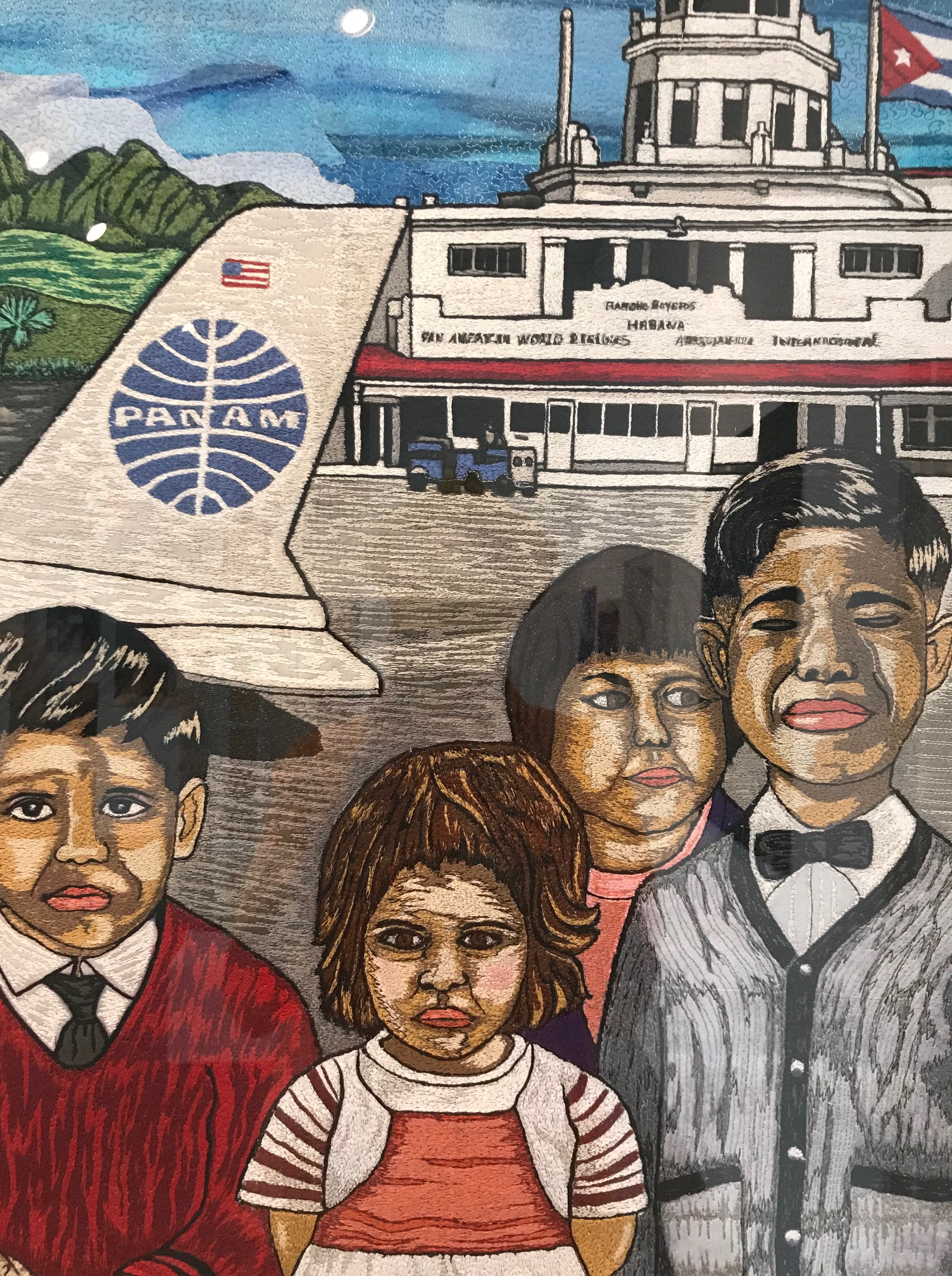
I’ve seen photos of Sacramento artist Andres Alvarez’ “Almond Blossoms, Mangos, Mask, and Memories,” and am glad to see it in real life. It doesn’t disappoint. A crouching figure behind a mask is set in a simple but magical space.
I’ve seen too many so-so cyanotype prints, but “Pods with Backbone” by Susan Chainey and Laura Reyes of Berkeley does something special with the technique that uses light sensitive paper or fabric and objects placed on them to create a shadow/ghost image. The work lines up four printed images of poppy seed pods and overlays them with a detailed human spine rendered in white thread.
Bambi Waterman’s “Rent, Stories of the Bay Area’ (not a great title), is a grid of porcelain pieces made of stacks of thin sheets of unglazed clay with wavy exposed edges, but highly finished tops. They could be inspired by buildings or magnified natural forms, but whatever the source, the result of the Petaluma artist’s work is very satisfying.
“Flower Child” by Sue Bradford of Napa uses pages about flowers from an old book, overlayed with the image of a child’s dress (printed directly from the dress in red ink) and then embellished with dangling dark threads. It is a striking piece beautifully made.
I wanted to couple the review of “Slice” with another group exhibition, the Axis Gallery national show. Turns out that McKinnie was juror for that as well. It is a little larger than “Slice,” with 44 works and just as diverse in medium, with many artists from Sacramento, a scattering from around Northern California, and a handful from the rest of the U.S.
Sculpture is the show’s strong point, starting with the monumental “Roots” by Marianne McGrath of Ventura. She has built a row of windowless, doorless connected white ceramic house forms with a huge bundle of sticks coming from the bottom like roots. The sculpture is mounted on the wall so it juts out in the gallery space. Next to it is a dress made of baby bottle nipples titled “Transitional Wear – Day to Night” by Lynn Dau of San Jose. The title is funny, but the work itself is more ambivalent in its emotion.
Oakland artist Clint Imboden’s “Shoveling” is made of – wait for it – shovels. The shovels with scoops of many shapes have laser cut shovel-appropriate writing on the handles, including “Dig You Own Grave,” “Golddigger” and “We Will Bury You.” The work beautifully explores the shape of the shovel as well as language (and maybe gives a nod to Marcel Duchamp’s snow shovel titled “In Advance of a Broken Arm.”) Shelly Gardner of Oakland has taken dozens of fabric circles of many colors, stacked them, then rolled to form a spiral. So simple, but so complex and beautiful.
Photography in the exhibition is also solid with standout work by Bryan Florentin of Dallas, Bonnie Smith of Port Hueneme and Jessie Vasquez of Sacramento.
Painting doesn’t fare as well and some look like first year art student work. There are exceptions, especially the two big works by Liz Brozell of Sausalito, one showing a mom with kids on a couch, all looking apprehensive. The other is of three men checking out a car, or the person in it. Although we can see only their bent over backs, the artist has perfectly captured their posture, clothing and relation to one another giving us an accessible story of sorts. The paintings are loose and jagged, but everything falls right in place, capturing both a frozen moment in time, but also asking us to ask what’s going on in the pictures.
The exhibition is up through Aug. 29.
Aug. 6/21
’25 Million Stitches’ a powerful project about the world’s displaced

What happens when you send a message out into the world asking for a very specific kind of response to a global tragedy? In the case of Jennifer Kim Sohn’s “25 Million Stitches,” installed at the Verge Center for the Arts, you get wide ranging responses from people around the world to the plight of 25 million people living as refugees. Sohn’s project is an attempt to visually represent the many displaced by war, famine and oppression of all sorts, by stitching on fabric panels. Those panels, made by hundreds of people from 36 countries and 49 U.S. states, were then put together in dozens of banners that form a forest of stories.
The project and installation is successful in many ways because it was made by many different people with many approaches.
Each panel (some created by individuals, others by a group) represent the plight of refugees in a unique manner. Some are narrative, some abstract. Some contain text, original or repurposed from writing that may be statistical and or may be poetry. Some directly address the crisis; others have general messages of kindness and unity. Some stitchers are pros, bringing a high level of creativity and technical expertise to the task. Others are trying it for the first time with rudimentary, but rich results. The beauty and power comes from the variety which in turn reflects the range of people — including refugees — who participated and how they view the situation. About 2,100 panels, made by 2,300 participants, make up the Verge installation.
Between four and eight panels were pieced together to make long narrow banners or flags, each about 14 feet long. These are suspended in Verge’s large gallery creating a series of tall narrow rows like the shelves deep in a library’s stacks. Visitors walk through the passageways looking up and down, trying to take it all in, although that is nearly impossible. Each wall of banners is visually overlapping, moving in the wake of walkers, providing glimpses into other rows and enveloping the viewer. It is a visceral as well as visual experience.
Moving through these passageways one can’t help but think about the way millions of displaced people at the center of “25 Million Stitches” are herded out of countries and into others, the many restricted paths — physical, emotional, legal — they are forced to take, and even the cramped spaces between tents in the sprawling refugee camps we’ve all seen in photos.
It’s probably impossible to know if “25 Million Stitches” actually contains 25 million stitches. What is not impossible is to feel the impact of each of these individual stitches, the people they represent and the passion of this project.
Through Aug. 22.
July 4/21
Alan Rath’s moving magical sculptures
I missed the Alan Rath retrospective at the Institute of Contemporary Art, San Jose, due to the pandemic. So I thought. But it turns out the show opened in February of ’19. I’m not sure what happened, but missing that first large-scale retrospective of the Bay Area artist in 20 years is something I’ll long regret. The pioneering creator of magical kinetic sculptures died last fall; he was only 60.
Rath’s art machines — dancing feathers, blinking eyeballs or mouths on screens, the mechanics and electronics that make them do their thing visible guided — might have crossed my path individually prior to my move to California in 2014. But the first time I recall was in ’15 at Contemporary Jewish Museum’s “NEAT: New Experiments in Art and Technology.” Those works have been embedded in all their magic in my memory since.
For the lame-os among us who missed the San Jose show, help is here thanks to the Hofsfelt Gallery.
The gallery’s Rath show covers 35 years from his silent speakers that seem to mimic human breath to those wonderful dancing feathers on to counting machines that never stop counting. Rath, who studied at MIT, did his own programming and his art in both elegant and amusing. These are friendly machines that ask us to approach and seem as curious about us as we are a about them. They are nice to spend time with.
I saw the show after spending a few hours with the Nam June Paik exhibition at SFMOMA. They are natural companions.
Through July 24.
June 26/21
Nam June Paik Exhibition a Once in a Lifetime Experience

I knew Nam June Paik, a founder of video art, was an important player in contemporary art , but not how important. Now I do, thanks to the monumental, 200-work exhibition at SFMOMA, organized with the Tate Modern, London. This is one of the best exhibitions I’ve ever experienced.
Paik gets the attention he deserves in this exhibition that seems to go on forever, but is never boring. It starts with his early experiments disrupting television signals with magnets to create original images, on to “Good Morning, Mr. Orwell,” a live video event among the U.S, France, South Korea and West Germany in 1984, stopping along the way to cut off his friend John Cage’s necktie. Paik, not some Silicon Valley boy genius, came up with the term “electronic superhighway.”
This exhibition is an amazing journey of seeing an entire artform emerge and develop over decades. Paik was using existing technology of everyday life to create something much greater, that was also art; this was DIY at its highest level. It’s hard to wrap one’s head around how far ahead he was. The only word that applies is “genius.”
Among the many great works in this exhibition are a couple of “robots” made of many televisions and named for his friends/collaborators composer John Cage and choreographer Merce Cunningham, along with short films of purposefully rickety robots walking around New York. Not surprisingly there are many videos of performances by Paik and his colleagues as well as excellent documentation through photos, programs and posters.

A delightful eyecatcher (you’ll have to fight for space to look at it) is his “TV Garden” (1974-1977) — 49 televisions in a jungle of plants. While the install is great, it’s what happens on the screens and speakers that make it special as the artist has manipulated videos of Nigerian dance, Japanese TV ads and other seemingly random vids and put it all to a soundtrack that includes Beethoven’s Moonlight Sonata and Allen Ginsberg’s chanting.
“TV Garden,” along with many other works, is just plain fun. While there’s humor in Paik’s work, the overriding emotion is joy.
The exhibition wraps up with the huge installation “Sistine Chapel,” filling a big space with waves of sound and images from throughout his career. It is being shown for the first time since it was created for the Venice Biennale in 1993. This is the sort of work we’ve come to expect from video/multimedia art ()although more ambitions and larger). It’s also what we often don’t like about it; it can seem sterile. “Sistine Chapel” is wild and full of life. Still, it doesn’t have the magic of the early, down and dirty work.
Born in South Korea in 1932 Paik trained as a classical pianist and early on became interested in new, avant garde music, especially that of Arnold Schoenberg and Karlheinz Stockhausen (who he later collaborated with.)
After moving the West Germany, he connected with an international, interdisciplinary community of artists, composers, designers and poets, many involved in the Fluxus movement.

The exhibition explores projects with work key collaborators composer Cage, choreographer/dancer Merce Cunningham, artist Joseph Beuys and Charlotte Moorman, a classical cellist who became a performer on many of Paik’s video sculptures. Most people know Paik through images of Moorman playing his “TV Cello” or wearing his “TV Bra For Living Sculpture.” Moorman was a major artist in her own right and gets much-deserved and overdue attention in this exhibition.
This is the first major Paik exhibition in the U.S. in two decade and the first ever survey of his art on the West Coast. Do not miss it. It’s a once in a lifetime experience.
Though Oct. 3.

June 11/21
The return of the di Rosa

A few years ago, a unique art collection along the road from Napa to Sonoma got a new name, new leadership, renovations, better public access and a revamped mission. Then it ran into an earthquake, fires, the pandemic and big-time blowback from plans to sell off most of its art.
The di Rosa Center for Contemporary Art, formerly the di Rosa Preserve, started big changes around 2015 in attempt to breathe new life into the into the mostly Northern California art collection of the late Rene di Rosa. (Some of these moves seemed prompted by the earthquake which damaged some art as did the wildfires, both of which forced the center to close for extended periods.)
Once past those natural disaster hurdles, the center mounted the huge two-part “Be Not Still: Living in Uncertain Times” that took on issues and included commissioned works, along with major exhibitions by Paul Kos and Viola Frey. The goal was to make di Rosa a player in the Bay Area art scene and not just a minor distraction for those on the wine trail and hard-core, long-time di Rosa fans.
Progress in making the di Rosa more relevant was destroyed when the center’s director and board announced in 2019 that they planned to sell much of the collection to create an endowment to fund operations. Protests arose from those ranging from long-time volunteers at the center to art world luminaries and major institutions. Then COVID-19 arrived. Not long after, the director left as did many staff members.
The center reopened in April. And plans to sell the collection appear to be gone.
The center reopened with the collection-based “The Incorrect Museum: Vignettes From The Di Rosa Collection”. The title comes from a Rene di Rosa-penned “singalong for an incorrect museum” when the collection opened to the public in 1997.
About half of the 100 works in the show are in first gallery, hanging almost floor to ceiling around the rhino-headed art car by David Best. The rest of the exhibition is displayed under six sections: Sweet Land of Funk, Dude Ranch Dada, Pot Palace, Nut Art, Museum of Conceptual Art, and Worlds in Collision.
The exhibition includes most of the usual suspects that you’d find at any show based on the di Rosa collection (or collections of Northern California artists at SFMOMA, the Crocker Museum or others.) There’s Robert Arneson, Roy De Forest, Peter Saul, David Ireland, Peter Voulkos, Viola Frey, William Wiley, Robert Hudson, Bruce Nauman, Stephen De Staebler and many others. It’s really hard to overstate how good this work is and how well it is shown. Nearly every single artist is well represented, although the standouts are Hudson and Wiley, who died in April.
Pre-wildfires, the house on the grounds where di Rosa once lived was jam packed with artworks covering almost every surface including the ceiling. Very cool to experience, but probably not the ideal way to see individual pieces or to insure their long-term care. “The Incorrect Museum” appears to include many of those works, so even if you saw them in the house, you can really see them in this context.
One oversight that stands out: nowhere is it stated that many of these artists are connected to UC Davis. It may be the first exhibition from the collection that doesn’t. (I work for UC Davis, but anyone who knows anything about the collection or these artists knows the connection.)
“The Incorrect Museum” shows this unique collection in all its glory — and that breaking it up would be a huge mistake.
During my visit I quickly passed through the first building/gallery because I wanted to head up the hill and look at outdoor sculptures before it got hot.
When I finally circled back to “Ceramic Interventions: Nicki Green, Sahar Khoury & Maria Paz” I was expecting to do a quick run through of (oh no!) more ceramic sculptures at a place that might have decided ambition and non-collection shows were overrated. And I’d already looked at 100+ artworks.
As soon as I started looking, I was no longer tired, wasn’t bored with ceramic sculpture, and saw that the di Rosa wasn’t moving backward. These three Bay Area artists are pushing clay in so many amazing ways, mixing up materials (first time I’ve seen clay and papier mache sculptures), hard and soft, brutal and delicate, giant and tiny, with all kinds of personal and political content. I was blown away.
I don’t know where things stand in the big picture and long term for the di Rosa. Let’s hope it comes up with a plan to pay the light bill, continue collecting art and attract more visitors.
One way of making the center more visible has happened: Mark di Suvero’s giant red sculpture has been relocated (as originally intended) to the earthen dam where it is a beacon to the thousands of cars (often halted in wine trail traffic) passing the center. It looks great.
A Walk Through Pompeii in SF
June 7/2021

An exhibition about the ancient, destroyed city of Pompeii wasn’t that high on my must-see list, but I was going to San Francisco with stops at galleries that were easier reached by car and since I was driving and hate to drive east across the Bay Bridge and I’d just purchased membership to the Fine Arts Museums of San Francisco, it made sense to go to the Legion of Honor and come home across the GG Bridge, and I like to be sensible in everything other than using periods.
“Last Supper in Pompeii: From the Table to the Grave” sounded like it might be one of those overhyped exhibitions all too common (especially from the Fine Arts Museums of SF).

It didn’t help that the exhibition was trying hard to tie the exhibition to the foodie world. According to the museum, the sculptures, housewares, frescos and so on “reveal how the ancients (like today’s San Franciscans) loved to eat and drink. It also offers a glimpse of how the food and wine were produced and distributed before being brought to the kitchens and ultimately to the dining tables.”
Fortunately, it never feels like the exhibition if trying to force feed us some farm to fork foolishness. It does an excellent job of putting sometimes beautiful, but also work-a-day objects into context. The most successful way that’s done is by making the exhibition a kind of walk-through of the home of wealthy Pompeiians before the houses and their owners were buried and burned by the eruption of Mount Vesuvius in the year 79.
The exhibition contains materials of everyday life: glassware, pots and pans, pitchers, drinking vessels and wine ewers. There are also bronze and stone sculptures of human, animals and mythical beings, along with a few magnificent mosaics. (Not all the materials are from Pompeii, but are representative.)
Worth the price of admission alone are the fresco paintings, especially since the museum has recreated how they would have been seen originally in rooms and courtyards. The largest fresco covers three walls and brings the outdoors indoors with flowers, ferns, flying and resting birds, fountains and garden sculptures. More modestly sized ones show groups dining, a breadmaker’s stall (show alongside a 2,000-year-old loaf of carbonized bread), the sign for a bar, a couple engaged in an amorous embrace and others. It is amazing how many styles of painting in these frescos are still with us.
This is also a super badass video at the end of the exhibition showing how the city might have looked while being destroyed.
Through Aug. 29.

A few other worthwhile shows I saw:
“The Small Matter” by Isabella Kirkland at Hosfelt and “Here And In Between” by Claire Burbridge at Nancy Toomey provide different sorts of detailed looks at nature (some very real, some imagined.)
It closes this weekend, but “The Ambiguities of Blackness” in the lobby/gallery areas of the Minnesota Street Project has stellar and varied works. If you feel the Crocker Art Museum gave short shrift to Lezley Saar in “Legends from Los Angeles: Betye, Lezley and Alison Saar” you can see several of her artwork here.
Also coming to a close June 12 is “Raymond Saunders 40 Years: Paris/Oakland” at Casemore/Kirkby (at Minnesota Street) and Andrew Kreps (657 Howard St). I was only able to see the part at Casemore/Kirkby. I regret not making time to see both.
May 19/21
Three in one – Michael Tomkins’ creates a rich conversation in his art

A couple of Saturdays back I hit several Sacramento galleries, but spent most of my time with Michael Tompkins’ amazing paintings and drawings at B. Sakata Garo Gallery. The exhibition, his first solo show in Sacramento in 20 plus years, covers more than a decade, but most of the works are recent.
There are three distinct bodies: highly finished paintings with lots of objects that hide and reveal other objects, some that aren’t objects at all, that border on trompe l’oeil; large drawings of trees/forests composed of nothing but thousands of tiny marks (and are completely made up I’m told); and small loose painting that seem like the fuzzy cousins of the first group, blending inside and outside. The latter ones remind me a little Giorgio Morandi’s watercolors and are the ones that most speak to me.
At first glance, to me, they look like they work of three different artists, but the more time I spent with them the more obvious the connections became and the rich dialogue taking place among them began revealing itself. Maybe the main thing they reveal is what a good artist Tomkins is.

Although he hasn’t show in the area for a long time, in the 1980s after finishing studies at UC Davis, he did landscapes emphasizing the superflatness of the place that were well know. Many people have seen his giant painting of an East Bay “refineryscape” the Crocker Art Museum owns. I have a feeling there are others who know him mainly from the drawings.
I have a feeling that Tompkins has been pigeonholed maybe in all three of these areas if that is actually pigeon-holing. You can’t go wrong thinking he is any one of these artists, but it’s more impressive that he is all of them.
This exhibition, on display through May 29, gives a well-rounded picture of his breadth and visual intelligence.
(Tompkins also has work in “Wayne Thiebaud: Influencer” at the Jan Shrem and Maria Manetti Shrem Museum of Art that’s reopening June 1.)
Two at Axis
At Axis Gallery through May 30 you’ll find “Omar Thor Arason – Quantum Collapse” and “Daniel Alejandro Trejo – Gravity Don’t Pull Me.”
Arason’s paintings have a collage like construction, unexpected colors, multiple perspectives, and a retro social realism feel to them in content, color and composition. There is always a lot going on in them. In one a man in a mustard suit with a blue head looks like he’s giving a lecture, while above him a very realistic chimp is doing his own thing that seem to be imagining infinity, while there’s a steel girder construction project going up behind them.
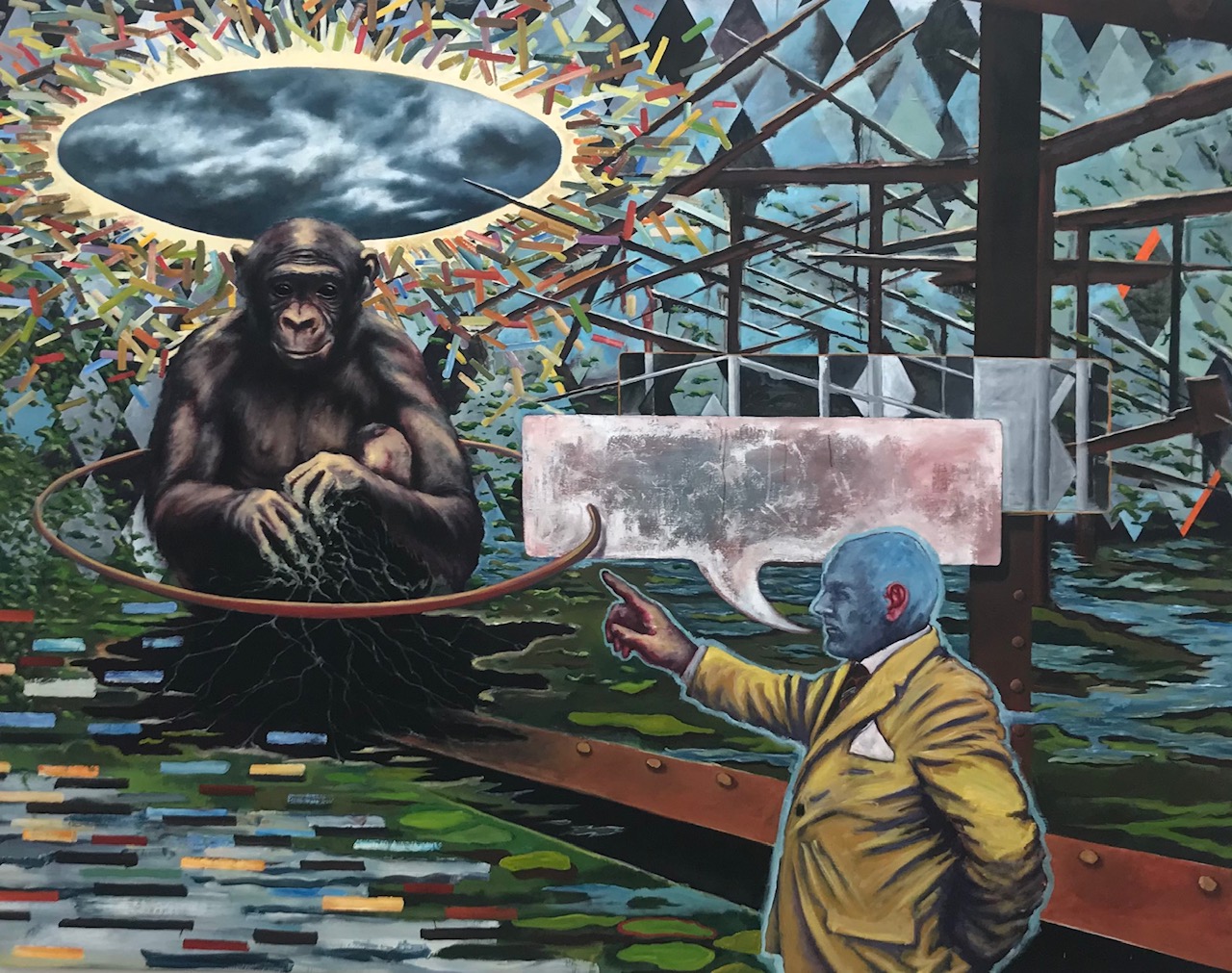
Not all of them are as good as that one, or as well painted, but you feel like he has a lot to say. You get to figure out what that is.

I was surprised by Trejo’s show because images I’d seen promoting it were of a studio overflowing with black and white drawings/paintings. The exhibition is actually five sculptures: two brightly colored ones about two feet wide hanging way high on the walls, a four-foot tall salmon-colored box, and a light blue stair step sort of things. It’s all awkward and wonderful. I don’t mind a surprise like this. (But I still want to see all those drawings.)
Big Figures – brutal and tender figurative sculptures at Pence Gallery
May 10
Ducked into the Pence Gallery in Davis a couple of days ago and felt a bit physically overwhelmed by the ceramic sculpture exhibition by Marc Lancet of Davis. Last night I dreamed about counting them, something I forgot to do when I was there.

Lets just say there are a lot — several nearly life-size figurative works, many smaller works, two walls filled with masks/heads. All have a certain brutalist feel to them, a mix of rough and smooth and shiny, fairly consistent in a greenish/gray color. While it is all figurative, there is more to the figure, which at times becomes part machine, part architecture. While the pieces make big statements and have a commanding presence, they also offer an intimate exchange in the often-delicately rendered faces.
This is the second recent huge installation-like exhibition at the Pence Gallery which continues to successfully walk a fine line between ambitious exhibitions from established artists near and far, and also giving a leg up to more local and emerging artists. Lancet lives in Davis, has shown internationally and is a longtime faculty member at Solano Community College. He’s doing an online talk on May 15.
The exhibition is up through June 13.
Hope to soon provide some small reviews of exhibitions I saw in Sacramento last weekend.
The “creative economy” and media coverage – observations and information
While the Sacramento media writes a story every time a restaurant town cleans its bathroom, they are usually missing in action on the arts beat. I have yet to see any news coverage on the recent closing of two of the city’s best galleries. That’s two out of how many? You tell me.
This Wednesday at noon the Sac Bee is having an online conversation with its new editor and others and is looking for input. IMHO the lack of arts coverage would be a worthy topic. I posted something about the meeting on FB but only two people responded and one lives in Georgia.
Has the local arts community just given up on getting any kind of real coverage from the local media? Again, you tell me.
And finally, If you want to learn more about the new City of Sacramento’s Cultural and Creative Economy Manager Megan Van Voorhis and the Sacramento Office of Arts and Culture’s plans you won’t find it in a wordy interview she did with the News and Review. Just a lot of vague policy wonk statements that says almost nothing about what is or is not working in the city’s art environment. I have a feeling this is not a person we will be seeing a lot of in museums, galleries, concerts halls and theatres.
And again, your thoughts?
April 19/21
California’s Brutal Gold History Made Palpable
With museums and galleries reopening, I was ready to get out and look and did most of a recent afternoon and evening.

After months of delays due to the pandemic, Jodi Connelly’s Fractured River opened at The Garage on The Grove (TGTG).
Connelly took over the garage and then took it apart in a visceral exploration of the environmental damage done by hydraulic mining. This gold mining method used high powered water streams to to wash away entire hillsides along the Yuba River (and others) during the 19th century with that and the gold extraction techniques destroying the land and polluting the water.
Connelly painted the entire space a glowing gold then proceed to cut away at it leaving deep ragged scars across two of the walls from ceiling to floor. These shapes of the river route spill onto the floor making a golden delta across the black floor. Against another wall are piled the remains of the walls (the tailings left by hydraulic mining.)
It’s a powerful and moving piece.
There are still several days the work can be viewed including nights and Sunday afternoons (!)
Mother and daughters – the Saars of LA
My main motivation to get to the Crocker Art Museum was “Legends from Los Angeles,” an exhibition by Betye Saar and her daughters Alison and Lezley. I’m most familiar with Alison Saar whose installations I’ve happily been devouring for years, although I’d not seen a solo show by her until 2016 at the Museum of the African Diaspora in SF.
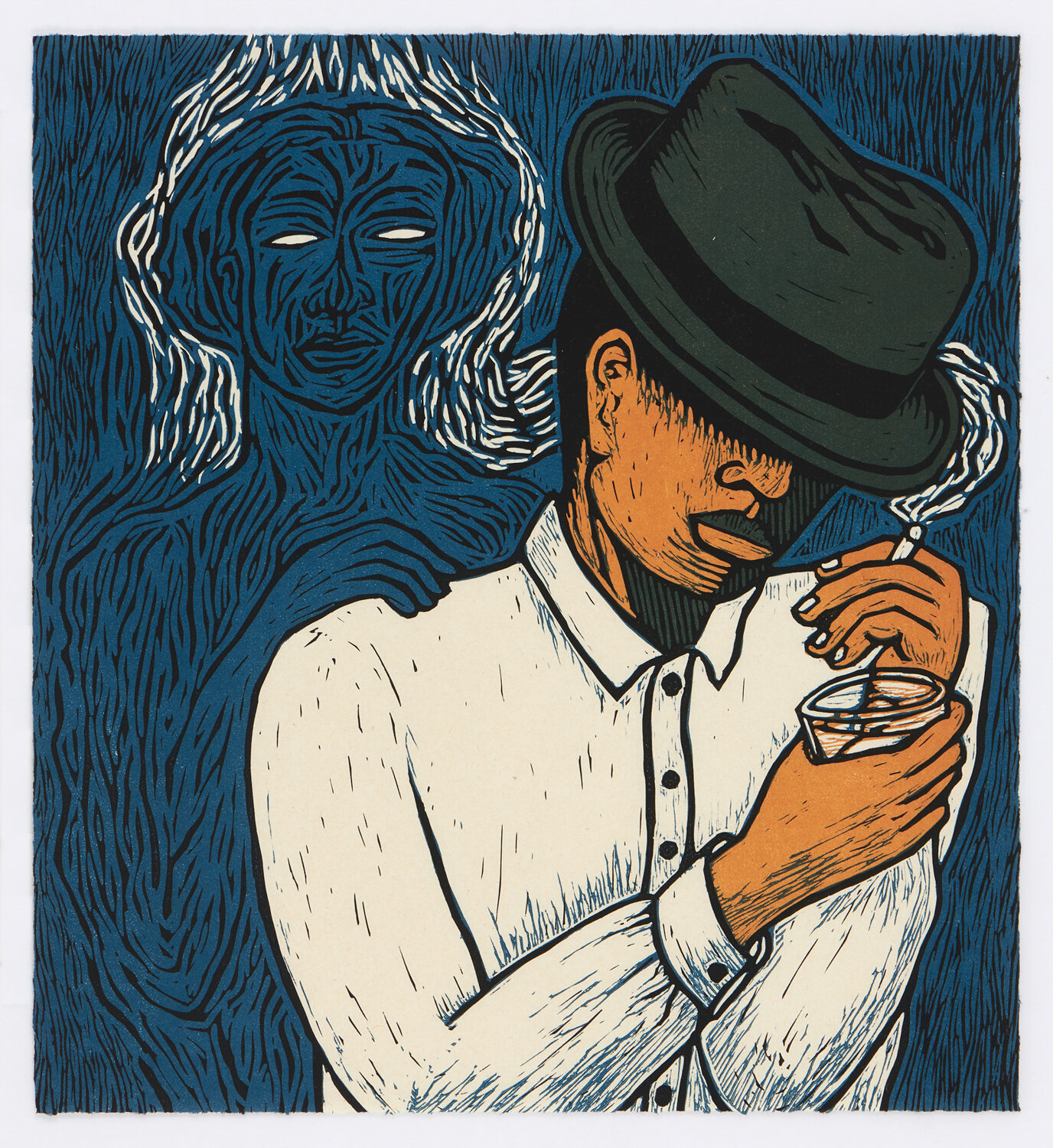
Betye Saar is a groundbreaking artist who emerged in the ‘60s taking on and reclaiming racist images like Aunt Jemimah who in a work at the Crocker leads a fiery rebellion. Honestly, I didn’t know Lezley Saar’s work at all and with only two pieces by her in this exhibition I still don’t.
“Legends from Los Angeles” is a small, solid show composed primarily of 25 recent works (all owned by the museum) that provides a very limited view of the three.
Betye Saar is mainly represented by a series of poetic serigraphs created using collage techniques, each inspired by the work of Zora Neale Hurston, a leading writer during the Harlem Renaissance of the ‘20s and ‘30s.
Although Alison Saar is best known for her sculptural installations which include all kinds of found object and text, but the museum has only one of those, the recently acquired “Hades D.W.P. II,”that speaks to the Flint, Michigan water crisis. The museum is showing a suite of her linoleum cut prints. The first time I was aware of her print work was at that MOAD exhibition where while standing solidly on their own, they also complimented the sculptures. Made with expressive marks and bold and bright colors set upon a dark background, they are figurative and narrative, tapping deeply into African American culture from the Gullah people of the coastal South to jazz. They’re great pieces, but hardly representative of Alison Saar’s politically and racially charged output.
Lesley Saar’s flag-like “Zerpenta Dambullah: Born under the shade of a black willow tree in New Orleans in 1826 sat on a rock turning rain into tobacco smoke,” deserves a name that long.
Though Aug. 15.
Three generations of Native American Women in one show
Also at the museum is another family exhibition, also by three women. Although the main title is “Spirit Lines: Helen Hardin Etchings,” there many Hardin works that are not prints and a significant number of artworks by her mother Pablita Velarde, and daughter, Margarete Bagshaw. It’s hard to understand why a show of three generations with good work from all would present a face that says it is about only one.
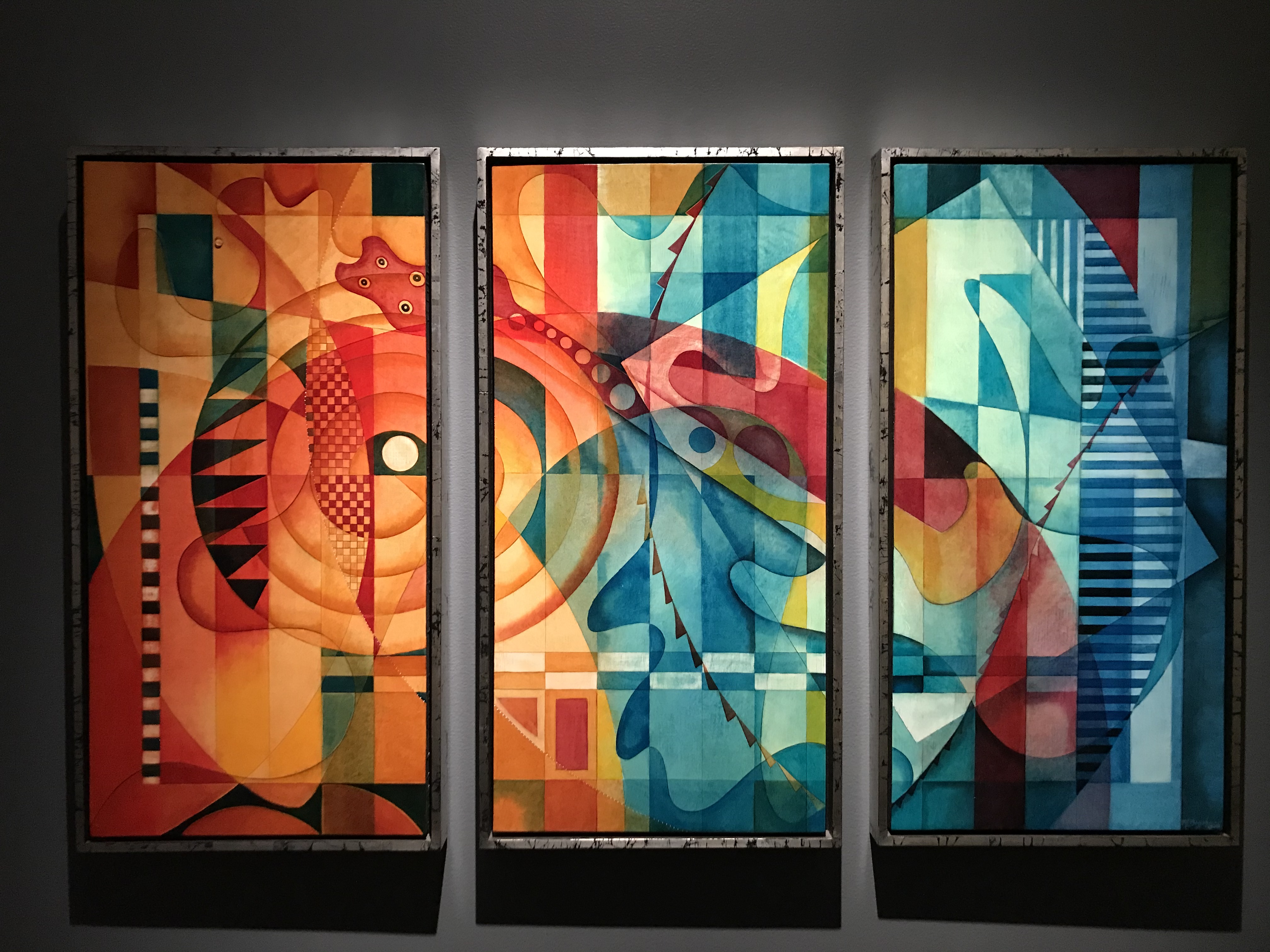
All three women were Native Americans from the Santa Clara Pueblo in New Mexico and their art successfully melds more traditional content and techniques with art that is very much of the 20th century. It’s fascinating to watch how each dealt with this.
Hardin’s copper plate etchings include small single color figurative works and large multicolor pieces that move into abstraction. In her paintings, she built up dozens of layers of ink washes, acrylic paint and glazes, developing stippled textures and intricate grids to create a dense rich surface.
Pablita Velarde’s early work uses “earth pigments” for small works that seem very related to pueblo pottery and traditional images, but she later moves to brighter painting of pueblo life.
Margarete Bagshaw embraced her mother’s more abstract approach and become fully immersed in it physically and spiritually.
Through May 16.
A Slog Through the Netherlands (with a little sun)
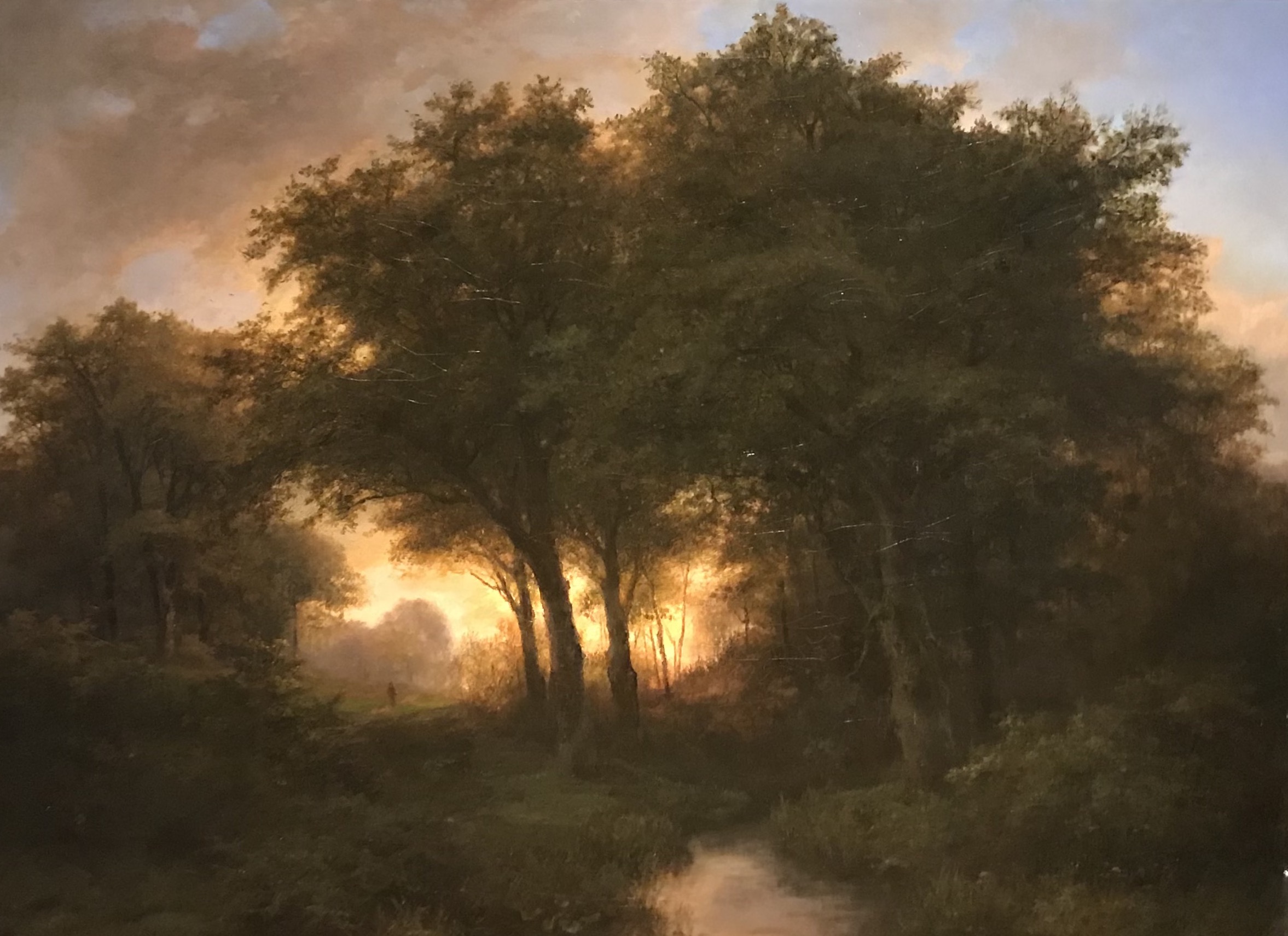
The big show at the Crocker now is “Country, City, and Sea: Dutch Romantic and Hague School Paintings From the Beekhuis Gift,” made up of 50 paintings from the mid-19th to early 20th century.
The works are drawn from a recent and earlier donations by the late G. Jan Beekhuis and his wife Mary Ann of 200 artworks from this period in the Netherlands.
The art of the Low countries (the Netherlands and Belgium) most of us are familiar with is from the 17th and 18th centuries – Rembrandt van Rijn, Frans Hals, Pieter Class, Jacob van Ruisdael, Johannes Vermeer. During that time the region was a global power, developed a strong middle/merchant class with a taste for relatable art, non-religious art. It birthed pure landscape, genre and still life painting and led the way in the use of a new medium, oil paint.
The art in “Country, City and Sea” is NOT that art. It’s art that I, like many people, am not very familiar with and it’s always nice to learn something. The collection makes the museum a great resource for scholars in this field.
But as is too often the case, the Crocker Museum doesn’t know when to stop. A smaller show of the strongest paintings would have made it all more interesting. That the paintings are displayed largely in chronological order adds to the slog.
The first section of the exhibition gets very old very fast with similar landscapes, town square and streets, one after the other. The same goes with marine scenes of ships, harbors, the occasional dramatic storm. There are great paintings, but just more that are not.
Things do get more interesting around 1860 with the emergence of what was dubbed the Hague school that was influenced heavily by France’s Barbizon school with an emphasis on realism, somber colors and subtle light effects. After this the Dutch artists are also following the French, moving into works more akin to that of the Impressionists (or their fellow Dutchman Van Gogh who spent much of his life in France.)
There are some fascinating paintings from this period, like “Country House on a Lake” by Willem Bastiaan Tholen, a flurry of color and movement with people partying under a wild sunset sky; other show the rise of modern industry; and houses along a river by Paul Bodifee reminds one of early work by the great modern Dutch painter Piet Mondrian who was six years younger than Bodifee.)

Most of the paintings are not dated (no doubt much more research to do on recent donations), but the artists’ birth and death years are included, which is helpful. Although the introductory text indicates the newest works are pre-World War I, it’s likely some are newer. As far as I can reckon the youngest artist, Cor Noltee, was born in 1903 and I doubt he did the paintings when he was 11.
The art isn’t well placed in context of what Dutch art history or Dutch history or how the periods intersect. While the early period represented, the “Romantic” and the later “Hague” school, are addressed in the intro text, the most recent paintings – which to me are a radical departure from the others — are not. It looks like three periods to me. Having the main text panel accompanied by one painting from each period and the paintings grouped by content and style rather than chronology would have added a great deal to the exhibitions look and visitors’ understanding.
Though May 2.
March 31/21
Vast Vagueness at Verge

When museums and galleries opened briefly last fall, I hit nearly everything open in San Francisco, Sacramento and points between. Good thing too because that didn’t last long.
So I was thrilled when Verge Center for the Arts reopened March 26. It reopened in a big way, showcasing new work by six artist who received Ali Youssefi Project residency awards last year: Justin Amrhein, Angel King, Brooklynn Johnson, Vincent Pacheco, Muzi LI Rowe and Terence Wong. Nearly every one of these artist fully engage both the eye and the intellect (their own and ours).
But the exhibition has many problems. More on that later.
In the huge gallery space, Justin Amrhein’s blue and white sculptural installation with videos and Vincent Pacheco’s wall of black and white drawings/paintings serve as bookends.
Amrhein has taken about 20 objects (a domed doghouse, the tub of a washing machine, car parts) transforming them with a coat of bright blue and painted white schematic lines. He has placed them on a similarly painted floor covering and surrounded them with small wall mounted video screens showing some of the objects in motion. The pieces bring to mind both architectural and mechanical drawings and props from a ‘70s science fiction movie. While it is tempting to try to figure out that the objects are, what he’s done with them is much more interesting than what life they may have had before, because he has given them a whole new life in a whole new world.
Where Amrhein’s work feels pristine and machine like, Vincent Pacheco’s are purposefully crude, like homemade tattoos. The simple black lines on white backgrounds, all 17 displayed on a giant pink wall, give them a pure and innocent feel as well. His drawings are populated by lowriders, voluptuous women with big eyelashes and bigger hair, crosses, Mercedes Benz emblems, rosaries. Work love, family, religion, and what he calls “cliches, stereotypes and old school Chicano art” are transformed.
Paintings by Vincent Pacheco and sculpture by Angel King.
Muzi Li Rowe is a photographer and a sculptor and while the content is the same, the approaches are very different.
Her beautiful still life photos are of photographic or computer equipment, usually outdated. The sculpture, as in some other recent show, is made of circuit boards, batteries and phone cases encased in resin. (Maybe a nod to UC Davis professor Lucy Puls?)
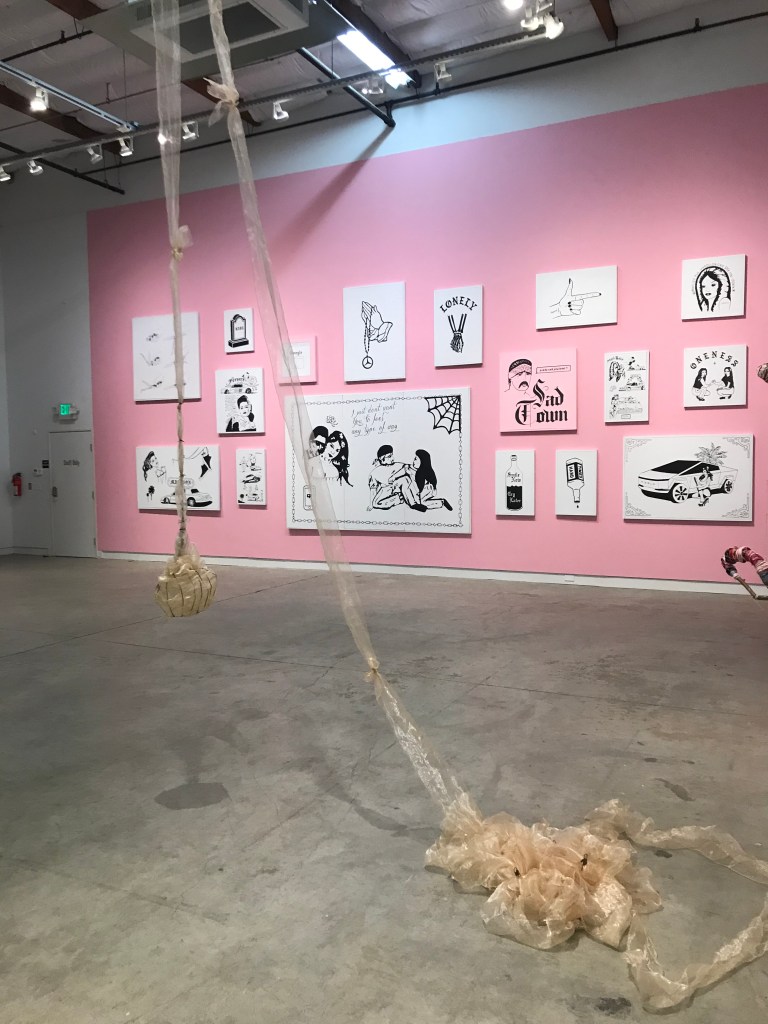
She also makes cameras that are themselves sculptures.

Rowe’s work is accessible and immediate in that it presents objects we regularly interact with such as computer and phones. Because they are mostly outdated object, they also tap into our memories. For the younger viewer, they present foreign technology that is as baffling as Maya writing systems from 2,000 years ago.
For everyone, her art provides a strong and direct reminder of where we stand in relationship to technology and it in relation to us.
Angel King’s “Buck, Tooth, Shot,” a sculpture made of an old couch stuffed with photos and draped with sheer lace curtains to which ceramic teeth and bullet shell casing are attached, speaks quietly. If there’s something Southern Gothic looking about it, King is from rural Georgia so she came by that honestly. Using other cast-off items, plastic bags, sticks, ribbon she’s made other delicate sculptures.
With just a few small “wool paintings” (dream-inspired landscape and still lifes made from colored wool) and a cutout painting on the floor, Brooklyn Johnson’s work get lost in the big room with such dominating pieces. They need an enclosed space where the viewer can have an intimate conversation with them.
It was hard to have a conversation with Terrance Wong’s work because the day I was there the sound piece wasn’t making any sound. The work includes a boom microphone encased in a small piece of ceramic, electronic equipment, photos attached to the wall, and a platform with a music stand holding score sheet inviting contributions.
Wong’s obtuse statement about the work posted nearby refers to a 1974 article written by composer/artist Max Neuhaus about policing “noise pollution” in New York. One can see where he is going, but he never follows through and the work itself does not either. One could, I suppose, look up the Neuhaus article.
Alas, the exhibition already requires one to look up so much.
The title of the exhibition is “Class of 2020.” What does that mean? It has no meaning without mention of the Ali Youssefi Project residencies. The Verge website has only the bare minimum about the exhibition stating that “The title is a nod to the unique challenges the artists faced pursuing their residencies during quarantine and largely in isolation as both the Verge and WAL communities were locked down.” What challenges? What is the Verge community? What is WAL? Unless you already know what the residence program entrails this means nothing. Verge doubles down on useless information with a text panel the lobby, not the gallery, with a vague statement about the Ali Youssefi Project. To learn about that, you’ll have to go to the Ali Youssefi Project website. (Here’s what I came up off the top of my head: local artists get a free studio space and a stipend and those from away get an apartment, a studio and a stipend. They all get to show at Verge.)
You’ll also have to go to the Ali Youssefi Project website to learn anything about the artists because there are no artists’ bios in the exhibition or on the Verge website.
Are all these oversights due to carelessness, cluelessness, a provincial outlook thinking everyone knows these things, or fallout from the pandemic? Probably a little of all this.
The Verge website does have an elaborate tour of the exhibition allowing one to virtually walk through the gallery. But you don’t really need that now that Verge is open.
And even so, this is not a well-designed exhibition virtually or IRL. Other than Amrhein and Pacheco’s installations severing as big bookends there is no design.
Although “contemporary” is not part of the Verge name, that is the art it shows. And with showing new, adventuresome art that can be daunting and difficult comes a responsibility beyond just sticking it in a room.
To its credit Verge is holding a series of online conversations with the participating artists. Maybe that will shed some light on what’s going on.
Last few days to see MFA exhibition (ends April 3)
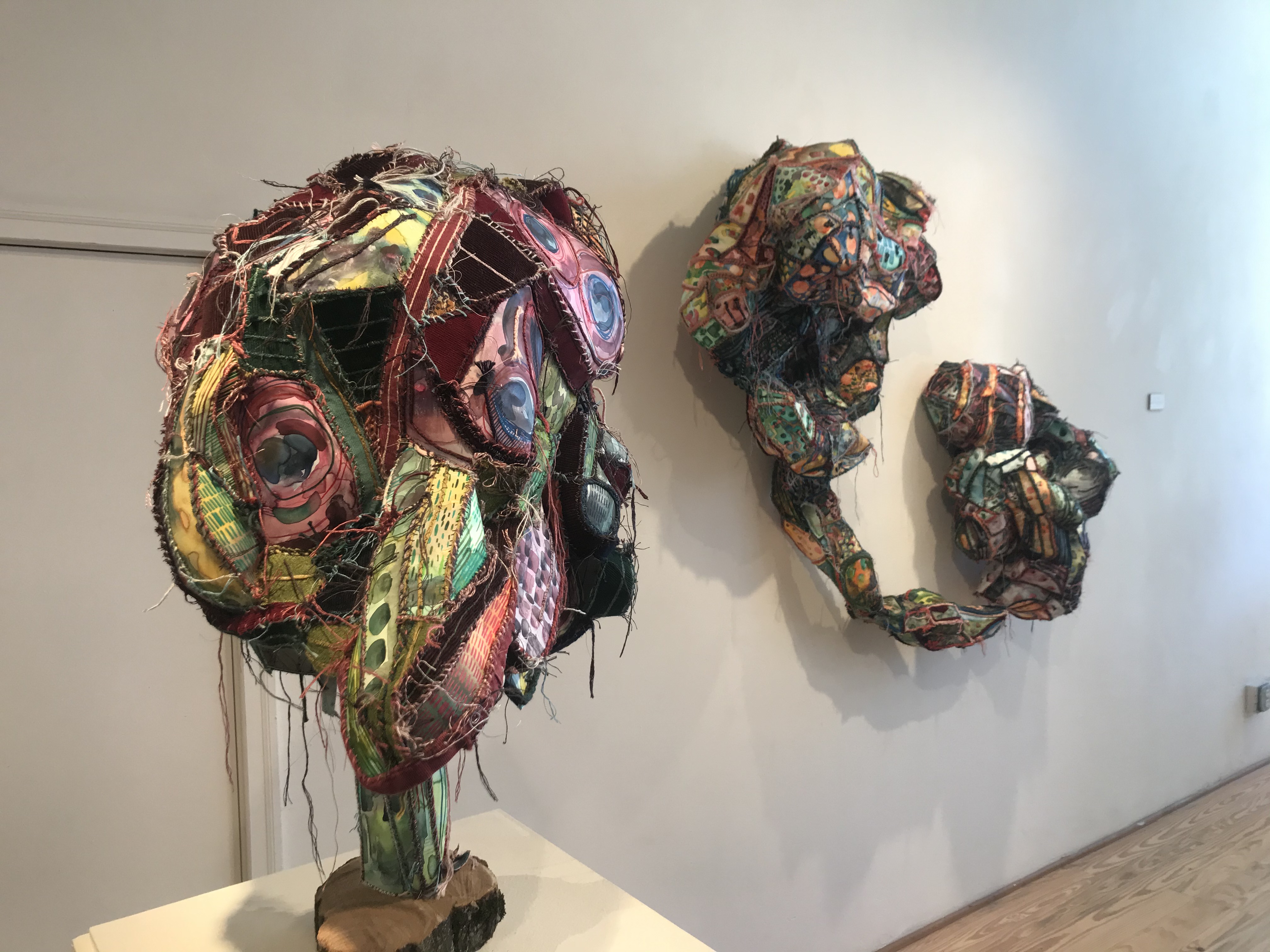
Mercy Hawkins’ sculptures.
A real “class of” exhibition is taking in Sacramento. Second ( and final year) UC Davis Master of Fine students. COVID has once again put the annual graduate student exhibition on campus online, so the eight teamed up with UC Davis alum and artist Chris Daubert and the B. Sakara Garo Gallery to get their work out there. Taking part are Havilah Aos, Sam Arcara, Jesse Aylsworth, Dino Capaldi, Genevra Dale, Mercy Hawkins, Gretchen LeMaistre, Dani Torvik (Due diligence for the students and myself – this show is not formally associated with the university.)
The students take over the gallery and a larger space a few doors away with wide ranging, often fun, always thoughtful, and frequently monumental, works.
Several stand out for me:
Mercy Hawkins who’s sort of figurative sewn sculptures are imaginative and well-constructed and with the large number she has done they are an exhibition in themselves.
Genevra Dale’s big blue cloth sculptures, like Hawkins works seem friendly, but also are lush and luxurious. You may not be allowed to embrace them with your arms, but they embrace you.

Sam Arcara’s photographs of fire devastated California are powerful in capturing the destruction, but also formally beautiful. His photos are all in one smaller room displayed around a miniature fire-blackened cell tower he has built. The installation takes us to the place where this happened.

Gretchen LeMaistre is another photographer who like Arcara is focused on one thing. She is even more focused, aiming her camera from above on the stages of reconstructing a large swimming pool. Each piece is made up of several black and white photos pieced together and displayed frameless.
March 11/21
I’ve put off writing anything recently for a variety of reasons. Lazy, busy, masked. It’s been so long WordPress has changed its format.
Feeling visited by the past recently, kinda sorta bittersweet

(The first part of this has little to do with Northern California art, but indulge me or ignore me. Or ask the local media to cover the arts here.)
A couple of days ago I was able to go to a Zoom forum with Leo Twiggs, an artist I got to know fairly well during my former life as an arts journalist in the South. In the 1970s, he began using batik of all things for his paintings and at the same time began incorporating images of the Confederate Flag in his work. He has continued to address social and political issues in his work – leaving interpretation to the viewers – but along with the flag (usually presented as torn and ragged and fading), targets and silhouettes frequently showed up in his art. One of his most recent series was about the murder of nine people at a Bible study class by a white supremacist at a Charleston, SC, church in 2015 and more recently about the police killing of George Floyd.
Twiggs reminded me that I got him in “trouble” for quoting him calling the flag “that old rag.” We both agreed it was “good trouble.”
Twiggs is 86 and shows no signs of slowing down. (He has an exhibition at the Morris Museum of Art in Augusta, Ga.)

Earlier this year another artist I got to know passed away. Philip Morsberger was a fun force of nature. When I posted on Facebook about his death, I began hearing from people who knew him from his decade at the California College of Arts and Crafts and they all liked and admired him as much as I.
I met him when he became eminent scholar of art at Augusta State University in 1996. He remained in Augusta after retiring. (He had also taught at UC Berkeley and Dartmouth and was the Ruskin Master of Drawing at Oxford.)
Morsberger was 88 when he died and although he’d been battling illness for several years, he kept making remarkable paintings. His art was full of life and color and funny faces, but it was also serious and in the ‘60s he did a number of paintings specifically addressing the Civil Rights Movement. The Morris Museum put together a nice video about him a few years back.
A few weeks ago, the UC Davis art history program held a seminar on Black representation in museum collecting, exhibitions and programming featuring art historians/curators/scholars Bridget Cooks and Susan Mullin Vogel. It was very insightful and informative event but I wish it had lasted three or four hours rather than two. One person whose name came up was Merton Simpson, mentioned for his role as a ground-breaking dealer of African art dealer starting in the 1950s. Not mentioned was that Simpson was also a great artist of often confrontational paintings – some titled “Confrontation” – and his work was shown at the Museum of Modern Art and the Guggenheim. He was also an accomplished musician.

Simpson was from Charleston, S.C., where there was no place for a young black man to study art. William Halsey, one of the few contemporary artists in South Carolina, gave Merton private lessons for free. They had a bond that continued through both their lives.
Halsey and Twiggs became friends and artistic colleagues as well.
To come full circle, one of Halsey and his wife the artist Corrie McCallum’s daughters, Paige, attended Twiggs’ online talk.
I’m lucky to have crossed paths with all these artists. And I could add a lot more to the list of artists, musicians, curators I’ve had to good fortune to meet. Thanks for allowing me to wallow in a bit of nostalgia.
CapRadio has some New Music Now!
One thing that has bothered me since moving to the area nearly 8 years ago (!!!!) is the lack of interest in what can be called, for lack of a better term, contemporary classical music. (I won’t bore you with all the details, but where I came from had an extraordinarily vibrant new music scene.) When I came to work at UC Davis I was thrilled to discover its doctoral program in music composition. During non-pandemic times I hear so many new works from these young composers.
My view on interest in new music in the area has become more positive thanks in part to “Saturdays at 6” (well we know when it is on, even if we don’t know what it is about) launched by Capitol Public Radio late last year. Hosted by Kevin Daugherty, the network’s classical music director, the two-hour program will provide something for nearly anyone’s taste in new music, including works that are very connected to classical, other bringing in the aural world of rock, jazz and whatever else you might think of.
I consider myself a big new music fan, but I’ve learned about so many composers by listening to the show (some who I don’t want to hear again.) Some names you might know recently featured: Arvo Pärt, Andrew Bird, Laurie Anderson, John Adams, Phillip Glass, Missy Mazzoli, Steve Reich, Danny Elfman, Max Richter, Gian Carlo Menotti — can you say “eclectic”?

The show has been getting plenty of feedback on the CapRadio Music Facebook page which is really encouraging. Maybe I’ve found some more of my people.
Personally and musically, I was very taken with “Through the Mangrove Tunnels,” by Scott Lee, inspired by Weedon Island in St. Petersburg, Florida, where he used to spend time while growing up — as did I.
Anyway, check in out.
Various visual art items
The second year MFA students at UC Davis have a big exhibition at the B. Sakaro Garo gallery and space next door in Sacramento. Opening event Saturday, 3-13. At this writing I’ve not seen it.
Two solid shows at the Pence Gallery in Davis.
“The Decameron” by Judith Foosaner (another octogenarian who taught at the California College of Arts and Crafts on and off for 30 years, is a huge installation in blacks and whites the parts of which she created during the 12 months of lockdown.

Across the hall is the smaller but no less impressive “Devoted Timelessness” by Susan Tonkin Riegel consisting of colorful drawings/paintings/collages (some with stitching as well) along with a number of black and white two-sided works displayed like sculptures in the gallery center.
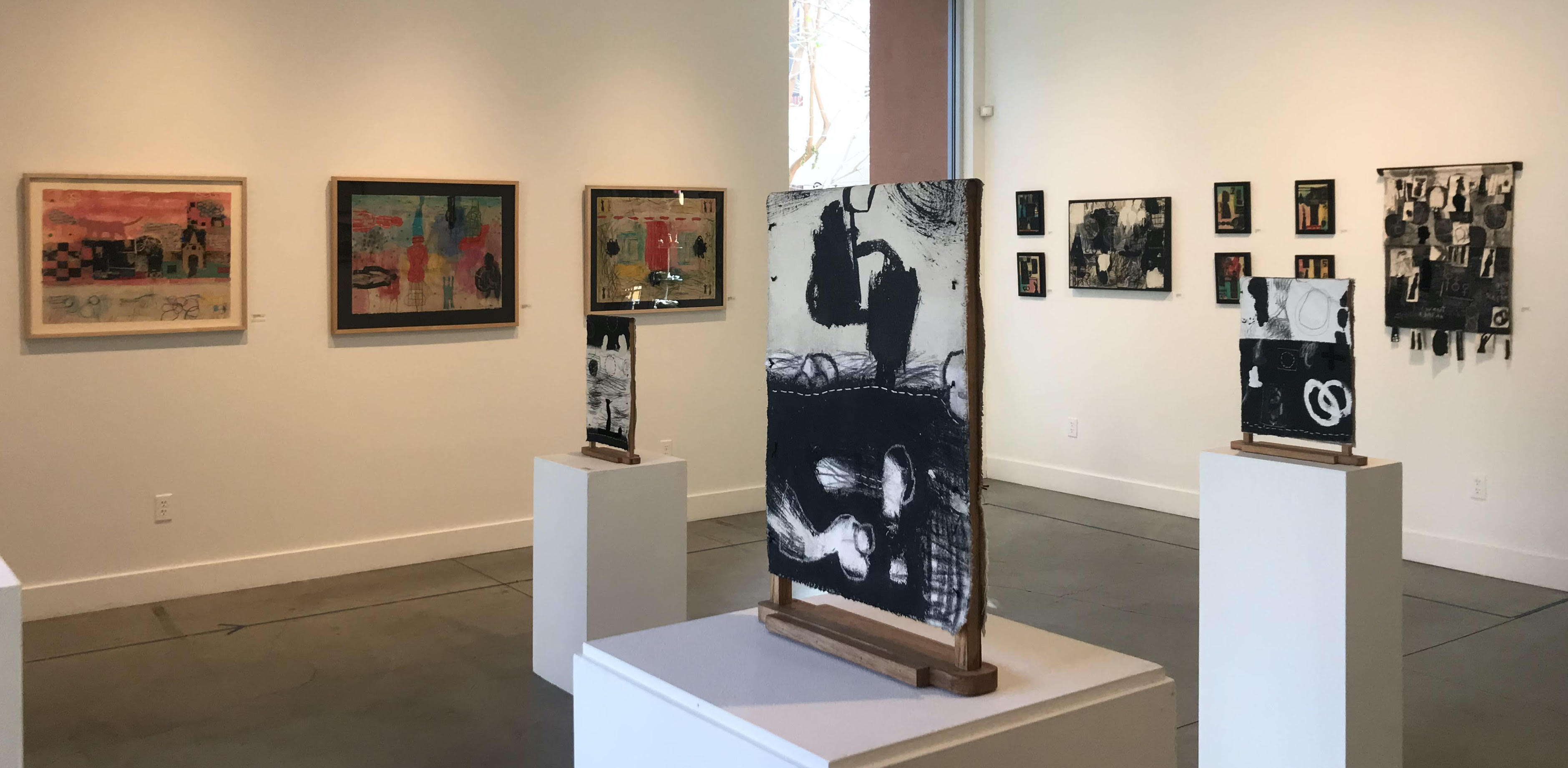
I don’t really have the time or space to do a proper review, but will say they are well worth seeing. Both are up through April 18.

And finally, sadly, at the start of the year ArtSpace 1616 in Sacramento quietly announced that they were closing. The gallery opened around the time I moved to the area and it was an art home away from home. I also think it was the best gallery in Sacramento. I saw a lot of art in the wonderful huge space by younger artists, but also saw a great deal of art by older artists of the region who had been in the spotlight decades ago and were brought back into it by the gallery. It might have been a repeat performance for some art viewers, but to me it was all brand new and I learned as much about Sacramento art history there as I did anywhere. I don’t know exactly why the gallery, run by Mima and Numan Begovic – two fantastic people — closed but I wish them well. It was the fucking best.
Nov. 11. 2020
‘Wayne Thiebaud 100’
As imaginative as its title
The Crocker Art Museum reopened a month or so ago and I was there the next day to see “Wayne Thiebaud 100: Paintings, Prints and Drawings.” I took notes and photos and then proceeded to not write about it. The exhibition of 100 works celebrates Thiebaud’s 100th birthday this month. Half are from the museum collection, the other half from the artist, family and foundation. It covers his career from 1960 (with a handful of earlier pieces) showing the development of his distinctive style and subject of carefully and uniquely observed painting of cakes, pies, people, cityscapes, landscapes, and a few more subjects. While best known for his lushly rendered dessert paintings that you want to lick and that are justifiably celebrated, his other subject matter is just as strong and often more creatively adventuresome. He’s also a consummate printmaker and that work is well represented in this exhibition.
One reason I didn’t write about the show immediately is that I was underwhelmed. So I went back again and found the problem: the exhibition isn’t that good. Since 2104, I’ve lived in Thiebaud’s territory and worked at UC Davis where he taught for 30+ years and have seen many well-conceived Thiebaud exhibitions and so much amazing art by him, so maybe I’m spoiled. But that doesn’t negate the issues with this exhibition.
 That doesn’t mean the art isn’t good. There are some of his finest still life and figurative paintings, with the large scale single and double figure works providing the visual monumentality in the main gallery that complement the mostly smaller still life paintings. But placement of two large landscapes – again some of his most distinctive and powerful paintings — in the adjacent hallway-like gallery steals power the big gallery could use. The exhibition is sorely lacking in his larger landscape and cityscape works. Most here are smaller and on paper (mainly prints that he augments with hand work) There’s not a single significant mountains/canyon work and those are as good and exciting as anything in his long career.
With all the art loaned by the artists the museum has some works probably not available to other institutions. If some of the works in the exhibition have never or rarely been seen by the public or there’s something extra special about them, the exhibition doesn’t emphasize that. And the inclusion of some of these needs an explanation. Maybe the Crocker couldn’t come up with a new spin on an artist it has been showing for 70 years; seems like that would make them qualified to come up with the best spin. Also, way too many mentions of Pop Art in the text.
Among the standouts on loan from the artist (and his family and foundation) are a view across a table and out a window of the steep hills of San Francisco from ‘93, a large drawing of a man on a gurney, a densely crosshatched etching of chocolates, and a wonderful completely naturalistic pastel of green hills and trees.
 The museum has put up 13 of his 17-piece etching and aquatint series from 64 called “Delights.” They are delights indeed.
Thiebaud’s main subject matter (food, people, cityscapes, landscapes) emerged more or less chronologically from ’60 – 68 then he went from one two another as he wished. The exhibition follows this chronology/subject matter path which is logical, but also looks lazy. And chronologically the newest pieces just feel like an overflow into the hallway gallery. That space would have been better used as a showcase for something specific (drawing, prints, sketchbooks, pre-1960 work, only work from the past year or two, a biographical gallery, work by his students.)
The inclusion of a few pre-60s paintings (a jewel of a study for his SMUD mural, a self-portrait from the 1947) are good for background and context in that the museum gave the artist his first solo show before his mature style emerged. What doesn’t make sense is looking into the gallery, the first painting one sees is a painting of a breaking wave from 1958. Even those who know Thiebaud’s work would be hard pressed to recognize it as his work and that is unlike 99.7 percent of the rest of the show. It makes no sense.
Go to the Crocker and celebrate the great painter’s life and art, be happy he has been with us for so long and is still here and still making art. Just don’t go expecting a thoughtful, definitive exhibition commensurate with his centennial.
(Thiebaud grew up in the Los Angeles area and during high school worked on cartoons for Walt Disney Studios. He worked as a cartoonist and designer and after serving in the military during World War II earned art degrees from what is now California State University, Sacramento, and has lived in Sacramento since the 1940s. After teaching at Sacramento City College, he was hired by UC Davis in 1960 and retired in 1991 although he continued teaching for a decade.)
“Jerald Silva: Through Another Looking Glass” at Artspace 1616
 For one reason or another I’ve just made it to “Jerald Silva: Through Another Looking Glass” at Artspace 1616. Silva been around his hometown of Sacramento and active as an artist for most of his 84 years, but I don’t ever recall encountering his work before. MY LOSS.
The gallery used a couple of photos of Silva’s painting in promoting the show and they looked beautiful, especially one of an older standing woman in a kimono glowing in the center of a room. A photo of an artwork, especially online, often tells one very little about the actual artwork. In this case the photo looked really good; IRL it looks even better. But then again, EVERYTHING in this exhibition – that in spanning 40 years is a mini retrospective — looks great.
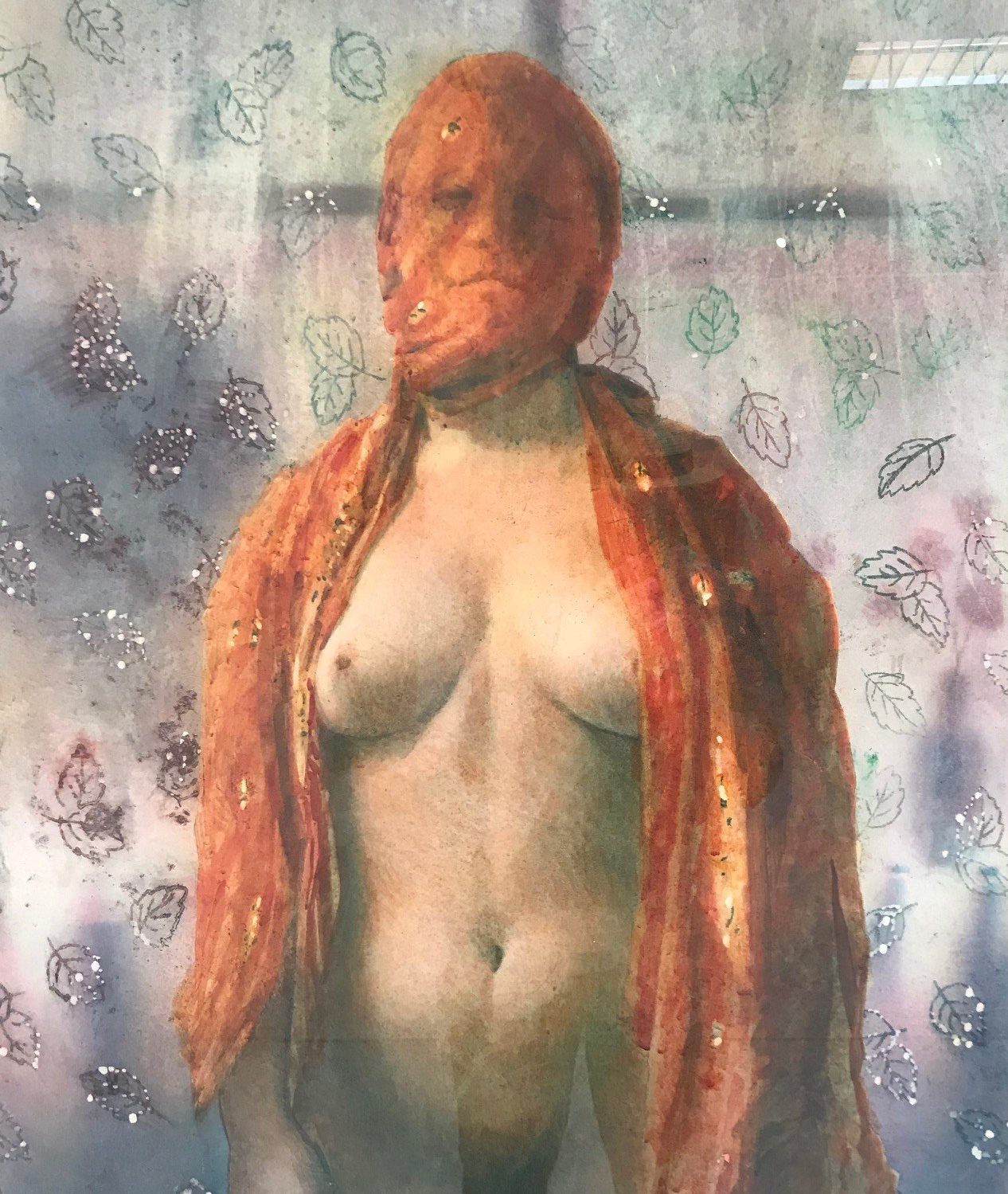 Although he uses watercolors, these are not traditional watercolors. Silva uses sizing on the paper which means that the pigment does not become one with the paper. The paint stays on the surface; the colors looks like watercolor, but the overall effect is different. I must have seen this technique before but I don’t remember where or when.
The bulk of the exhibition is large figurative works, something I’m a fan of, sometimes solo figures, sometimes several. They are beautiful and well composed, intricately painted with colors, fabrics and flesh gorgeously rendered. There are a handful of faces. Several of the earliest works from the 1970s have a more traditional watercolor approach, but he subject matter and painting style are similar to later work.
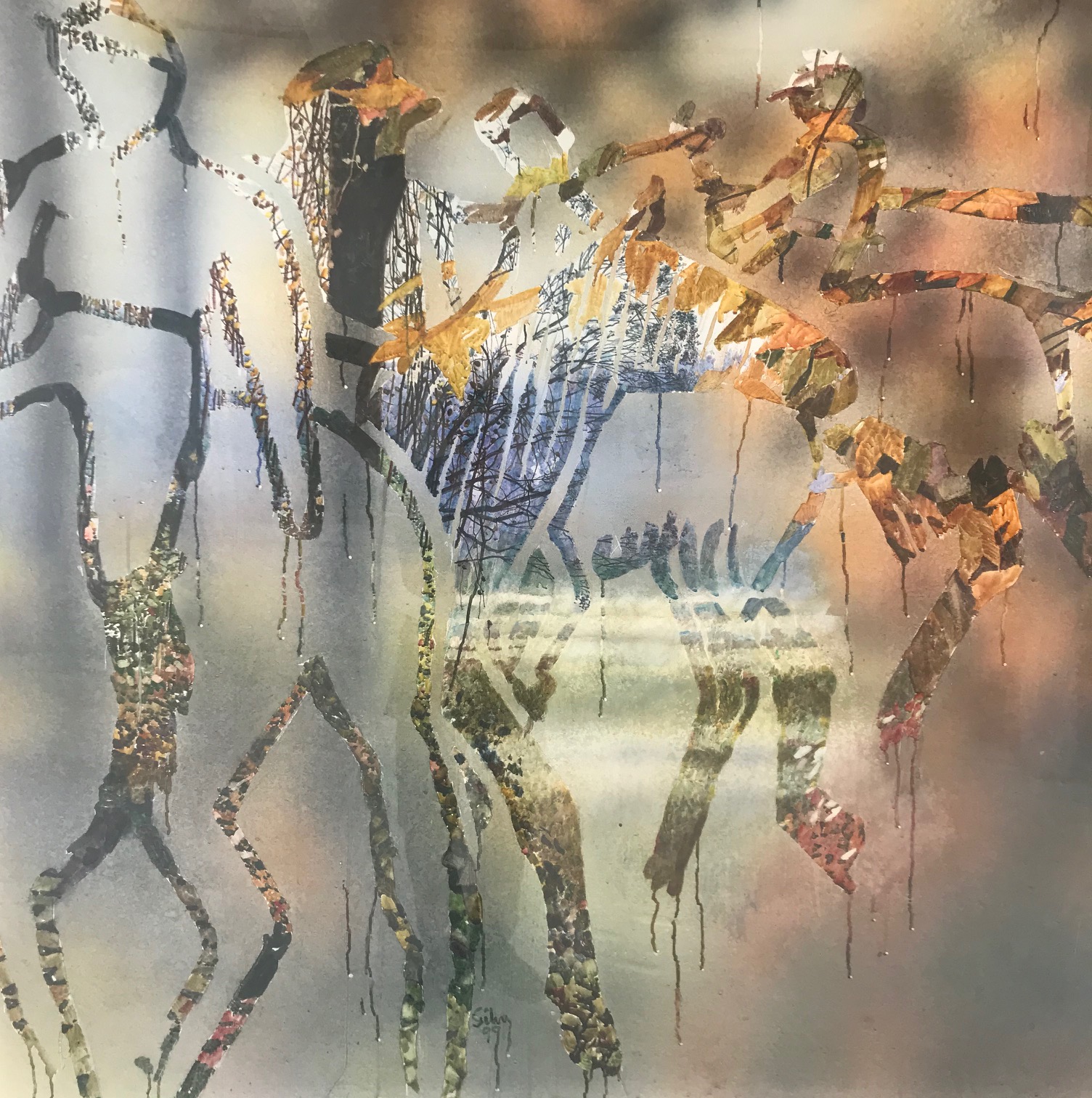 Silva has also headed in a new direction, focusing more on the landscape, but seen in a very different ways, as if through a foggy window. These are also large works and it is so exciting to see an artist in his ninth decade continue to explore and push himself.
I go to a lot of art shows and this is one of the few that blew me away. It’s on display until Nov. 29. See it. He has a good website with many images and other goodies. I’m waiting for the museum exhibition now.
Here and there in Sacramento
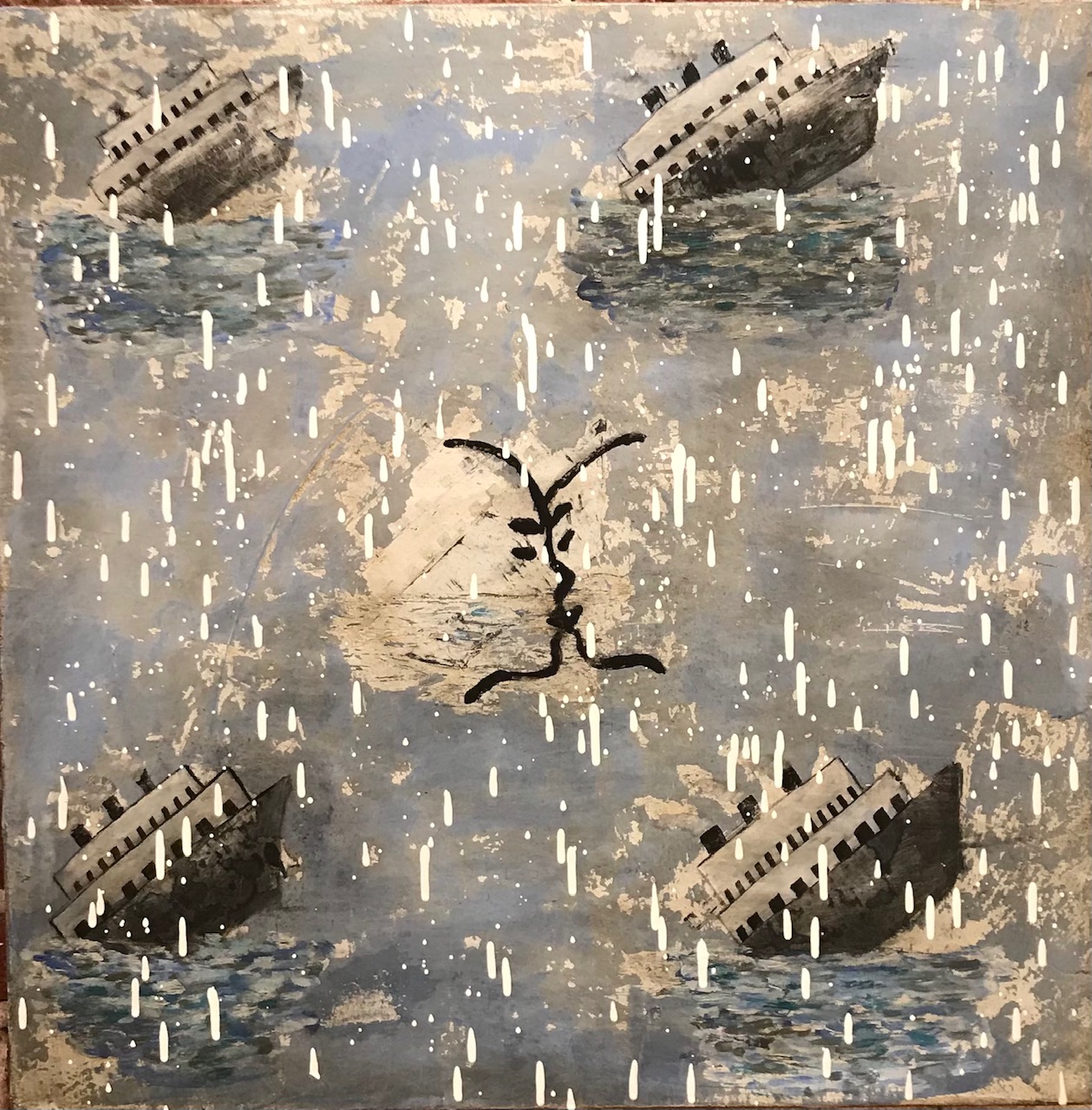 I saw the newest show at b. sakata garo before it officially opened (opens Saturday) so no labels although gallery owner Barry Sakata was kind enough to walk me around the gallery and ID the artists. Some are unmistakable – starting with a Richard Diebenkorn ink drawing, and others that I sort of recognized are Paul Wonner, David Park, Elmer Bischoff. The exhibition celebrates Wayne Thiebaud’s 100th birthday. With artists like this you know it is good. Among my favorites: small abstract painting by Mike Henderson, a big painting of a sinking ships at sea and a kissing couple by Squeak Carnwath (pictured), a cubist tondo of a horse by Hung Liu, , and a beautiful large nude drawing by the man himself.
Through Dec. 5.
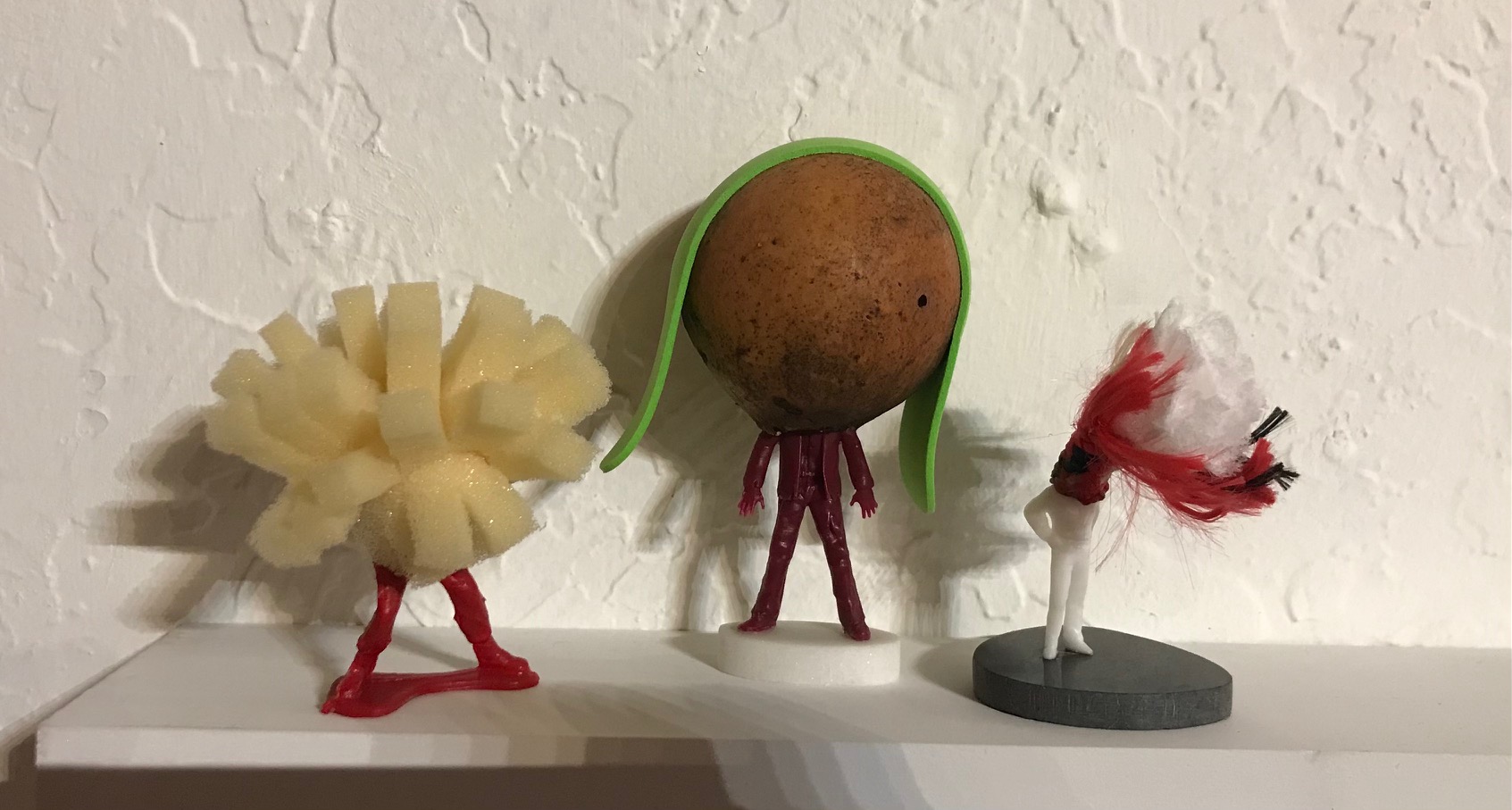 The huge space in the building across the alley from sakata garo that previously housed a wide range of mostly bad art, is now an art project space overseen by Sakata (I think.) The first project is a doozy by Robert Ortbal. Giant rabbit heads, tiny plastic figures he has muted, bunch or small sculptures of various shapes and sizes. There must be at least 100 works and it is all pretty wonderful. “The Be Cool Club” opens Saturday eve and continues through Dec. 6.
For both these contact the gallery directly for appointment and hours.
 Also ducked into Jay Jay Gallery to see the solo show by Michael Sarich. He’s best known for his big paintings that incorporates pop culture imagery (think Mickey Mouse) and there are some of those in this exhibition. What really stands out are the smaller pieces of paintings/drawings/constructions surrounded by ceramic skulls. And there’s a giant free-standing sculpture with some smiley face knobs all over it that is a must see. (Not sure of the details; nothing on gallery website. Best to contact the gallery directly.)
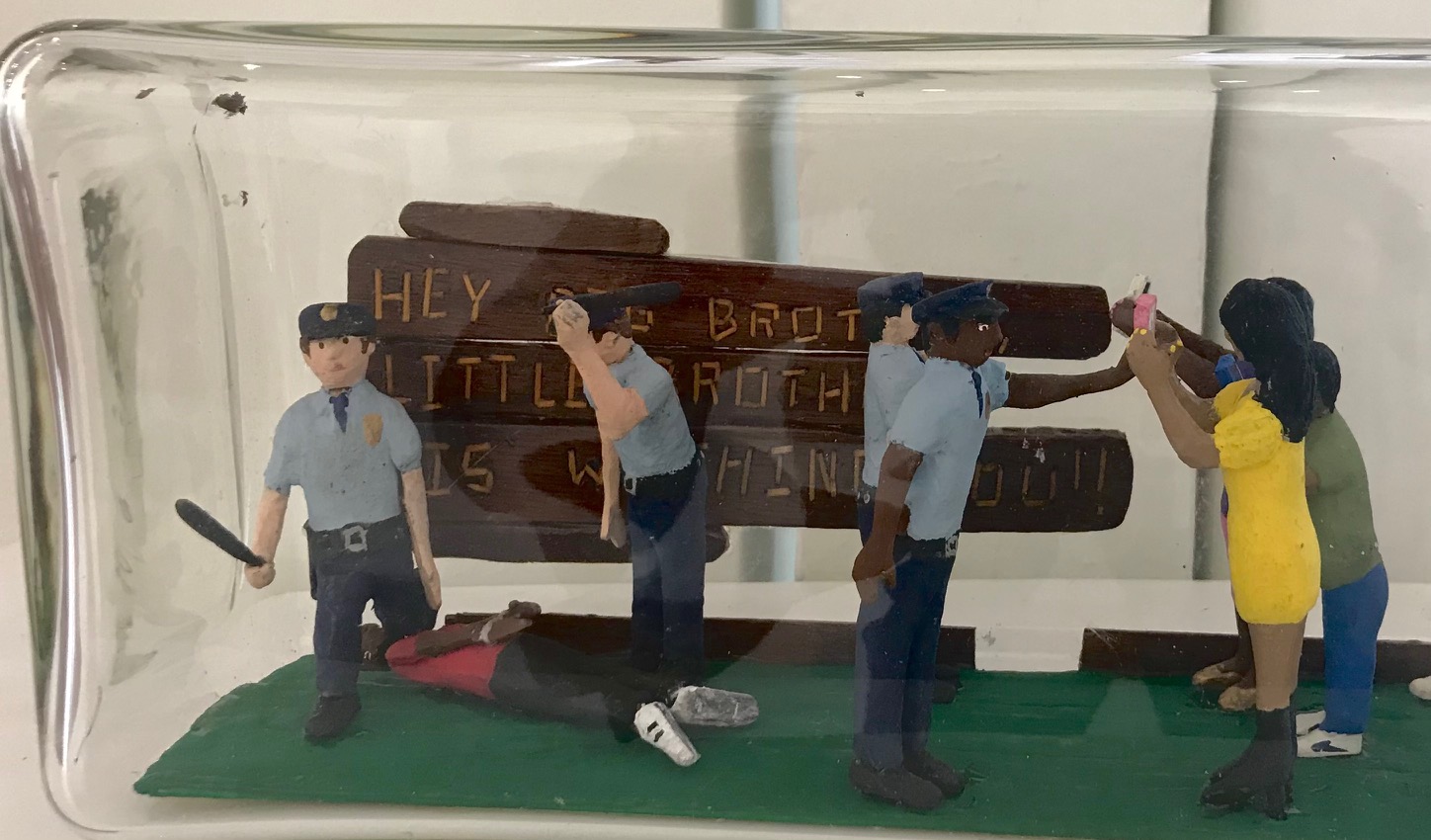 And finally saw wonderful and weird “patience bottles” by Steve Moseley at Arthouse. The St. Louis artist constructs scenes with hand carved wooden figures inside bottles (and a few paintings) commenting on social, religious or political issues of the past and present. So you can find the three wise men visiting a strip club and a confrontation better a group of citizens and cops standing over a black man they have handcuffed and on his face. Sorry to say, but I think the show is over.
Oct. 17/2020
Mysterious objects in the dark, bright colors in the light
In Davis, we’re lucky to have the Pence Gallery where I’ve seen so many great shows.
 The most recent is Chris Daubert’s “Firewood, An Installation.” Over the past couple of months I watched some of this work come together on Daubert’s FB page, but wasn’t prepared for this installation. The 10 individual works, made of wood originally destined for the fireplace, are mounted around the gallery perimeter behind black scrims, each individually lighted and the windows of the gallery blacked out. This lends the already strange objects an even greater sense of mystery.
The sculptures range from vase like objects to multiwheeled piece that reminds one of the wacky bicycles you can sometimes see around Davis. Three of the vases’ have beautiful turned bottoms with the tops remaining raw chunks of wood, while others are completely carved into complex shapes. Looking through the haze of the scrim your reminded of Morandi’s paintings of vases and bottles, and indeed, one is called “Morandi 2 A slatted house structure is the largest piece, shooting out light like it is burning with more than fire. A piece in the shape of three paper airplanes show how Daubert can do so much with so little.
Having been teased with earlier images of the works, I was a little disappointed to not get to experience the wood more intimately, but this is a bold show.
It is up through Nov 29.
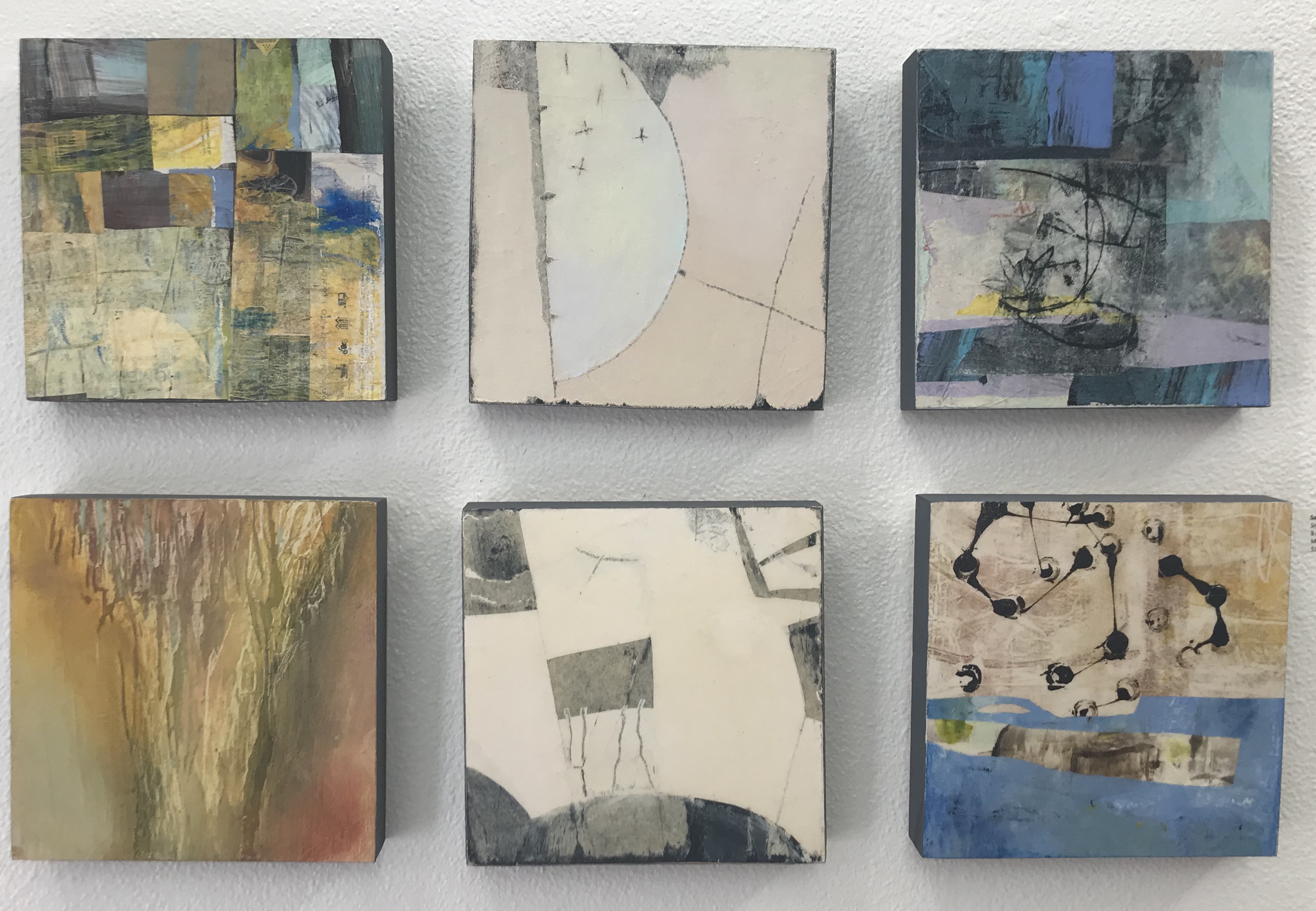 Also showing at the Pence is Sara Post who has taken some new directions that show a new direction with an emphasis on line and color. “This is Not a Dream” is still dominated by the beautiful calm muted colors and shapes that are sometimes nebulous, other times solid and strong, evoking city and landscapes. I was most taken with a group of very small works by the gallery entrance. It can be seen through Nov. 1.
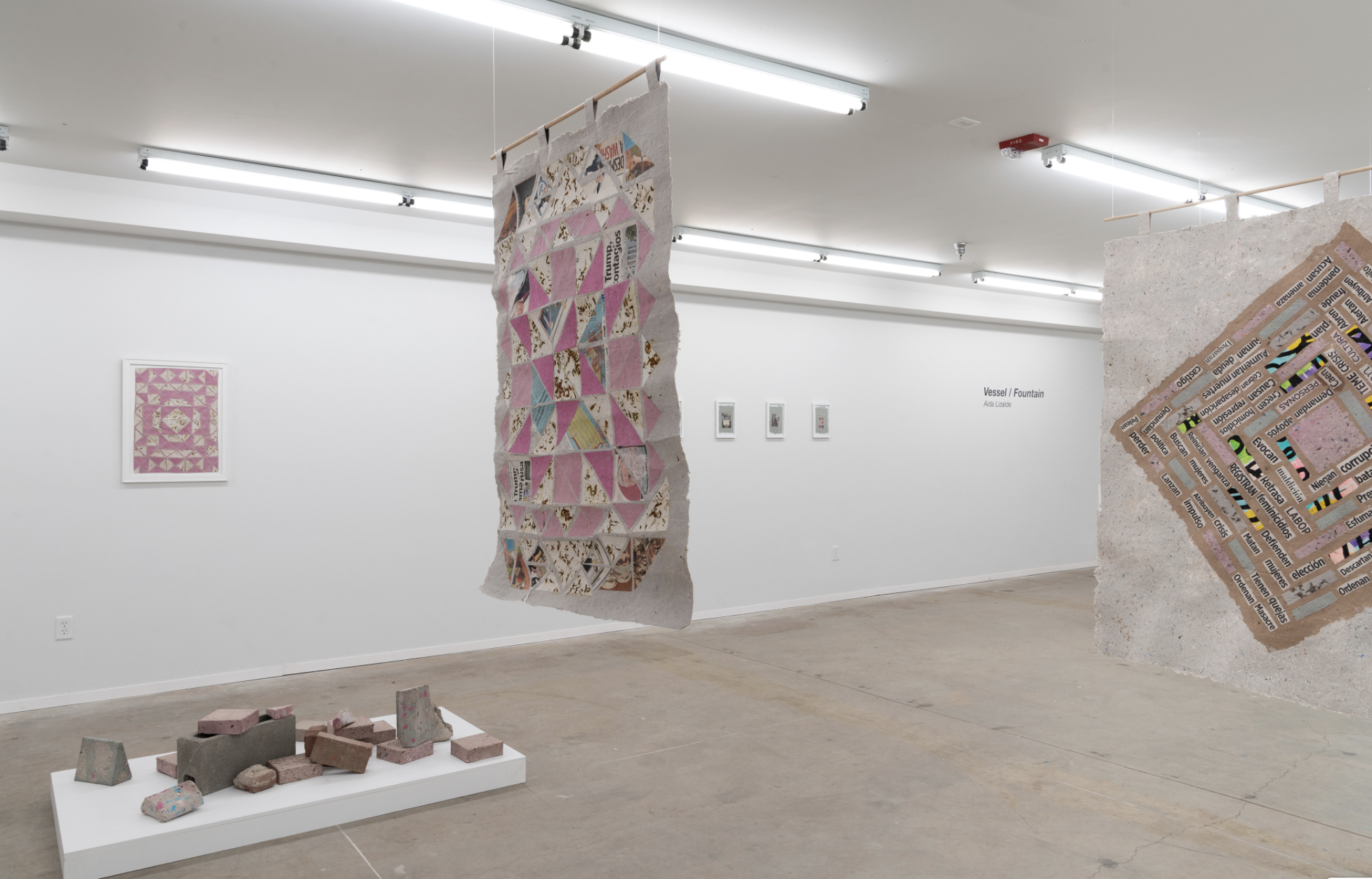 Just back from a residency in her native Mexico, Aida Lizalde’s new exhibition, “Vessel/Fountain” at Axis Gallery has more of an emphasis on 2-D works from an artist better known for sculptures. But with many of them being made of thick topographically surfaced paper, the material she was working with in Mexico, they’re still close to sculpture, and the larger pieces are hung from the ceiling to be viewed from both sides. All the works, including smaller framed ones, incorporate collage, printmaking and other techniques with the paper.
There is one large sculpture on the floor that mixes paper objects with bricks and cement block, and two smaller sculptures, one of which includes items found at culturally significant sites in Mexico City.
With 20 pieces all made recently and installed shortly after she returned to Sacramento it is an ambitious exhibition that fulfills its ambition. Though Oct. 31. The gallery is currently only open noon to 5 on Saturdays by appointment. If you can’t make it then ask if they can make another day/time work.
 The supernaturally productive and energetic Julia Couzens (artist, writer, curator) has a BIG show of all new work at the b. sakata garo gallery in Sacramento. I’m never sure how her sculptures, seemingly construction of random cloth or cloth like material, actually hang together, but hang together they do.
She often uses fabric of ugly pattens and colors, pairs them with more of the same, tosses in some fake fur, nylon shock cord, an entire skein of yarn, and comes up with something that is fun and compelling and thought provoking. One can study the pieces for a long time, getting lost in the materials and compositions, watching sometimes representational elements emerge. There are two funny/scary figurative works. On many levels, Couzens artworks remind me of paintings in which the paint has decided to be a lot more active than paint normally is. With one exception, all hang unframed, sometimes spilling down the wall and onto the floor. It’s controlled chaos.
Most of the 15 pieces are on the smaller side (3-feet by 3 feet or so), but there’s one about 6 feet by 6 feet that resembles a landscapes seen from the air, with a large green swatch (a blanket) surrounded by whites and tans and brown, as opposed to the sometimes garish colors in other works. It’s a real stunner.
The exhibition is up until the end of October. Contact the gallery for an appointment.
(Full disclosure: Daubert, Lizalde and Couzens all hold degrees from UC Davis where I work and where part of my job is promoting the work of UC Davis alums. That’s not what this is. Also, I own art by Lizalde.)
Art Gets Rolling Again
Oct. 6/2020
Wanted to do a quick rundown of some exhibitions I was recently able to see before some others come up.
Powerful Pinatas
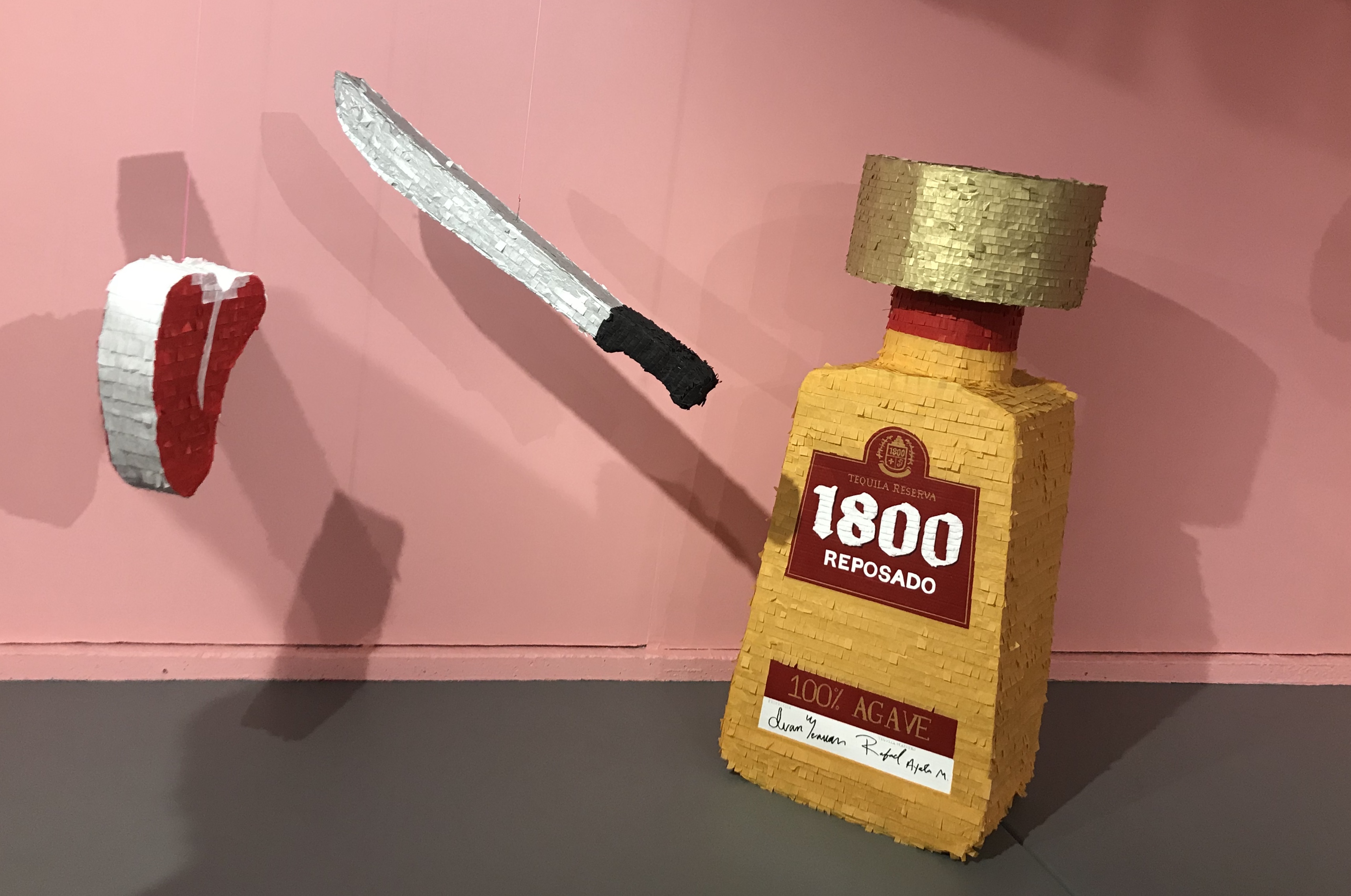
You only have a few more days to see Vincent Pacheco’s “Smile Now, Cry Later” installation at The Garage on the Grove in Sacramento. Pacheco, who I met when he was an MFA student at UC Davis a few years ago, has filled the garage/gallery with pinatas in the shape of pistols, a thick stack of Benjamins, a VHS tape, brass knuckles and more. For those who saw his rustic cabin in the graduate exhibition he was part of, this may come as a surprise. It’s a very compelling show, with the pieces finding a fine line between threat and humor. The bright pink walls make the whole place vibrate. The gallery will be open Saturday night (with a performance by another recent UC Davis MFA, Orang Hutan. If you want to go a different day/time, contact them.
From Garage to Barn
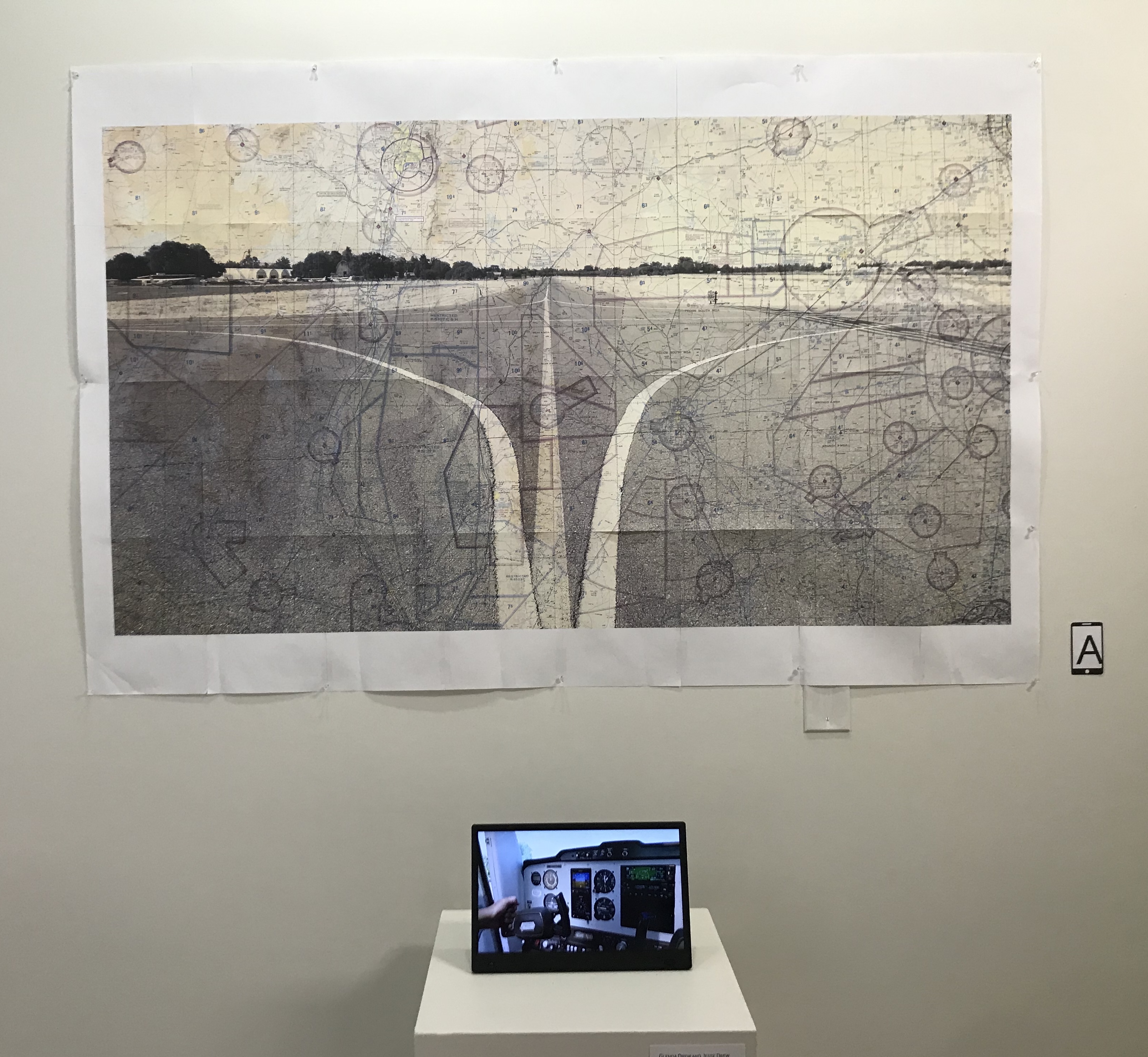 Also close by is a great exhibition at the Barn Gallery, that is part of Yolo Arts in Woodland. Memories of a New Future by seven artists explore time, travel, space … actually I’m not sure what it explores, but there is plenty of intriguing work by the Lynn Beldner, Steve Briscoe, Melissa Chandon, Chris Daubert, and Glenda and Jesse Drew (photo).
It’s a fun and thoughtful mix: Brisco’s playful non-functional shovels, Daubert’s beautiful scrap metal sculpture, and the Drews wall works that interact with videos.
This is the second time I’ve been to the gallery and the second time I’ve seen a solid show there.The show is up through Nov. 14.
Art and AI
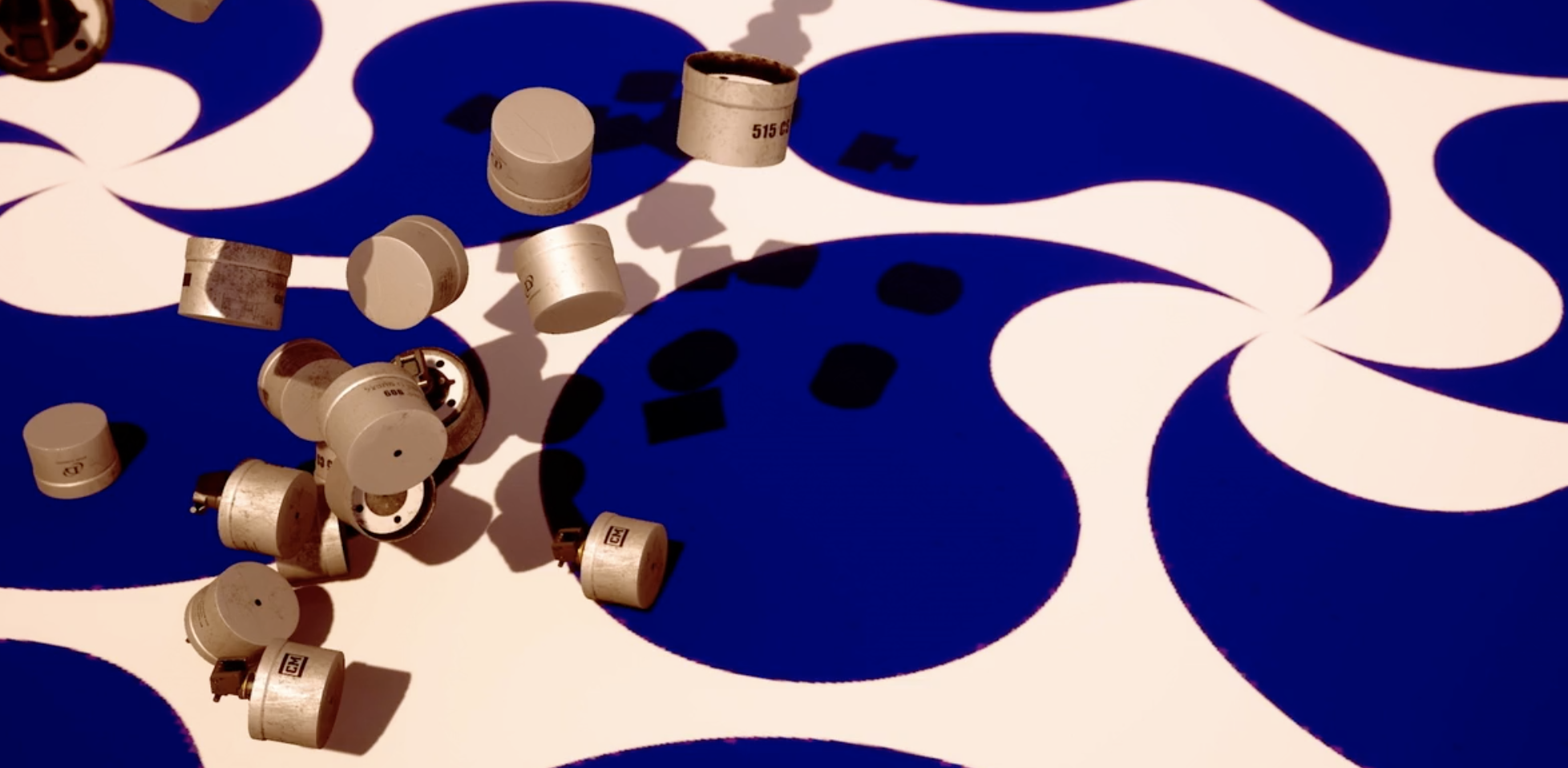 I was at the DeYoung Museum of Art in San Francisco a few days after it reopened, mostly to get back inside a museum – which didn’t work out exactly as planned. I wanted to see the temporary exhibition “Uncanny Valley: Being Human in the Age of AI” (that opened just before everything shut down) and to just wander around the collection.
Not surprisingly, “Uncanny Valley” involves many screens and quite a bit of sound and it is the kind of work that some people, including me, have trouble fitting into the category of art. Maybe I just needed to be in a museum or maybe this work is just strong, but I was taken with it. Nearly all is highly complex, mining all kinds of data, to create physical/visual representation that do more than simply convey the information.
The collective Forensic Architecture explores a widely-distributed teargas grenade called the triple-chaser, showing how to identify it among millions of other images and visual clutter through a hectic video with flashing colors and changing backgrounds. It also pairs the video with Strauss’ “Four Last Songs,” a favorite of Warren Kanders, CEO of the company that make the grenades. Kanders was a vice-chairman of the Whitney Museum of American Art, until protests led to his resignation last year.
 Trevor Paglen’s “They Took the Faces from the Accused and the Dead . . .” is a wall of 3,000 mugshots the American National Standards Institute used to train early facial-recognition technologies — without the consent of those pictured.
Visitors can become part of Lynn Hershman Leeson’s “Shadow Stalker;” it allows viewers to see the trail of data they have left behind online — their digital alter ego.
The entire exhibition is well designed and is fairly easy to navigate. There is a LOT OF TEXT and it is well written and extremely helpful.
“Uncanny Valley” runs through next June.
After getting through that I explored a few galleries in the museum (I’d forgotten there was so much 19th century American there) until a fire alarm went off and we all had to leave.
The Father of Bay Area Figurative
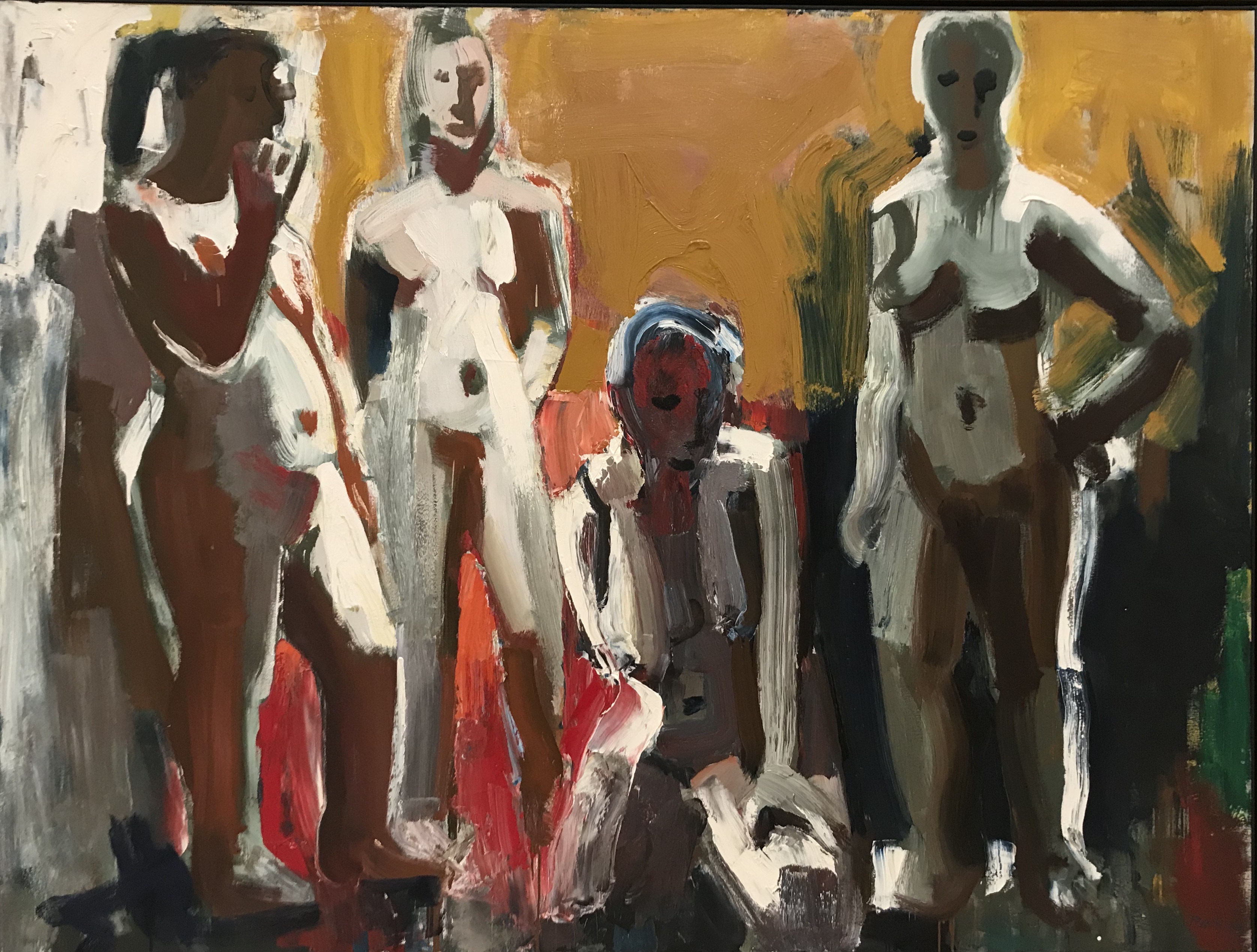
I was back at SFMOMA, I believe the day it reopened to members.
While I’d have been happy to return just to go to the museum, there was another great reason: a David Park retrospective. The first one in 30 years.
Park was a Bay Area artist who in the early ‘50s made the then-radical move back to the figure from abstraction – becoming the center of what came to be called the Bay Area Figurative Movement.
The exhibition covers his career from early figurative paintings from the 1930s to his death in 1960 at only 49. There are even a few non-representational pieces that didn’t go the dump with the rest he left there (most show the heavy hand of Picasso.)
 Although it covers his entire careers, it is not a huge show, but has some of his finest works, many smaller pieces and a large number from private collections that are rarely seen by the public. I could have done with a bigger show and am wondering if the pandemic had an impact on what made it to the museum.
One of the best know paintings is “Four Men” from 1958 on loan from the Whitney, with its four simplified figures, three on the beach and one in a rowboat his back facing us.
Like many of his painting, Park’s placement of the figures from front to back adds a real dynamism. This can be seen most dramatically in a 1950 painting of boys on bikes one riding away and in the distance, the other almost coming through the picture plane.
Along with a handful of monumental (by Park’s standards anyway) are many medium and small work where his muscular brushstrokes and confident paint application can be appreciated even more.
The exhibition includes quite a few small paintings on paper (too many), Park did during his final illness. The prize among this late work is a 7-inch by 17-foot scroll painting that is a travelogue through his life. (About 10 feet of it can be seen but the whole can be video on video.)
 A companion exhibition, “David Park and His Circle” contains mostly fast sketches of models done in weekly sessions with Park, Elmer Bischoff, Richard Diebenkorn and others. If the model didn’t show up, they posed for one another. (That’s Park drawn by Diebenkorn.)
Last or No Chance Show
Because it is closing in just a few days, and I’m running out of time, I’d be remiss not to mention the decades-spanning photography exhibition An American Project by Dawoud Bey. It includes work from his “Harlem USA” series of the late 1970s, though a project commemorating the 1963 bombing of the 16th Street Baptist Church in Birmingham, Alabama, and recently landscape nocturnes imagining the journey of a fugitive slave moving along the Underground Railroad.
The last day is Oct. 12, but the museum is offering free admission through Oct. 18 and I hear all the tickets are gone gone gone. Such a shame because nearly the entire run of this important show was wiped out by the pandemic.
Back in the galleries
August 20202
After not being able to visit galleries or museums for months, this week I’ve been able to go to several. I posted on FB a few days ago about a couple of shows at the Pence Gallery in Davis, but those closed yesterday so I’ll skip them. And in a few days I plan to visit Axis Gallery and will report back on the exhibition there.
Some galleries in San Francisco are open with appointments, and it seemed like it would be a lot cooler there, and I’d not been since the start of all THIS, so I dropped out of a kayaking trip Saturday and headed down. I’m going to run through these in an order that makes sense to me, but I’m saving the best for last; yeah I know better, but I don’t care. (I’d also note that all these places are fairly close to one another, so it’s a lot of art in a concentrated area.)
“Orlando’ at McEvoy Foundation
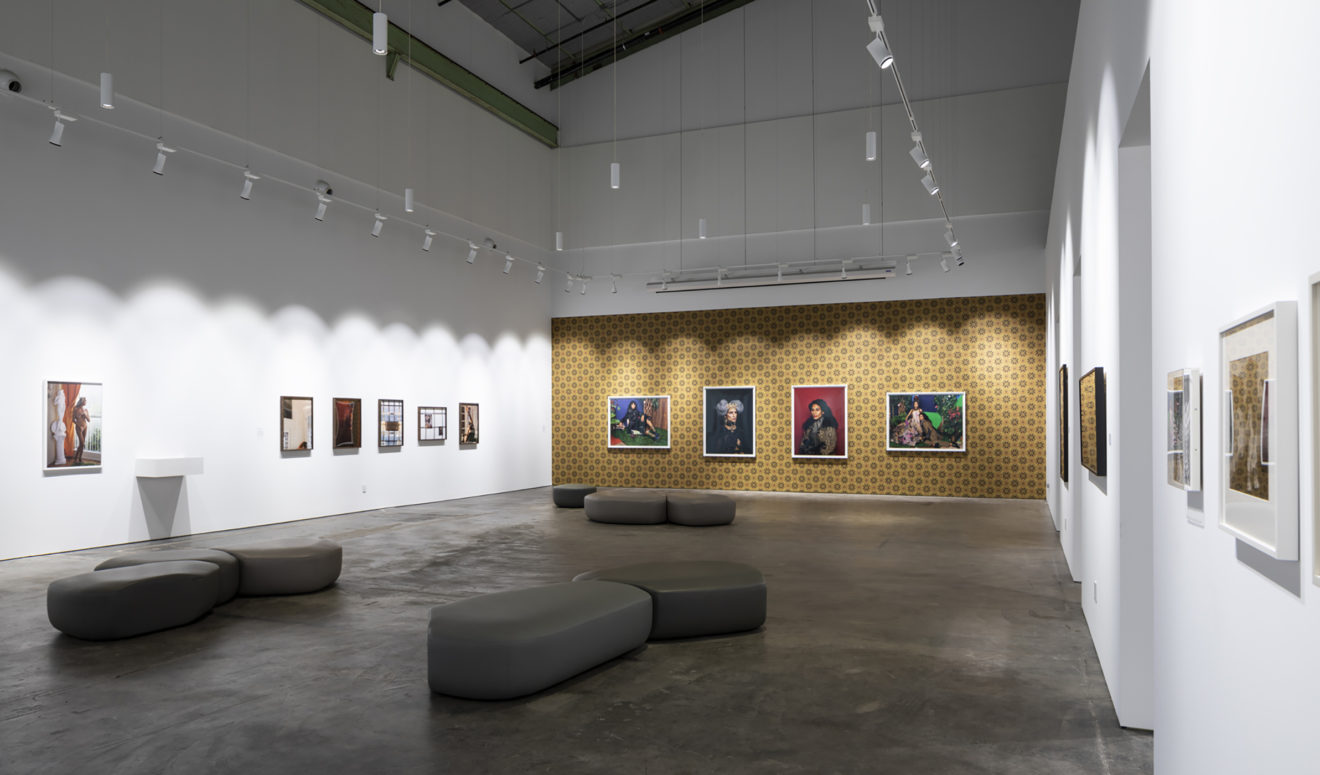 The originating impetus for venturing out was “Orlando,” at the McEvoy Foundation for the Arts, organized by actor Tilda Swinton and connected to the groundbreaking 1992 movie of the same name she starred in. And my motivation for that was the participation of UC Davis professor emeritus Lynn Hershman Leeson who has worked with Swinton several times. The exhibition explores identity, gender and history, largely through photographic techniques.
Hershman Leeson’s offering is primarily connected to the alternative character “Roberta Breitmore,” she became for several years, getting a credit card, apartment and seeing a psychiatrist as her.
Also included is “Orlando” director Sally Potter’s book about the movie made before the movie as a pitch device to studios. Almost no one was interested or thought it was possible to make a movie based on the Virginia Woolf book.
The works range from documentary to the experimental, with the medium reflecting the richness of gender and identity.
The exhibition is visually dominated by the huge lush, pseudo-historical photos (“Orlando Series”) by Mickalene Thomas.
Through Sept. 5, reservations required.
Two Shows at Minnesota Street
More or less across the street at the Minnesota Street Project, McEvoy has another exhibition, “In This Light,” by four artists showing work created during the pandemic or pieces that were going to be in exhibitions that were canceled.
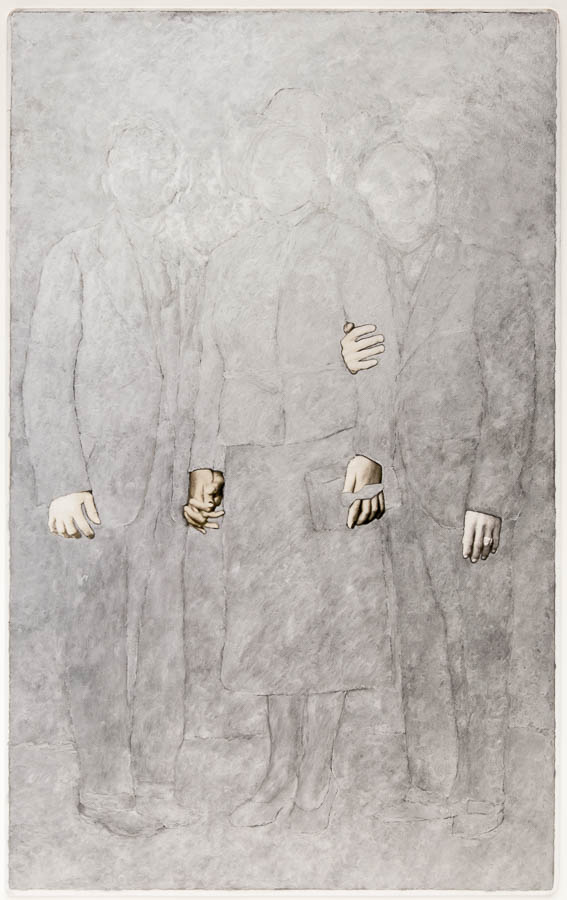
Beverly Rayner’s “Holding On”
The Minnesota Street Project was on the to-see list for the group show “Invincible Summer” drawn from most of the commercial galleries (many closed, some open by appointment) at the center where so many galleries now have homes. Each gallery selected artworks that responded to the “invincible summer” line in an Albert Camus essay, “that expresses hopefulness in the face of challenge.” Not sure the show succeeds at that or even if the specific pieces do, but if you’re like me you see most art as an expression of hope in the face of a challenge (such as the challenge of making art.)
As expected the work is all over the place in content and quality and is rich and fun and thoughtful because of that.
Standouts for me are the silver ghosts of Beverly Rayner’s “Holding On;” Agelio Batle’s shaped black “painting” in gold frame “Black Mirror;” Amani Lewis’ crazy mixed up media “Giovanni in the Meadows;” and Hung Liu’s docu-interpretation-expressionist “Fetching Water III.”
(See it online. You need a reservation to see the show and it is a complete pain to find the link to do so, so here it is: https://www.eventbrite.com/e/1275-minnesota-st-admission-tickets-110291625220)
30th anniversary at Brian Gross

“Blueprint for Self-Portrait” and “Hand Brick” by Robert Arneson
The first stop was, as it often is on SF gallery trips, Brian Gross Fine Arts. The Utah Stret gallery is having a 30th anniversary exhibition including works by artist it has represented over that time and in some cases the entire time. As the gallery states, it isn’t a comprehensive exhibition, but is a great sampling of artists.
I knew there would be some UC Davis folks and there were. The earliest piece in the show is Robert Arneson’s “Blueprint for Self-Portrait” from ’69. There are also a couple of sculptures by Arenson, along with works by UC Davis professors Robert Hudson and Roy De Forest.

Mokha Laget’s “Wherefore”
The show has a surprisingly large number of beautiful hard-edged abstract paintings (and one sculpture) by Pard Morrison, Mokha Laget, Cheonae Kim and others. Those who would rather looks a works that are made up of a bunch of tiny marks, turn to Andrea Way, Teo González, and Adam Flower. What I really liked: Dana Hart-Stone’s piece made up of repeated photos and the print-tin collage by Tony Berlant. With 32 artists, most represented by more than one work, this varied show goes quite a way toward quenching a thirst for art.
Up until Aug. 29, reservations required.
Hotheads by Julie Heffernan
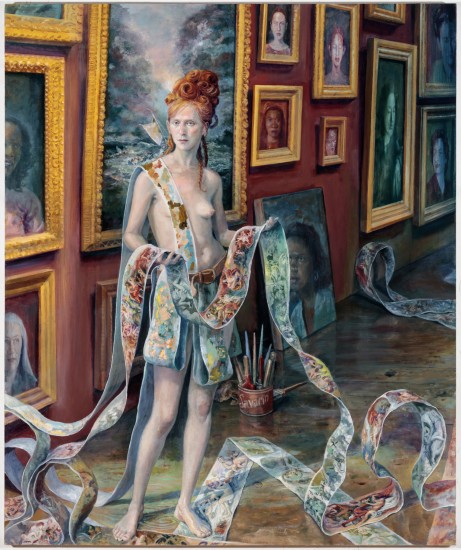
“Self-Portrait with Shipwreck,” Julie Heffernan
I only decided Saturday morning to see what the Catharine Clark Gallery (in the same building as Gross) had going on. Oh, Julie Heffernan; sign me up.
Didn’t really know exactly what the show, “Hotheads,” would be, but when I left the gallery to make my next art appointment I told them, “I should have blocked out two hours for this show.”
The exhibition revolves around a series of huge paintings of a nude woman (a kind of self portrait) celebrating other women thought the scrolls she holds and portraits that surround her of women ranging from Artemisia Gentileschi to Joni Mitchell and a lot more, as well as well-known paintings from the past.

“Self-Portrait as Hothead”
The more you look, the more you see. Heffernan is doing some rich cultural mining here, tapping into so many sources and loading the paintings up with content. As usually they are visually stunning,from composition to the miracles she makes the paint do. They’re full of magical power and some humor (check out “Girl Party”). Did I mention, they are BIG painting. The work in “Hotheads” goes back to 2014, but all of those full length “self-portraits” were done in the last two years which is remarkable.
Part of the show is a “hotheads” wall for which Heffernan invited other artists to make a work about other “hotheads.”
An aside: I first saw Heffernan’s work in person at P.P.O.W. in NYC around 2003. I was taken with the magic of the paintings where figures dissolved into light or butterflies or birds, where the world was lighted by strange fire, where the giant baby in the turban or the co-joined twin girls with 17th century French hair looked like places and people I wanted to spend more time with. Talking to the people at the gallery I learned they were interested in working with museums traveling the works, and I suggested they contact the Columbia (S.C.) Museum of Art. That worked out and the museum hosted “Everything That Rises” in 2006. The museum even purchased a painting.

“Self-Portrait with Rescuer”
The exhibition is up through Sept. 5. Although I recommend seeing it IRL there’s a great video interview with the artists on the Catharine Clark Gallery website where you can also make a viewing reservation.
5/6/2020
Live from Folsom Prison in Photos
 In May of 1968, the recording “Johnny Cash at Folsom Prison” was released and if everything wasn’t closed, you could see a photo exhibition about it at the Pence Gallery in Davis. “Folsom Prison: A Redemption” is made up of 32 photos by Gene Beley and Dan Poush, mostly from the two January 1968 concerts at Folsom. The highlights are the concert photos, candid backstage shots and Cash posing outside the stony prison gatehouse.
A photojournalistic exhibition is unusual for the Pence Gallery, but it’s a nice addition thanks to the regional connection. An exhibition like this isn’t completely defeated by being viewed online either. Nearly half the photos can be seen online at the websites of the Pence and show organizer ExhibitionsUSA. In addition, gallery director Natalie Nelson created a nice video tour.
 The performance photos that show the inmate audience are among the best, along with a handful of the backstage pictures that include June Carter. (Carter and Cash married two months after the concert.) Many photos include the other musicians who played at the concert, including Cash’s old Sun Records labelmate Carl Perkins. There’s a mix of black and white and color throughout, with all the portraits of Cash at the gates in color. Even those posed photos aren’t all that posed, seeming to catch Cash looking ready to move on.
There’s a photo of Cash with inmate Glenn Sherley who wrote the song “Greystone Chapel” that Cash performed and is included on the recording. We see Cash a few days before the concerts with his parents in Oakview, California, where they lived at and ran the Johnny Cash Trailer Ranchero. He and his wife Vivian and their four daughters had lived nearby. Scattered among the Folsom photos are shots from concerts in Riverside, Anaheim and San Bernardino.
The Folsom Prison concert was far from Cash first foray into making music by and about prison and prisoners. He wrote “Folsom Prison Blues” way back in 1953 and recorded it in 1955. Cash had been doing prison concerts since 1958. The first one was at San Quentin where Merle Haggard, serving time for robbery, heard him.
 The Folsom album marked Cash’s comeback after a few slow years and a year later, Cash had his own television show. That’s really where I first encountered him as a kid although I was too young to realize how groundbreaking that show was. His career would take another dip again, and he was even dropped by his longtime record label in the 1980s before coming back as part of the country music supergroup The Highwaymen. The last decade of his life was among his most productive with his collaboration with producer Rick Rubin and songs from Trent Reznor, Nick Lowe, Chris Cornell and others that introduced him to a new audience. It was some of his best work.
I got to see Cash perform at a music park in the Georgia in the early 1980s. I even got to very briefly interview him then, but that that consisted of me asking about his custom-made boots in a gravel parking. (Turns out one of the camera crew there in the parking lot was from “60 Minutes” so I appeared with Cash on “60 Minutes” for about 60 seconds a few months later.)
Not all of the photos are technically great, and little of it will be a surprise to Cash fans, but it will still please them.
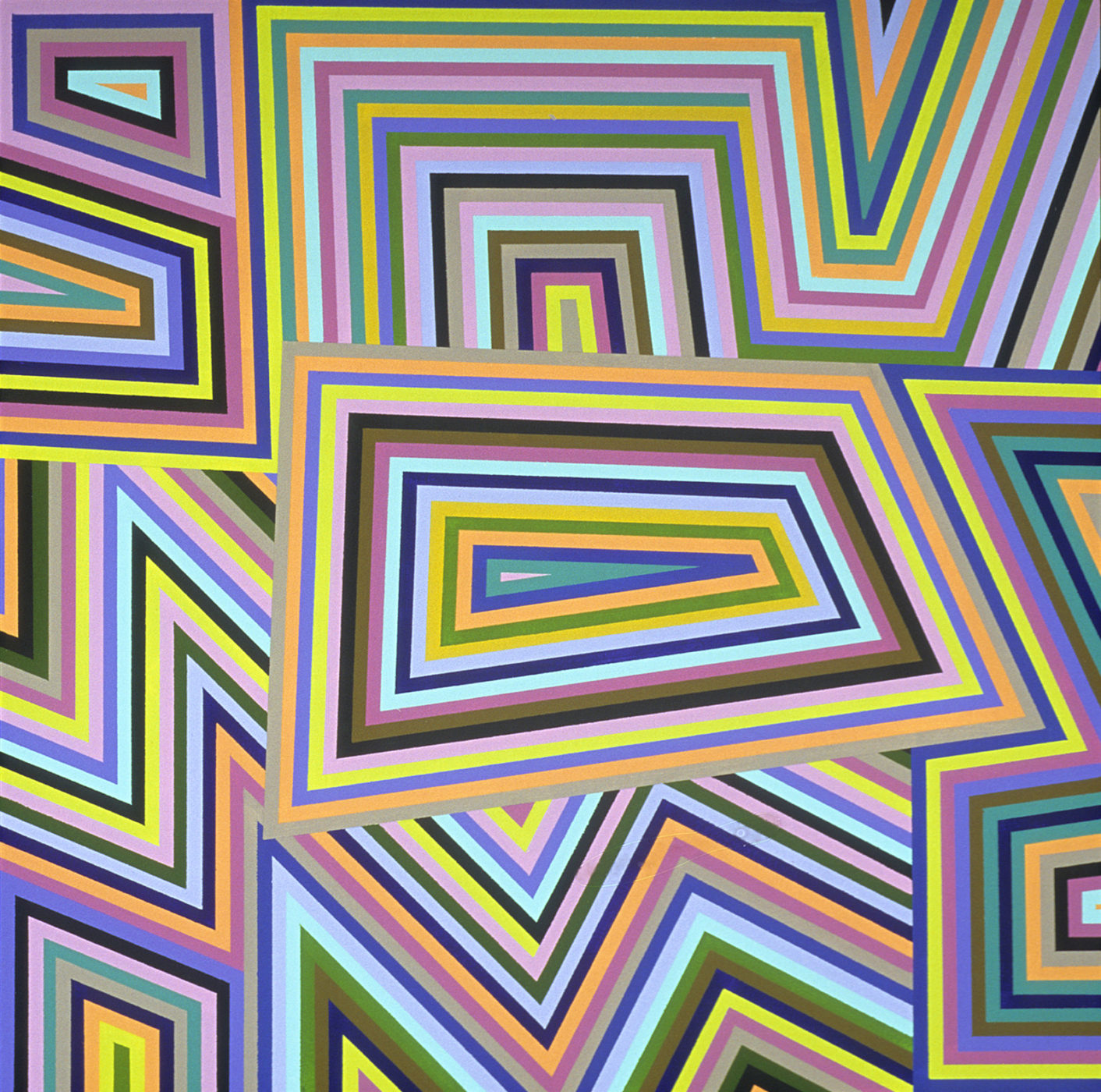
Axis Gallery in Sacramento has been one of my favorite places and one of the best places to see art in the last few years. Run by artists for artists, the gallery isn’t letting a pandemic get in the way of a good show.
That’s the show by Mark Emerson and Justin Marsh that you can see online. Emerson, who early a MFA from UC Davis in ’94, does colorful geometric painting, that explore color and form in a wide range of approaches, from grids to oddly overlapping blocks of paint. His 10 paintings were one between 2008 and 2014.
 Marsh, a preparator at the Manetti Shem Museum at UC Davis, frequently has figurative elements in his paintings (sometimes human figures, sometime object like wheelbarrows) living in a world of broad swatches of painted background and geometric elements. But just as often he’s working completely abstractly in a very loose manner and also has two pieces where text in the primary element. In addition, there are two of Marsh’s videos. All of it is interesting, but it is too much. Where’s the curator?!
I will not pretend that looking at art, especially paintings like these, many of them quite large, is a substitute for the real thing, but here we are. And the work is really exciting. All that goes for the next item too.
An artist I met and first wrote about when he was just starting out, Brian Rutenberg, is in an online group show at Nancy Toomey Fine Art in San Francisco. He grew up in South Carolina (that’s where I know him from) but has long lived in New York where he has a show at Forum Gallery. Forum has created a video of his current show there.
Two recent UC Davis recent MFAs, Muzi Li Rowe, and Vincent Pacheco, have been awarded Ali Youssefi Project residencies in Sacramento. That makes four of the five recipients of the award’s recent graduates of the UC Davis MFA program, the others bring Jodi Connelly and Brooklynn Johnson.
The UC Davis Arts Newsletter is something I do every month and I’m happy to say it continues in spite of the pandemic. The university has arts events online and I’m happy that this downtime for performances has allowed us to share already existing videos of university performances .
3/11/2020
Don’t judge to soon: landscape painting and narrative ceramics at Crocker Art Museum
After a recent conversations with a friend, I felt like telling him to avoid “contempt prior to investigation.” I didn’t have “contempt” for a couple of exhibitions that recently opened at the Crocker Art Museum, but admit to some unfounded negative expectations prior to seeing “Granville Redmond: The Eloquent Palette” and “American Expressions/African Roots: Akinsanya Kambon’s Ceramic Sculpture.”

It might be easy to dismiss Redmond, who spent nearly his entire career from the 1890s to his death in 1935, capturing the California landscape on canvas. Redmond was a very fine painter as this exhibition of 85 works shows, but he got pigeonholed as the “poppy painter.” He wasn’t happy with the title, but found that those works were the ones he could sell. The museum doesn’t completely help revise his reputation by making 50 percent of the exhibition poppy painting, several almost identical. At the same time, one can’t fault the museum for providing an accurate rendering of his artistic output. Fortunately most of the other paintings provide a much-needed broader perspective of the artist’s work.
The first painting, and I believe the only one from a few years he spent in Paris in the 20s during the 1890s, is amazingly accomplished for a 24-year old artist from California. It is a large work, about 4 by 5, of barges in a Paris canal on a foggy morning that could stand up alongside similar works by older artists who studied and lived in France.
Nearby is a small, horizontal gathering of lemons ‘round a teacup that I could look at for hours.

The early California paintings (1898 – 1912) are moody, falling into what is dubbed Tonalism, but they remind me also of some of the more subdued artists considered Impressionists. He captures the low rolling hills and valley oaks, more distant mountains and the light at all times of the day, but especially twilight. You feel them as much as you see them. Looking at these, I turned to another viewer and said “These paintings make you want to live in California, don’t they?”
 What really grabbed me in many of these painting is the sky. We are not talking big billowy clouds or thunderheads, but dappled, subdued and subtle tones of light blue, gray, pink, gold, and lavender. (Later works come with big white puffy clouds.)
 Redmond’s brighter palette, and poppies blossom after 1910, first quietly but getting turned up as time passes. There are great paintings with fields of flowers in the exhibition — really almost off of them solid, interesting paintings, but the repetition gets repetitious. And there are a scattering of not very good paintings that could have been cut. The exhibition spills out of the main gallery into a hallway gallery; the exhibition would have benefited from not having this space, because like many shows, it would be better with less.
I can understand the dismissal of Redmond as a painter of nothing more than pretty flower pictures, but once you see the breadth of his work that this exhibition provides you’ll see him as much more.
Though May 17.
(Interesting side notes about Redmond. A case of scarlet fever as a child rendered him deaf. He attended what would become the California School for the Deaf where his artistic skills were encouraged. Several of the painting in the exhibition belong to the school. He developed a friendship with Charlie Chaplin to whom he taught sign language. He appeared in several of Chaplin’s movies as well as those by others.)
I saw a photo of one of Akinsanya Kambon’s figures on horseback in a local publication and thought it didn’t look all that great. A fairly small figure looking rather crudely made with a monochromatic glaze. I’ve seen plenty of folk and outsider art and I can be a fan of crude and odd. But what I saw in my cursory glance is hardly representative of what’s in the exhibition: complex pieces that meld vessel shapes with full sculpture and relief sculpture along with a wide range glaze surfaces and colors.
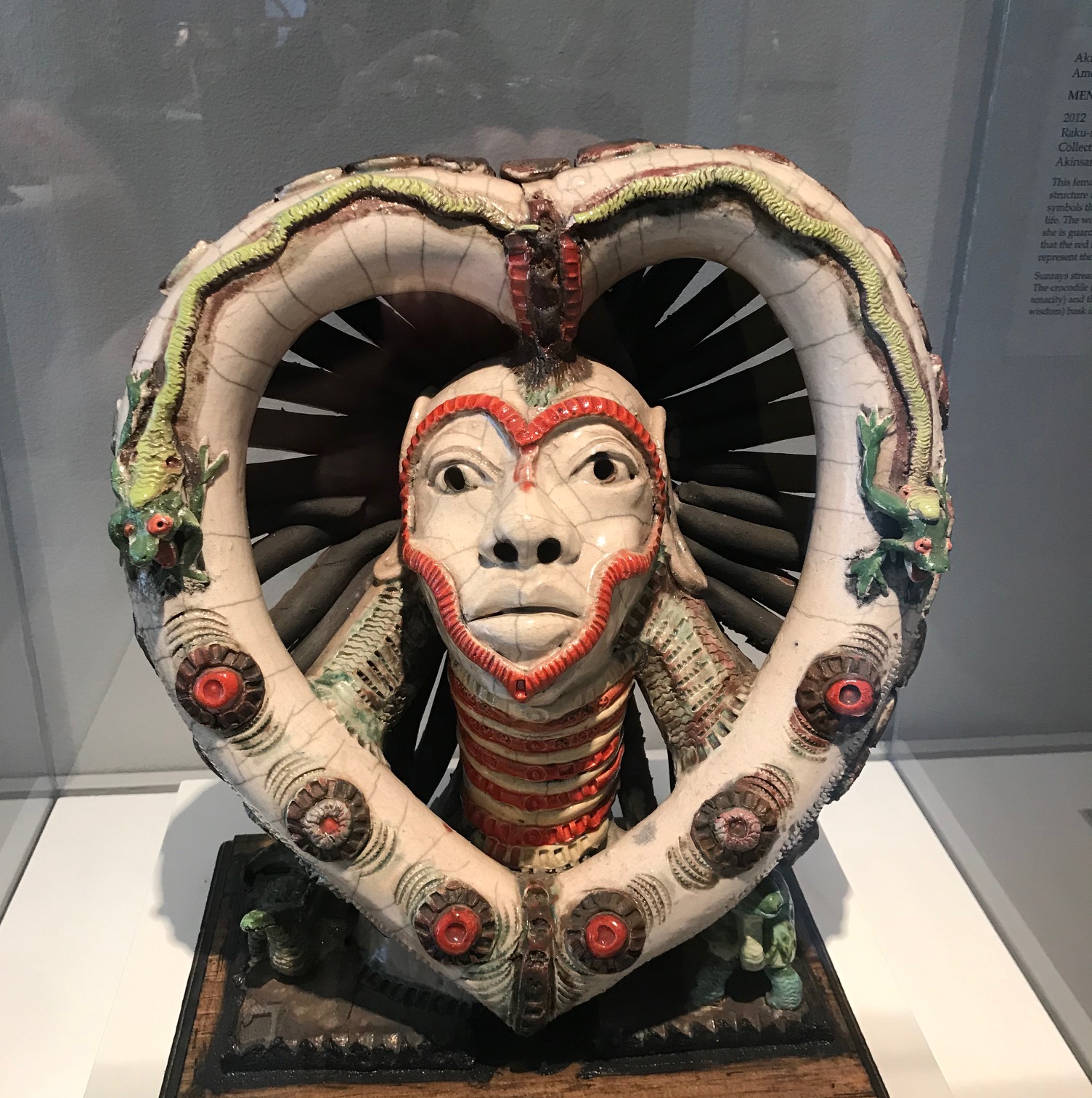
Born as Mark Teemer, Kambon grew up in Sacramento and visited the museum when he was young. Early in his life he suffered serious illness, was sent to Vietnam, was in the Black Panthers, and was later diagnosis with PTSD. All that is reflected in his art as is his artistic training. He earned an MFA and was at California State University, Long Beach.
Although located in two fairly small galleries, the exhibition teems with energy, tapping into the power and presence of ceramics, the figure and spiritual/political content. Kambon isn’t afraid of mixing things up, be it content or form and it pays off. The works drawn on African and African American designs and history, religious art of Africa, and American folk art of the South. Although the picture of the figure mounted on the horse
 that first made me underestimate what this exhibition would be, those mounted figures – linked both to African society and the black Buffalo soldier and cowboys of the American West – are some of the best work in the show.
It is a very solid exhibition. The only issue I have is that everything is under Plexiglas boxes. I sort of understand why they’ve protected like this, but it distracts greatly from the art.
Through July 5.
There are a couple more exhibitions at the Crocker I didn’t have time to take in during a recent visit. Hope to get back to them soon.
A Sort of Grand Tour
Circumnavigating San Pablo Bay for Art and Architecture
March 3/20
 Timing (mine and the world’s) and geography worked out Saturday for an artistic circumnavigation of San Pablo Bay on Saturday. On the route were recently opened, or closing before long, exhibitions and an architectural landmark I needed to spend more time with. And it looked like a nice drive though vineyards and wetlands.
(If you don’t know what San Pablo Bay is, it is the bay that is north of and connected to the San Francisco Bay.)
di Rosa Center for Contemporary Art
The first stop was a bit north of the bay proper at the di Rosa Center for Contemporary Art
There are one or two exhibitions depending on how you count them, by two artists, Davina Semo’s “Core Reflections” and Jim Drain’s “Membrane.” The two were commissioned to create works for di Rosa’s new “Conversations” series and make a good match.

Semo’s works, although at times using garish colors and materials, are also contemplative and quiet, even though some of the works are bells visitors can ring. A couple of the bells are polished bronze with a ringing tone, while one is dark and clunky in look and sound. Wall pieces meld mirrored pinkish surfaces with metal grids and 3-D printed seed pods.
The rest of the gallery visually vibrates from Drain’s pink walls and lawn chairs and chaises that have been rewoven with brightly colored rope and bedecked with tassels and fuzzy poofs, along with screens of similar materials. The works will be up for a year with elements put to use and moved around for talks and other events. You can sit in those chairs.
The di Rosa provides a fine description of Drain’s install saying it “riffs off of Northern California countercultural utopian design themes encompassing a mix of Buckminster Fuller’s geodesic domes, macramé textiles, and colorful tie-dyed motifs and draws from the rich history of craft and handwork centered in the Bay Area in the 1960’s and 70’s.”
These shows are in the center’s Gallery 1 (I think it used to be called the Gatehouse Gallery) that looks out over the center’s lake, which always becomes part of whatever is in the gallery.
Unfortunately there’s no exhibition in the much larger gallery up the hill until May when Deborah Remington: Kaleidoscopic Vision opens. You can still look at the outdoor art on the grounds.
Di Rosa still seems to be suffering from fallout from its announcement about selling many of the works in its collection, loss of its chief curator and others. Maybe that has something to do with a five-month lull between shows, especially after the last two exhibitions at the center ran for 10 months each.
Next stop: Marin Museum of Contemporary Art.
I bet some of you didn’t even know there was such a place (on the edge of Novato and almost right on the bay. More about the location after the art show info.) I’d been once before several years back for an opening of an exhibition by mostly local artists which looked very much like a local artists’ show.
“Elmer Bischoff: A Survey of Paintings and Drawings, 1937 – 1972” is a whole different matter. In a word: GO!
 Bischoff, along with David Park and Richard Diebenkorn, was at the forefront of the Bay Area figurative movement made up of artists who moved away from the abstraction dominant at of mid-century to re-embrace the (guess what?) figure.
This exhibition of 40 pieces starts with a couple of lovely still life paintings from Bischoff’s student days at UC Berkeley in the late 1930s. It also include many smaller drawings and sketches, a wide range of figurative paintings both large and small with a surprisingly wide range of approaches that don’t seem that connected to when they were done. Several early abstract paintings are very much of their time (in a good way) with one looking very much like Mark Rothko’s mid-1940s pictographic works.
And there are some remarkable landscapes, such as 1954’s “Landscape with Green Trees” that I felt I’d just driven past where highway 37 cuts through marshlands around the Petaluma River. More abstract and engaging though is “The Meadow” from 1954 with chunky black and blue paint/rocks/trees, leading through vibrant green slashes of tree trunks, all tightly framing a golden meadow. In many of the larger figurative paintings the landscape is a major character, especially “Cortez Square” also from 1953. For better or worse these three paintings, all done in the same small time frame, look like they could have come from three different artists.
Of the three core Bay Area figurative artists, Bischoff is the one I’m least familiar with and this is the only solo show of his work I’ve seen. I’d love to see a big Bischoff exhibition , but this one is quite good with many works on loan from private collectors and his family. (I’m interested in how this show came together, but I don’t have time at the moment to chase that down.)
Bischoff, born in 1916, was from Berkeley and after graduating from UC Berkeley taught high school in Sacramento for a few years, at the San Francisco Art Institute for a decade, and UC Berkeley for 20 years. He died in 1991. His son John carries on the artistic tradition as a composer, pioneer of live computer music and professor at Mills College.
The exhibition is up through April 12.
Exploring Hamilton Field
 The last time I was at Marin MOCA it was evening and while I knew the building it is in, and surrounded by, seemed pretty cool, it was soon dark and I didn’t have time to explore. This time I did. The museum, along with artists studios, are in what was once the administration building for Hamilton Field, an Army air field opened in the 1920s and in various military uses until around 1980. Most of the Spanish Colonial Revival buildings were constructed in the 1930s and some are in good shape and been repurposed for MOCA and a history museum. Many of the houses for service members are boarded up, some giant beautiful barrack have been turned into housing and some big ugly new subdivisions have opened on some of the land.
Although some areas are off-limits there is plenty to explore, including the wetlands along the bay with a hiking and biking path. I suggest coupling it with a trip to Mare Island, another former military installation along San Pablo in Vallejo (where you can also find art and cool buildings.) Or the next stop.
An inside look at Marin Civic Center
I didn’t plan on spending that much time at Hamilton Field, but this is exactly the kind of free- floating exploration I don’t do enough of.
 My next stop, the Marin Civic Center, took a similar turn. The center was one of Frank Lloyd Wright’s final projects, completed in 1960, a year after his death. The entire structure as it now exists was finished in 1969.
Most of us have seen the bright blue roof and dome and golden spire speeding down Highway 101, but who the hell has time to stop? I’ve only done so once, but figured I’d do so again to get a closer look and better pics. But I’d spent so much time in Novato, that the sun was now in the west and the lighting not so hot, and the place to get close to the exterior was blocked off, and really you can see it all better from a distance. Then it turns out, the building was open. There’s a public library branch under the dome open on Saturday and there was also some primary election business going on. So I finally got a good look at the interior. (There are tours but on Wednesday and Friday mornings, so not very handy for me.)
I was thrilled to say the least.
Honestly, it’s just a lot of long hallways stacked around a four-story atrum under huge skylights (once open-air) with terracotta colored flooring, bronze-colored metal around the office windows, but it is the best in what it is; beautifully functional with just the right amount of decoration on both the exterior and interior with intersecting lines doing most of the decorative work. The library is actually under the dome, but it is not well lighted and has a rough texture so the effect is somewhat lost. But the library on entrance the fourth floor is one of the most enticing elements, pulling the eye in from afar.
 There are so many fantastic details in the building, the kind of things that often get destroyed over time in public buildings: rounded water fountains, an information booth, curved benches that can be set up so they form a circle; pay telephone booths and banks (one actual pay phone), clocks, and a wooden display area for newspaper boxes. There’s room for six newspapers, and the biggest surprise (especially for me, a former and longtime journalist) is that four of them are still occupied.
This is what I learned last time I took the exit to take a closer look at the center; up close isn’t the best way to see it. You must be farther away to take in the magnificence. When you are standing next to the building, you are actually far below most interesting details. Maybe next time I can find the best places to see the building from both near and afar.
The center was Wright’s largest and last public commission and not surprisingly got wrapped up in design and cost controversies, Displays in the building provide a good primer on all that. There’s also a great model. Several adjacent Wright buildings — a post office, exhibition hall and auditorium — were completed by 1976. Make sure you include them in a visit.
Richmond Art Center
For the final leap over San Pablo Bay (officially SF Bay at this point), past San Quentin, the old and new shipyards, and on to a place that has a rich history and where I’ve always seen good exhibitions: The Richmond Art Center.
The center was founded in the 1930s and I’d tell you more about the rich history, but the center doesn’t provide that in its history. I do know that Richard Diebenkorn and other Bay Area artists had shows there early in their careers. I learned that from one of the first shows I saw there a few months after I moved here in ’14; a Diebenkorn exhibition. Since I’ve seen several more shows there and I remember them all as being good.
I’m not sure about the history and organization of the current exhibition “The Art of the African Diaspora. It appears that artists in the Bay Area were invited to drop off art and all that art was put on display. Maybe first come, first hung. A few good pieces got in.
This long-running annual exhibition was created to showcase local African American artists, but ends up being an insult to them. The intentions may be noble, but the result is not. If the center wants to provide a very inclusive forum it might be better to do so in a smaller space with a shorter run.
I don’t know it for a fact, but I do know it for a fact: there are African-American artists in the Bay Area doing important and accomplished art. They should be the ones the Richmond Art Center should show.
Got home, a nap, some food, and then a concert by The Academy of St. Martin’s the the Fields with music conductor/violinist Joshua Bell at the Mondavi Center. The chamber orchestra performed Paganini’s Violin Concerto No. 1, Op. 6 and Beethoven’s Symphony No. 5 in C Minor, Op. 67.
Paganini’s music is usually played with too much flash for my taste (Hey, who do you think you are Mr./Ms Fiddler? Paganini?) With Bell it was all substance (not to say there were not fireworks).
How many times have I heard B’s 5th … probably more than 5 times, usually with a larger orchestra and orchestras that are not nearly this good. I almost felt like I was hearing it for the first time.
A quick note closer to home. The Pence Gallery in Davis mounts many solid shows in its fine downtown space. The current “Water + Color National Juried Exhibit” is not one of them. It reminds me of almost every juried watercolor exhibition I’ve even seen, and I’ll tell you, I have seen a lot. There are a handful of accomplished works that have solid content, content and a masterful use of the medium. Then there are those that are mainly showing off watercolor techniques (most of which all of the artists learned in watercolor workshops), the usual picturesque scenes (water, boats, fortunately no paintings of “exotic people” done from photographs), and some by artists who are not very good at watercolors. I am happy to report that these are all watercolor paintings and not the catch all “aqua media” that many watercolor exhibitions accept.
The other big problem with the exhibition is that although the artists are from all over the country, where they live isn’t included on labels. It would be useful info. (Not including this info in group shows is a regular, annoying Pence practice.) Also, the label copy is all over the map, apparently cut and pasted from whatever the artists provided. Most of it is not helpful. Though March 31.
2.14.20
A Great and Great Big Show at SFMOMA
The “Soft Power” exhibition (at SFMOMA only through this weekend) has gotten a lot of attention. It’s the largest single exhibition the museum has ever done with 58 artists from 22 countries and 58 new works, many commissioned by the museum. The exhibition (in the words of the museum) examines “the ways in which artists deploy art to explore their roles as citizens and social actors” which is a clear if open-ended description. And an accurate one.
Still from Andrew Nguyen video
I have long been wary of art used for political and social messaging and activism, because there has been so much bad art of this sort. I saw a lot of ill-conceived and shallow issue art during the 1980s “culture wars.” My feeling is if you want to make a political statement write an op-ed.
My takeaway from “Soft Power” (after viewing it twice) is that artists have gotten a hell of a lot better at this kind of work and museums have gotten better at picking it. Most of the work is engaging and accessible without (for the most part) pandering or oversimplifying; it addresses issues without losing the power of art.
I like that some of the work is right upfront about what it is addressing, some take a middle ground, and more leave the interpretation to the viewer. This is the kind of exhibition where curators and artists tend to rely heavily on text panels and while some of these do have a lot of words, most are helpful without trying to tell us what the work is about or what to think (with a couple of extremely annoying exceptions.)
There is a level of pure artistic accomplishment, from things that look purposely piled up and visceral to some of the most complicated, beautifully put together (if not traditionally beautiful) things I’ve even seen.

Eamon Ore-Giron painting
Some favorites:
- Videos by Tanya Lukin Linklater of dances taking place among storage cases at UC Berkeley that contain the cultural belonging of the Alutiiq people of Alaska.
- Composer, musician and artist Jason Moran’s “drawings” made by applying pigment to his hands then playing the piano with paper covering the keys.
- Andrew Nguyen’s multiple viewpoint video project (above) exploring the complicated lives of children of Senegalese soldiers, part of the French occupation of Vietnam, and Vietnamese women.
- Tavares Strachan’s “Encyclopedia of Invisibility,” an ongoing project of about 17,000 entries on people and events that never made it into your history books.
- Tepee coverings by Duane Linklater with floral imagery inspired by goods traded between the Cree and English settlers in the 17th
- Eamon Ore-Giron’s large beautifully rendered geometric paintings (left.) They are what we old-timers would call hard-edge painting, so I don’t know how they fit into “soft power,” but they are so good.
ALSO AT SFMOMA
Photos of a time
“Thought Pieces: 1970s Photographs” by Lew Thomas, Donna-Lee Phillips, and Hal Fischer, provide an insight into photography that is very much of a particular time and place. These range from quite conceptual piece (barely photographs) by Thomas and Phillips to a kind of pseudo-documentary approach to gay men’s lives and looks of the time. The show is really too big for its own good with the latter material (the weakest and most dated) undermining the groundbreaking and timeless pieces. Through Aug. 9.
Problematic but powerful
For his video and photography installation “Incoming” Richard Mosse used images made with infrared cameras that work at great distances to create a unique view of the mass migration and displacement of people in the Middle East, African and Europe. The cameras provide a kind of black and white photo negative feel that is glowing and ghostly. Several huge panoramic black and white photos of refugee camps draw viewers into a large room where across several screens we see people milling in refugee camps, border guard with binoculars, and fighter planes launching from aircraft carriers.
The work has been criticized for turning tragedy into eye candy. Not sure I agree with that, but the approach seems gimmicky. Why not just show us straightforward video of this terrible tragedy; would that make it not art? Still, I found it a riveting visual and emotional experience.
Like “Soft Power” it is only up through this weekend.
Play me now
Just for fun, check out the crazy musical instruments by Nevin Aladağ made by splicing many instruments (drums, zithers, didgeridoos, saxophones) together. I’ve seen a lot of great musical instruments (if you are ever in Phoenix, gods forbid, go to the Musical Instrument Museum), but these very fun and impressive. But I want to hear them (there are a couple of opportunities to do so.) Up to June 7.
Man Ray here, Monkeys there
Like SFMOMA, a couple of nearby galleries were open on a Monday.
At Gagosian the extraordinarily rare show MAN RAY The Mysteries of Château du Déthat includes screenings of his movies and many objects associated with them. I can’t wait to go back and spend more time. Though Feb. 29.
 Mark di Suvero’s sculptures from the past few decades are the name show at Berggruen. The earlier to me are much stronger than the newer. But I was captivated by John Alexander’s paintings there. These are pretty painting of mostly pretty things (water with lily pads, a flock of ibis in flowering trees), but they are so well painted and have something going on beneath the literal and figurative surface. And there are monkeys, so that’s a plus. Both shows close at day’s end Saturday, Feb. 15.
Feb. 3.20
An Amazing Week of Music – Nearly All New
From Thursday through Sunday, I heard 20 musical pieces I’d never heard before, nine of them premieres, over the course of six concerts. Most of this took place as part of the Taproot New Music Festival at UC Davis and one with the Left Coast Chamber Ensemble in Berkeley. I’m not unaccustomed to going to more than one performance a day for days on end (which I used to do at the Spoleto Festival in Charleston, SC) but it has been a while. Didn’t seem like a particularly heavy schedule to me. I’d like to do it more often. Especially when the music and performances are as good as these.

Six of the eight composers
For me the most exciting and eye-opening concert was by the Chicago based Spektral Quartet playing pieces by three of the eight composers (Daniel Godsill, inti figgis-vizueta and Emre Eroz) invited to write new works for the festival. These were very dramatic works, complex but accessible, engaging to the ear and the mind. I’d love to hear them all again. (not available for viewing right now, maybe that will chante.) Same goes for the two pieces by Inga Chinilina and Yuting Tan) premiered by the Empyrean Ensemble. Those you can see/hear along with performances by Spektral and the Quince vocal group here but I’ll warn you, it starts with a piece from the 16th century.
And the finale, Steve Reich’s “Music for 18” was fun and amazing. (You can watch it here.)
The next Taproot will be in 2022.
The new piece in Berkeley was by Kurt Rohde (a music prof at UC Davis) linked to a production he saw of Olivier Messiaen’s five-hour opera St. Francis d’Assise (his program notes with descriptions of the opera are inspired, and rather hilarious – “stretches of tedious, almost maddeningly incomprehensible enactments of mystical experiences …”) Right now I can’t really unpack the piece (for piano and violin), which is the problem with hearing so much new work. (Before the concert I talked to Kurt who vaguely chastised me for overloading my ears/brain.)
The concert ended with Messiaen’s “Quartet for the End of Time” – one of the few pieces of the concert marathon I’ve heard in concert multiple times. If you’ve never heard it, you need to because it’s a fucking masterpiece.
Art Shows Around
Still working my way through the two new exhibitions at the Jan Shrem and Maria Manetti Shrem Museum of Art. Took some time with Stephen Kaltenbach’s “The Beginning and the End” and left intrigued, impressed and amused. The show has gotten a lot of (even local) press. Hope to do an interview the artist before long for my job.
 The new Ron Nagle exhibition, “Handsome Drifter,” at the Berkeley Art Museum/Pacific Film Archive is handsome. His quirky little sculptures are impeccably crafted, but seemed empty calories to me. Think I filled up on this, with more protein, at Kathy Butterly’s exhibition last year. Also – everything in is behind plexi.
A stunning surprise there was “Brave Warriors and Fantastic Tales: The World According to Yoshitoshi”,åabout a dozen small exquisite, dynamic and very modern woodblock prints. Created by Taiso Yoshitoshi (1839–1892), they are all about ancient tales from Japan and China, but there isn’t anything ancient about them as art. This is the sort of thing that inspired so many early modern artists in the west.
Jan 20.20
FOG and a few more things
Fog Art + Design fair was fine. First time for me. It seems to me the SF Art Market in March has more galleries from around the globe. While most of it is high-end art (so why isn’t Design first in the name?), there’s a lot of ostentatious home decor, which I guess falls under design. Next door at SFAI Fort Mason the much-hyped Rashaad Newsome exhibition left me underwhelmed too. Maybe you need to see the performance.
Ran down to Minnesota Street Project and environs where I was pretty much blown out of my shoes by the Damian Ortega papier-mâché sculptures that blend famous buildings with animals at Adrian Rosenfeld Gallery. Feel like I’ve seen four or five shows by Serge Attukwei Clotty at Ever Gold Projects, but I’m never less than thrilled by the constructions made of cut up plastic water jugs (mostly yellow.) And the Donna Ruff burned books, papers Jack Fischer gallery
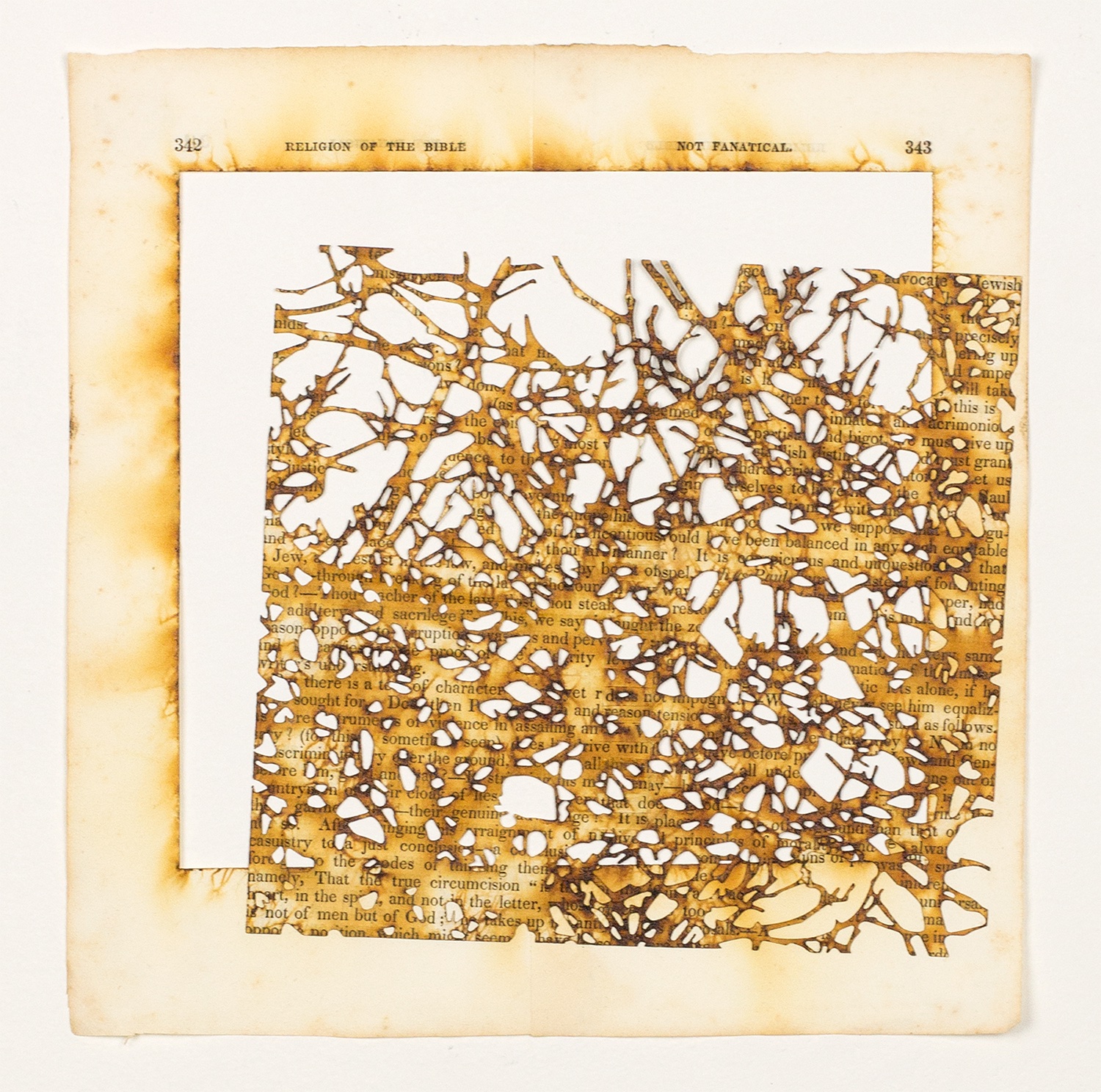
Donna Ruff at Jack Fischer
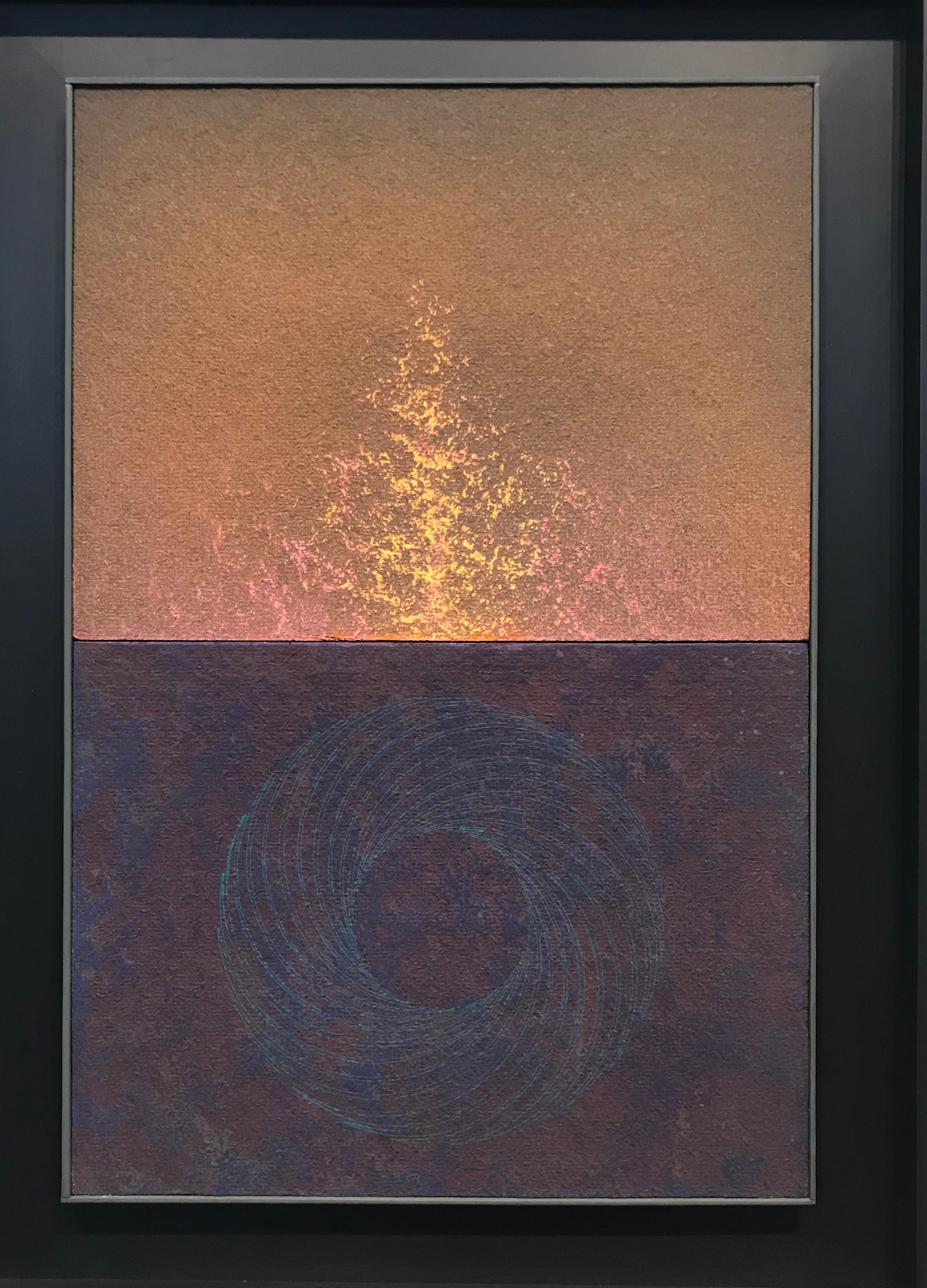
Jordan Belson at Matthew Marks at FOG
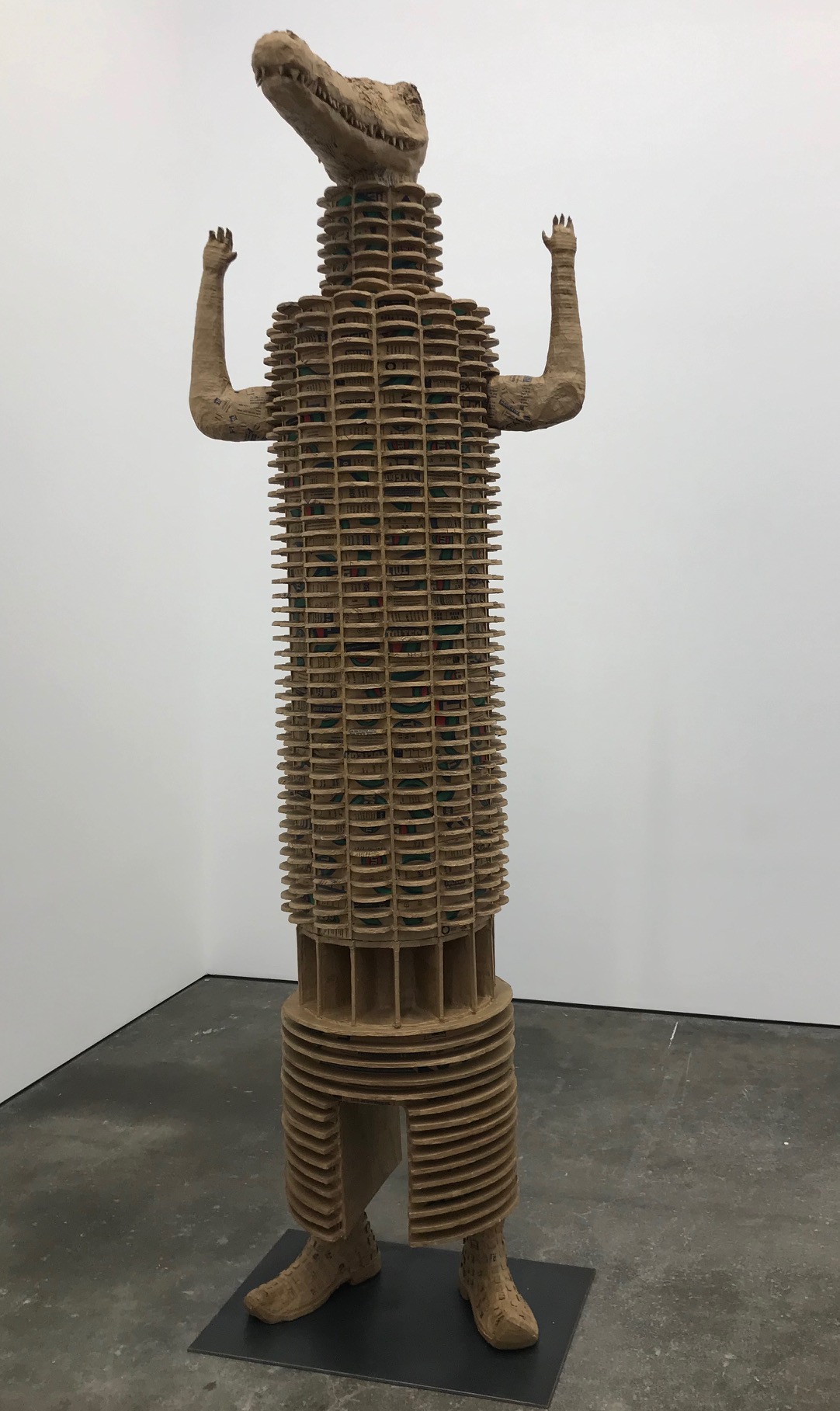
Damian Ortega at Adrian Rosenfeld

Serge Attukwei Clotty, Everygold
In $3.5 million award cycle, Sac gets $10,000
Good to see that the Latino Center of Art and Culture has received an award of $10,000 from the National Endowment for the Arts. A little less encouraging is that the center is the ONLY place in the Sacramento area to receive $$$ from the NEA in this recent round of funding of $3.5 million. ONE $10,000 GRANT OUT OF $3.5 MILLION.
Where are the Crocker Art Museum, Sacramento Philharmonic, Sacramento Ballet, Verge Center for the Arts, the theatres, higher educational institutions? (Sidenote: a UC Davis design/art/science project got $20,000 from the NEA last year for a project that launches soon.)
Can someone with these organizations explain what’s going on – or not going on? Maybe I’m missing something.
A few (more or less) funding facts:
During the ’18 – ’19 fiscal year the California Council for the Arts received $1.4 million from the NEA and a lot of that gets passed on in grants. That year Sacramento groups/projects received about $602,000 of $24 million (46 of 1,337) grants made by the California Council. If anyone wants to see the list of 46, I have it; if anyone wants to crunch numbers or ask more questions, the folks at the council have been very helpful.
(You can find info about the recent NEA grants and Calif funding at the Arts Council.)
By the way, the grant to the Latino Center (one of my favorite places) will help pay for creation and performance of a play based on the experiences of residents in the Oak Park neighborhood of Sacramento. That the sort of community, underserved community, youth and education based programs most governmental funding goes to now.
A remarkable essayist
On Tuesday night Aisha Sabatini Sloan shared some of her remarkable words at the visiting writers series of the creative writing program at UC Davis. The series generally has poets and fiction writers; Sloan is a non-fiction writer, but there sure as hell is a lot of poetry in her writing and reading. There is also a great deal of music, art, theatre, dance, and politics big and small and personal. She read one piece that circled around Jean Michel Basquiat in the most remarkable. You can read it yourself: https://www.theparisreview.org/blog/2017/10/26/basquiat-black-body-strange-sensation-neck/
Or you could go to her website or you could buy her books. Or next time, you can come to her reading. Or those by others.
A small disclaimer. I work at UC Davis, but at this point that will not prevent me from mentioning a/an event(s)/person(s)/thing(s) there that seem important. I will not use this site for simply promoting an event/person/thing there and for obvious reason I’m not going to trash UC Davis stuff.
A busy Saturday; Verging on appreciation
Started the day with the dark, early 20th century opera,“Wozzeck” by Alban Berg, simulcast from the Met Opera, designed by South African artist William Kentridge. Great, but I wasn’t blown away. Maybe the seats were too comfy (it’s been so long since I’ve been in a movie theatre so didn’t know first hand they had such things) or I’m spoiled by the intensity of seeing live opera (or in the case of recent operas I’ve seen in the Bay Area, no climate control, heat, traffic noise, the War Memorial Auditorium interior and lack of legroom.) For life balance we followed it with fried chicken.
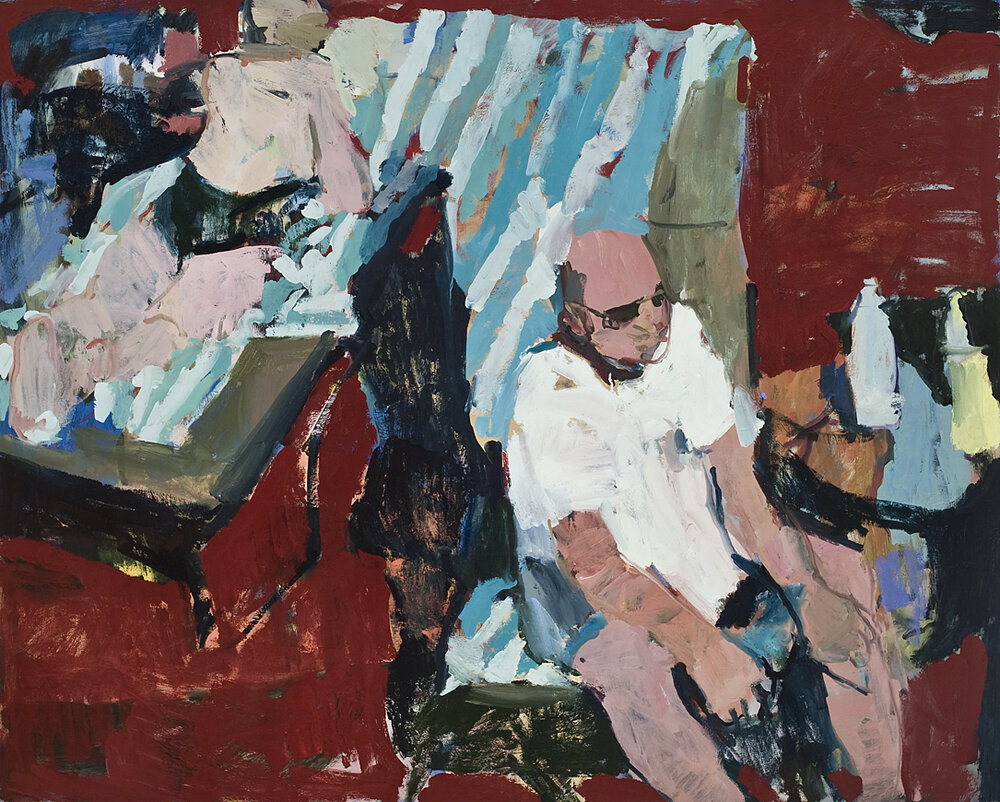
Jennifer Pochinski
- I may have seen Jennifer Pochinski’s art before (I think), but her solo show of large paintings, a few sculptures and monotypes at B. Sakata Garo Gallery caught me by surprise. Loose free paint with an underlying structure that holds it all together. Great show.
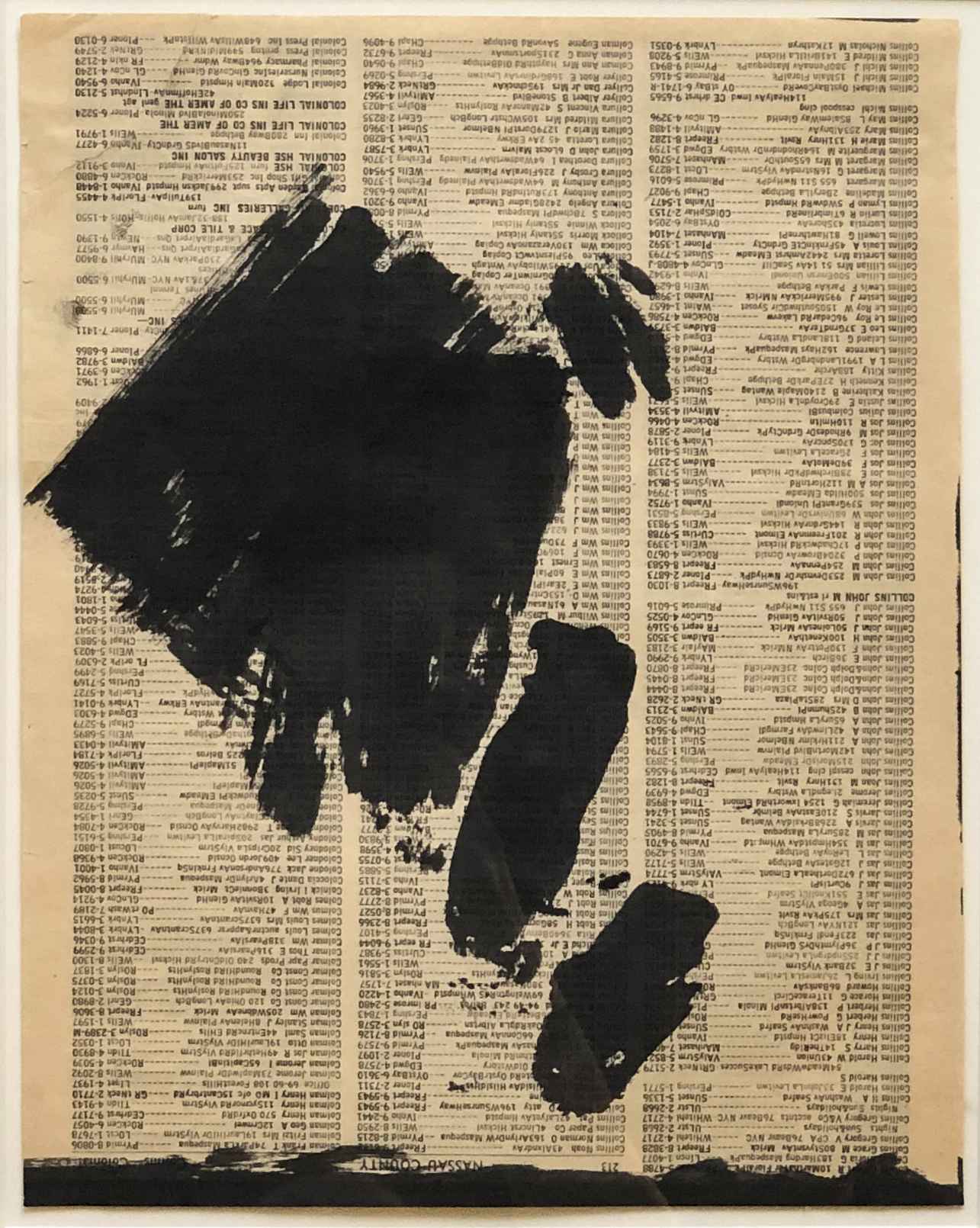 Franz Kline sketches on phone book pages given to Wayne Thiebaud by Kline in the ’50s at Elliot Fouts Gallery. It’s all there in a few explosions of black. (If the concept of a phone book baffles younger viewers, the phone numbers will be an even greater novelty – GRammercy3-5642.
- Was very taken a couple of years back by paintings on paper bags by Beth Consetta Rubel during Verge’s Open Studios tour. She’s sharing space for a show at Axis Gallery. She’s done a great installation with video, a couple of huge drawings, but I wanted more.
- Speaking of Verge Center for the Arts, went in again to see the ALI YOUSSEFI PROJECT RESIDENCY EXHIBITS: JODI CONNELLY AND MICHAEL PRIBICH – such a good show coming out a a fantastic project. It may seem sparse but the works are monumental in every sense.
Also, I am reminded that Verge has been such an important place for me since I moved here. Looking back through past exhibitions listings realized that the first Verge show I went to was only their second one since re-opening in 2014. Haven’t missed one since.
After a Real Pie Company break was able to get into an open rehearsal for the Sacramento Ballet in the late afternoon, taking me back, mostly pleasantly, to when I was piecing together jobs and one of my clients was a ballet company and I spent a lot of time in the rehearsal studio. I don’t get enough dance.
Then on to the 5th anniversary show/celebration at Artspace. Maybe more later, but Ron Peetz’s FB page give an excellent overview.
Five years with ArtSpace 1616
Jan. 7, 2020

Mima and Numan Bejovic
In January of 2015, I went to the inaugural exhibition at Artspace 1616 in Sacramento. I’d moved to area in April of 2014 and feel like we’ve been on a five-year journey together. The gallery has been an important part of my art experience here and I don’t think I’ve missed a show there.
Artspace digs deep into the regional art community showing work by younger artists, active established artist, and artists who were in the spotlight sometimes decades ago, but who have disappeared for a while. The gallery has been a significant component of my education on art of the region from the past 60 years.
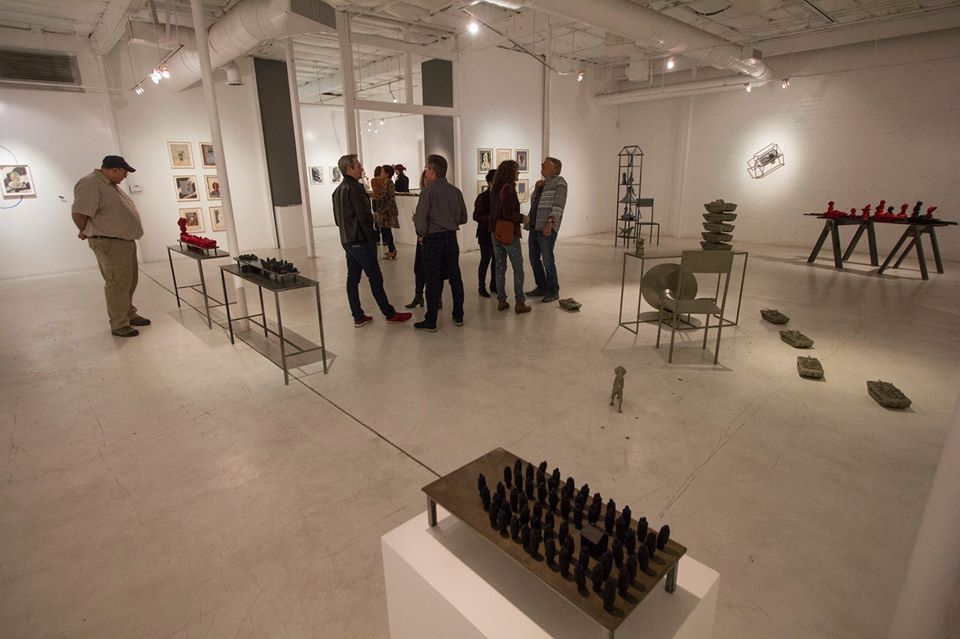 The gallery is huge with lots of big white walls and many different kinds of spaces that make it an interesting place to show and see art. But if the art wasn’t good, the space wouldn’t matter.
Sure there are misses, but by and large it seems to be the most ambitious and consistent gallery in Sacramento. And then there are the people who run it — Mima and Numan Bejovic, who are obviously committed and hardworking, Also I like them.
The gallery generally has two shows up at the same time, with one of the shows swapped out a month or so later for another, so there’s an overlap that gives one a different perspective and a chance for a second view. Artspace has actual exhibitions, is open hours that allow those of use who have regular jobs to see the shows (that means Sunday hours!) and the owners (or whoever is standing in for them) talk to you when you come in.
Mima and Numan (who is an artist with a studio in the gallery building) fled the war in the former Yugoslavia in the 1990s. After periods in Germany and Great Britain, they came to the U.S. in 2000. I don’t know a lot of their backstory, but seems to me we are lucky they are here.
The gallery on Del Paseo Boulevard had a previous life as the Temporary Contemporary and apparently the whole area was/is part of a Design District that collapsed during the recession. When I first started going to Artspace, the area was pretty grim and empty, but lots of new businesses have opened. I don’t much care about the either way, but I’m sure the gallery has given a boost to the area.
Artspace opens its 5th anniversary show this weekend: “Five Years in 50 + 1 Voices” will include artists who have exhibited at the gallery. An opening reception takes place this Saturday, Jan. 11. The show is only up until the end of the month. See you there.
WHAT GRABBED ME in 2019 (to the best of my recollection)
JAN. 3, 2020
Art and music at or connected to the place I work (UC Davis)
Robert Arneson’s “The Palace at 9 a.m.” a huge ceramic “portrait” of the artist’s house on Alice Street at the Jan Shrem and Maria Manetti Shrem Museum of Art as part of a landscape show. Also there, UC Davis alum Cathy Butterly’s retrospective. Each of her ceramic pieces was magical and the installation was perfect, allowing viewers to see them from every single angle.

Art professor Annabeth Rosen’s retrospective at the Contemporary Jewish Museum in SF received the same installation attention, and the show is huge, and the work is stunning. (through Jan. 19.)
“Indigenous Futurisms: Explorations in Art and Play” at the C.N. Gorman museum has captivated many with its mix of sci-fi, speculative fiction, comics and Native American motifs. (Close end of January.)
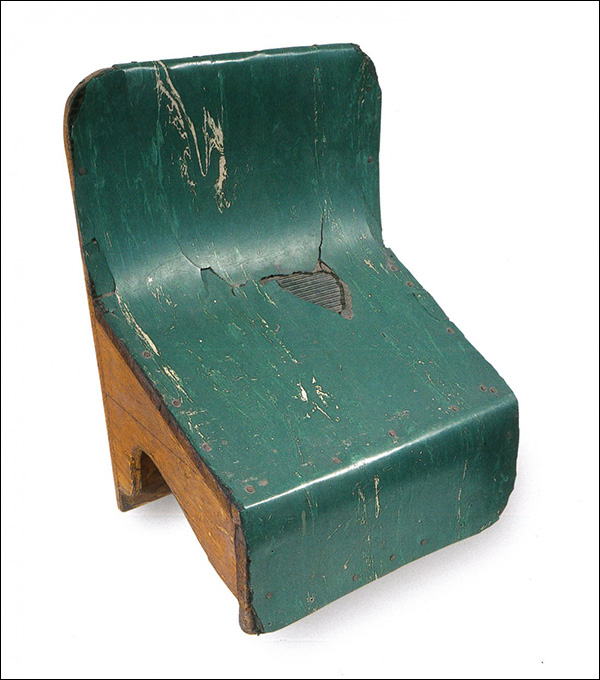
“Slant Step Revisited” at the Verge Center for the Arts. Loved it loved it loved it. I got pushback from people who said they were sick of the Slant Step, but ya know what? I’m not from around here and found it fascinating. The local media gave it not one word, but SF’s KQED and Art News did.
The UC Davis Symphony Orchestra with Sacramento native Max Haft as soloist for Lutosławski’s “Chain II” (Violin Concerto) was a great surprise. Haft also gave one of my favorite concerts of new works by UC Davis doctoral music students a few days earlier. I hear so many concerts at the UC Davis music department (many with all new music by comp students) and some were early last year, so it’s difficult to picks specific ones, but they all have great pieces. (More at the Taproot New Music Festival at the end of the month.)
Presented by the Mondavi Center for the Performing Arts:
- The Zurich Chamber Orchestra, led by the fantastic violinist Daniel Hope (also director of SF’s New Century Chamber Orchestra) paired Vivaldi’s “Four Seasons” (1717) with Max Richter’s “Four Seasons Recomposed” (2012). Richter, who has done lots of soundtrack work, wrote the piece for Hope.
- For the 100th anniversary of Merce Cunningham’s birth, the French company CNDCd’Angers/Robert Swinston brought two important pieces to the Mondavi with live music. Also, dance company Ballet Preljocaj (I really need a lot more dance.)
- Joshua Bell, violin and Alessio Bax, piano (no offense to Bell but I wasn’t planning on going until I saw Bax was playing too.)
Music in the Bay Area
Premiers of Hiroya Miura’s mini-opera “Sharaku Unframed” by the Left Coast Chamber Ensemble, and Michael Gordon’s new “Oceanic Migrations” by the SF Contemporary Music Players with Roomful of Teeth and Splinter Reeds.

Sara LeMesh
Composer Missy Mazzoli (whose music I’ve long liked) and librettist Royce Vavrek in 2016 did an opera adaptation of the dark, disturbing and beautiful Lars von Trier movie “Breaking the Waves.” How’s that gonna work? I got the see and hear the incredible West Coast premiere by Oakland’s West Edge Opera. Sara LeMesh as Bess gave one of the best performances I’ve ever seen
I usually see two W.E. operas each summer, but time and $$$ make SF Opera a little tougher. Still made it to “Manon Lescaut,” and hell yes.
Flashback to what I experienced for two decades at the Spoleto Festival in Charleston – the St. Lawrence String Quartet performing (among other things) Osvaldo Golijov’s “Dreams and Prayers of Isaac the Blind” with clarinetist Todd Palmer. The concert was part of the Mill Valley Chamber Music Society.
Art around the region
Pueblo ceramics and the contemporary Native American art at the Crocker Art Museum. Both are still up for a tiny bit longer.
“Changing And Unchanging Things: Noguchi And Hasegawa In Postwar Japan” at the Asian Art Museum.

David Hammons in “Soul of a Nation.”
“Soul of a Nation: Art in the Age of Black Power 1963–1983” at the de Young Museum. (Saw it twice.)
Early Rubens at the Legion of Honor. It’s Rubens.
William Wiley (retired UC Davis art prof) at the Hosfelt Gallery. It’s Wiley.
Viola Frey at the di Rosa Center for Contemporary Art. (Saw it twice.)
“Stay Awhile: A Nathan Cordero Show” at Verge. I didn’t know the late artist from Sacramento, but he seems to have been loved by many people. What I do know – excellent art and exhibition.
Gerald Walburg (UC Davis, MA, 1967) massive, diverse show at ArtSpace 1616 in Sacramento.
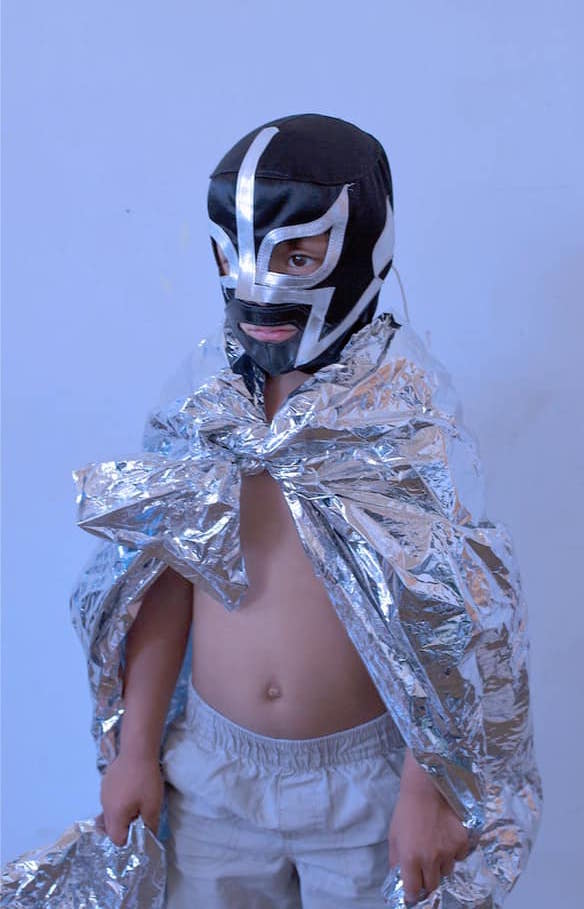
La Lucha
The Latino Center for Art and Culture in Sacramento has become one of my favorite places. I like the shows, the off-the-path location and the people who go there. I especially liked La Lucha: Convergence of Identity ~ A Visual & Interactive Exploration of Self by Andres Alvarez (and others.) And the Fiesta de Frida!
“Seeing Sound” at Davis’ Pence Gallery.
April Dawn Alison
At SFMOMA: April Dawn Alison was the cross-dressing alter-ego of commercial photographer Alan Schaefer. High art and high camp that surprised me visually and emotionally. “Andy Warhol—From A to B and Back Again,” once again proving me and a lot of other people wrong about Warhol. I have to go see “Soft Power” again before I can figure out what I think.
Words Words Words
I’ve attended a decent number of readings, but few compared to art shows or concerts.
Several of the best for me were part of Poetry in Davis, led by UC Davis faculty member Andy Jones. A highlight was the reading by the legendary Gary Snyder (a UC Davis emeritus prof.) Katie Peterson, head of creative writing at UC Davis, whose work I knew, was great as expected, was joined by her friend Candice Reffe who really knocked me out. Elana K. Arnold (a graduate of UC Davis creative writing) read from her new novel and was joined by her sister poet Mischa Kuczynski (who works at UC Davis). Both are unbelievably brave and powerful writers and readers. Arnold will be back in the area for a reading in March.
For the UC Davis visiting writers series Jamil Brinkley and Tom Pickard stood out for me. Some great ones coming to up in the next few months in the series.
Other
I did SacModern’s tour of Streng homes — what fun, even if these places make me jealous.
During a few days in L.A. at the end of the year I jammed in a bunch of stuff. Hit and miss Manet show at the Getty Center, but it had a lot of work from private collections. First visit to The Broad – so much so-so ‘80s art. Both places were madhouses.
First time to Huntington Library, Art Museum, and Botanical Gardens. I’d drive to Pasadena just to go there.
Got to see the outside and inside of Frank Lloyd Wrights’ Hollyhock House and outside of Ennis and Storer all in one day. Way cool.
Now I have to go reconstruct my hiking schedule for the year.
Subscribe Here
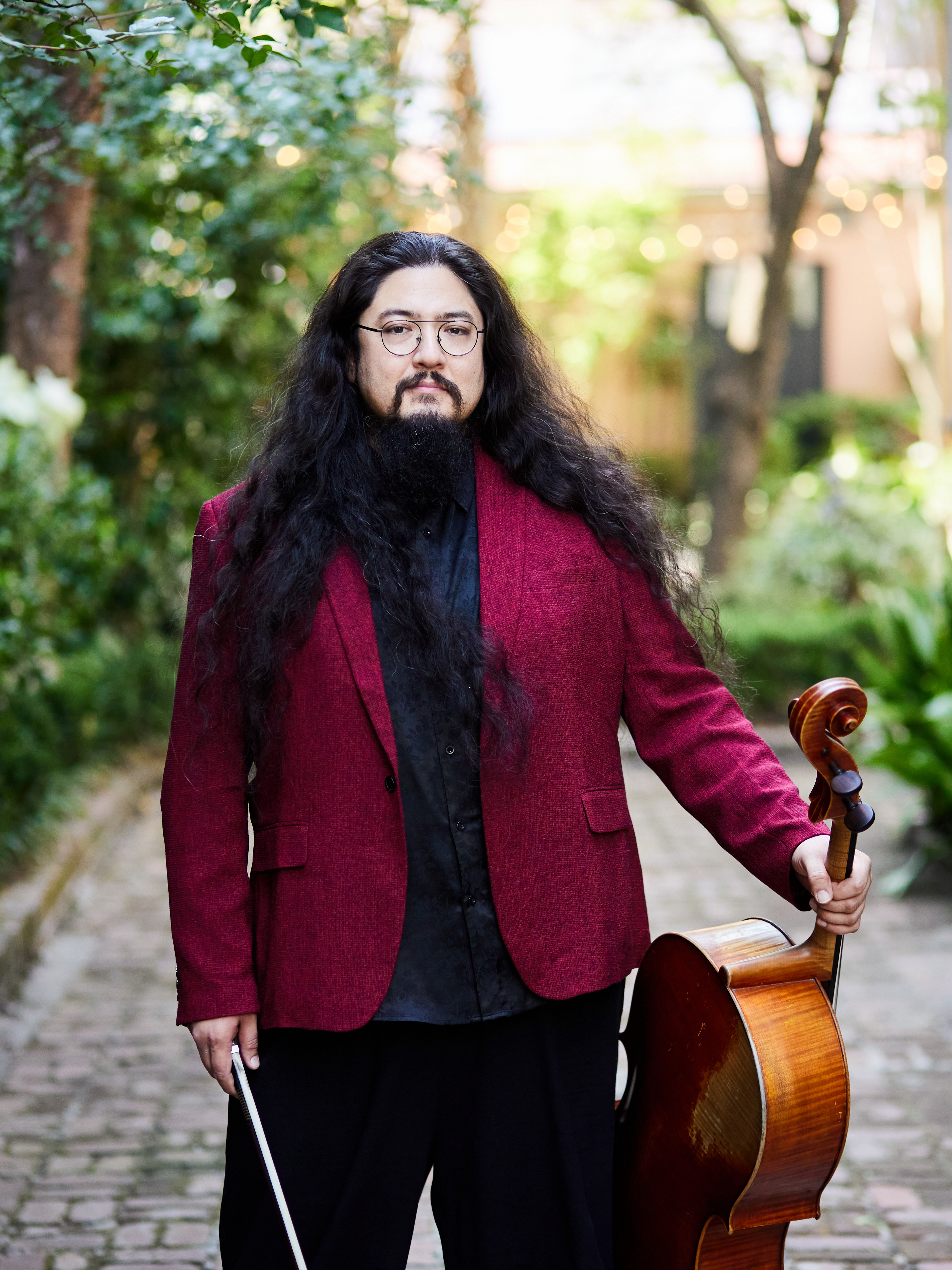
 Jeffrey A. Day